
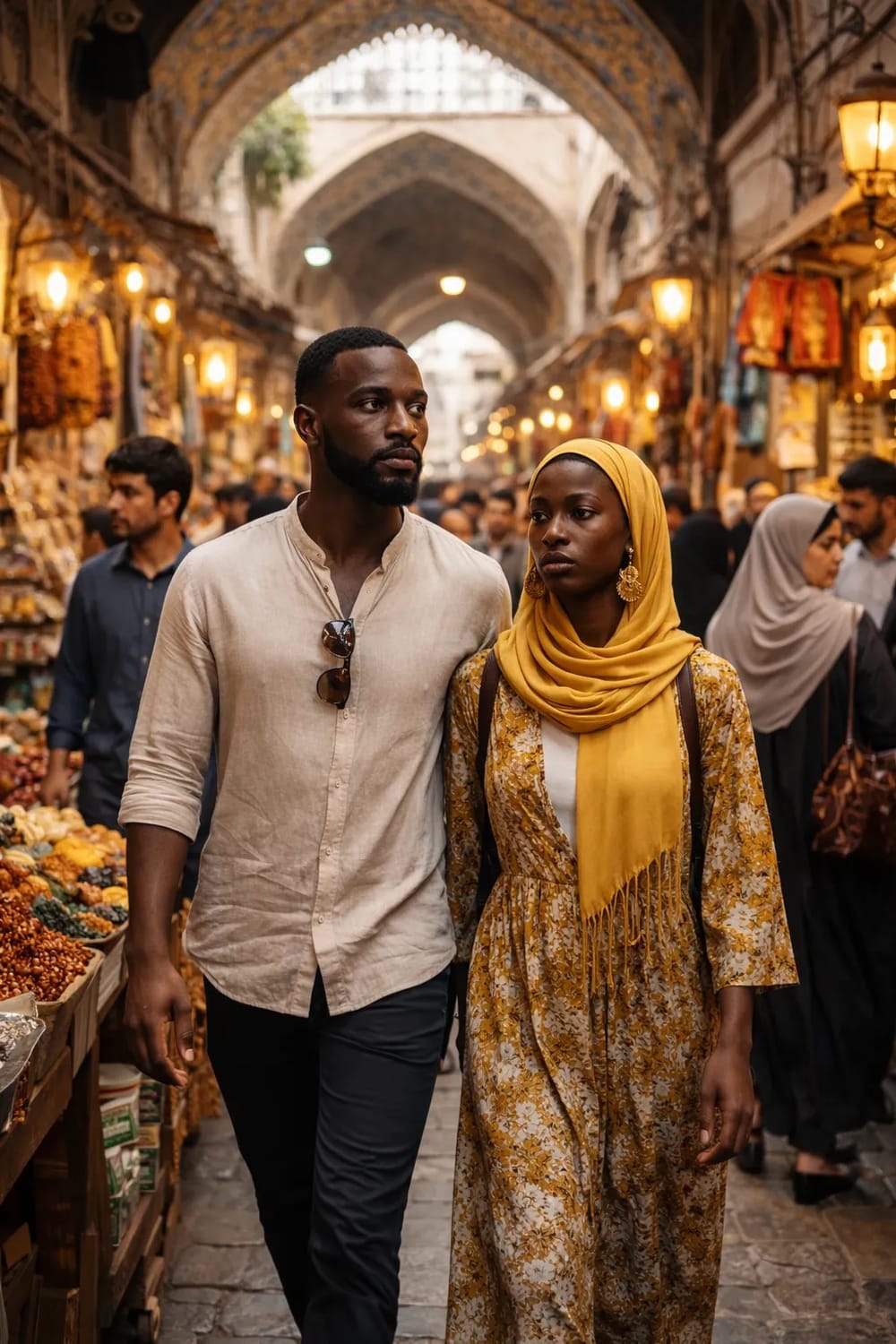
Most people aren’t aware, but Iran’s population includes Black Iranians who are among the most overlooked communities in the world.
Africans migrated across the Indian Ocean centuries ago through trade routes connecting East Africa and the Persian Gulf. These Africans included sailors, merchants, laborers, and kidnapped and enslaved Africans who traveled on ships moving between the Swahili Coast and Persian ports.
Many came from areas that today include Tanzania, Kenya, Mozambique, and Ethiopia. Less arrived voluntarily as traders or sailors, but most others were brought through systems of slavery that operated across the Indian Ocean world.
Their descendants today still live primarily in Iran’s southern provinces of Hormozgan and Bushehr, as well as on the island of Qeshm, situated several miles off the Iranian coast. These coastal regions historically served as maritime routes linking Persia with Africa, Arabia, and South Asia. For centuries they functioned as a vibrant crossroads of trade and migration.
Long before European colonial powers began dominating global shipping routes, the Indian Ocean was the most interconnected commercial network in the world.
Persian merchants traded extensively with East African cities like Zanzibar, Kilwa, and Mombasa. African merchants crossed the ocean to transport ivory, spices, textiles, dates, pearls, and other goods.
But the rest of the story is a sad familiar one. These maritime routes facilitated the movement of kidnapped Africans and their culture.
During the Safavid period (1501–1736), which brought Shiite Islam to Iran, and later under the Qajar dynasty (1789–1925), which modernized Iran, kidnapped Africans were brought to Iran in large numbers through ports in the Persian Gulf.
Some of these enslaved Africans worked in domestic service, others in agriculture, pearl diving, maritime labor, and even military roles.
Slavery in Iran wasn’t formally abolished until 1929 under Reza Shah (father of the man people refer to as “the Shah”), which was part of broader modernization and reforms aimed at aligning Iran with international norms.
By that time, many African-descended communities had already been living in southern Iran for generations.
Though their descendants today identify fully as Iranian, speak Persian and practice Islam, their East African heritage remains visible in several cultural practices.
Even four centuries later, East African culture still shows up rhythmic traditions, healing ceremonies, and spiritual rituals.
One of the most well-known cultural expressions is the “Zār” ceremony, a healing ritual found across parts of the Persian Gulf and, not coincidentally, the Horn of Africa.
Zār incorporates drumming, dance, and spirit-invoking practices that scholars trace to East African traditions carried across the Indian Ocean. Similar rituals appear in Ethiopia and Sudan, illustrating how deeply interconnected these regions once were.
Music in southern Iran also reflects this forgotten heritage. Rhythmic patterns, percussion instruments, and dance styles in cities where Black Iranians live, closely resemble those of the East Swahili Coast of Africa more than those of the larger citiies in Persia. Instruments such as the “tanbura” and rhythmic drumming traditions were heavily influenced by traditions of East Africa.
In port cities, African-descended communities helped shape the cosmopolitan atmosphere that once defined these trade centers for centuries.
They also helped make these areas some of the most culturally diverse regions in Iran. Ports like Bandar Abbas and Bushehr historically hosted Persian merchants, Arab traders and Indian financiers, but also African sailors. Most people don’t realize that ship building in East Africa actually predates that technology in most other parts of the world.
Despite this rich history, Black Iranians remain largely invisible in both Iranian national narratives and broader discussions of the African diaspora. The Persian slave trade and Black Iranian history is left out of the curriculum in Iran.
So, outside of anthropological studies and occasional documentaries, their story is rarely told.
While their numbers remain small, there are also signs that Afro-Iranians face forms of social marginalization.
Iran doesn’t maintain official racial categories in its census or public statistics, so data on racial inequality is scarce. Anecdotal accounts, journalistic reporting, and academic research, however, suggest that darker-skinned Iranians encounter prejudice, colorism, and stereotyping.
In everyday language, the Persian word “siyah” (black) has sometimes been used pejoratively, reflecting broader social hierarchies tied to skin tone.
Some Afro-Iranians report that they’re mistaken for foreign migrants or treated as outsiders despite having lived in Iran for generations.
Others describe limited representation in media, politics, and national storytelling. In popular Iranian television and film, darker-skinned Iranians are almost never depicted, reinforcing a perception that Iranian identity is tied primarily to lighter Persian features.
Geography also plays a role. The southern coastal regions where many Afro-Iranians live are among the less economically developed parts of the country compared with major urban centers like Tehran, Isfahan, or Shiraz. While this disparity affects residents regardless of ethnicity, it gets compounded for Black Iranians because of their invisibility in Iranian discourse.
Still, Black Iranians are deeply woven into the fabric of Iranian society. They participate in religious life, work in local industries, and identify strongly with Persian national identity.
In recent years, some Iranian scholars and filmmakers have begun documenting their stories, attempting to bring greater visibility to this overlooked chapter of Persian history.
This forgotten history challenges the common assumption that the descendants of enslaved Africans exist only in the Americas. The African diaspora extends across the Middle East, South Asia, and the Indian Ocean world in ways that are still poorly understood and sadly overlooked.
Black Iranians are part of that broader global story. A reminder that the movement of kidnapped Africans shaped societies far beyond the Americas, and their important influence ought not be erased.