
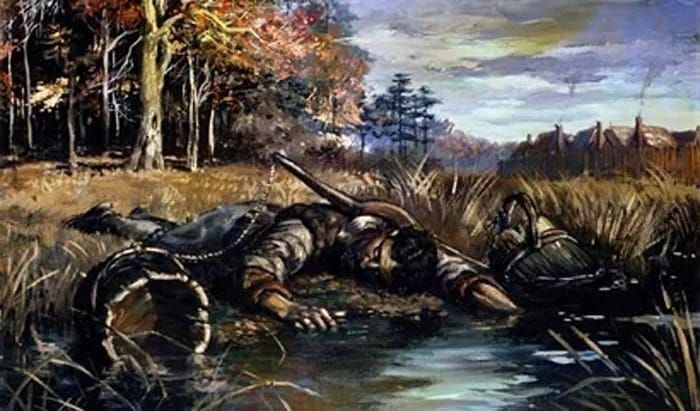
America is about to celebrate its 250th Anniversary as a nation, dating back to 1776. Slavery in America dates back further; Virginia received its first enslaved people in 1619, though they were technically indentured servants. When John Punch ran away from his servitude, he was joined by two white indentured servants. He found out he was different when the two Europeans saw their contracts extended, but Punch became indentured for life. Even earlier, in Spanish-controlled Florida, Pedro Menéndez de Avilés founded St. Augustine in 1565, bringing with him both free Black soldiers and enslaved Black people.
The earliest confirmed European landing on the mainland territory that would become the United States was by Juan Ponce de León, who came ashore on the Atlantic coast of Florida in April 1513. Ponce may have landed dear St Augustine in 1513, though you wouldn’t know it driving through the city where his name and image are ubiquitous. Ponce was accompanied by Juan Garrido, a conquistador who was born in West Africa, captured and enslaved at a young age, and sent to Portugal. Garrido was baptized at age 10 in Lisbon and later moved to Spain. Some say he was granted his freedom in Portugal, while others say he earned it by fighting for Spain in Puerto Rico. There’s no question that Garrido was free when he landed with Ponce de Leon in Florida. Garrido was the first Black man to arrive in what is now Florida, rather than “La Florida,” which encompassed Georgia, South Carolina, North Carolina, Alabama, Mississippi, Louisiana, East Texas, and Western Tennessee.
In 1526, five hundred years ago, Spain attempted to establish its first permanent settlement in Florida, bringing over 100 enslaved Africans to do the work. Lucas Vázquez de Ayllón received a royal patent in 1523 from King Charles V and the Royal and Supreme Council of the Indies, permitting him to establish a settlement on the eastern seaboard. He assembled a fleet of six ships, approximately 600–700 people, including the slaves, supplies, and livestock, including pigs, cows, sheep, and one hundred horses.
On August 9, 1526, the fleet’s flagship struck a sandbar and sank off the coast of South Carolina. The court interpreter and other Indians brought along as guides deserted the fleet and escaped into the woods. The crew and enslaved people built a replacement ship and moved about 200 miles south. Upon landing, they quickly built houses and a church. On September 29, 1526, the settlement was christened San Miguel de Gualdape.
The group immediately suffered from dysentery, hunger, cold, and Indian attack. On October 18, Ayllon died, and the settlement’s leadership was in question. Captain Francisco Gomez initially took command and wanted to stay at the settlement and wait for fresh supplies. Gines Doncel and his lieutenant, Pedro de Bazan, wanted to leave the settlement and return home. Doncel and a group of supporters seized and arrested Gomez and others supporting him and locked them in Doncel’s home. When Doncel and Bazan set out to ambush other opponents, the enslaved Africans set fire to Doncel’s house and freed Gomez and the other captives.
The enslaved people used the disarray among the Spaniards to make their escape and live with the local Native Americans. Their escape is considered the first slave rebellion in mainland North America. In July 1527, the remaining 150 Spaniards left San Miguel de Gualdape, not to return.
The state of Florida doesn’t teach about the first successful slave revolt in its required studies. Neither do the other 49 states. The Spanish were understandably ashamed about the slave escape, which included the death of Spanish conquistadors. I can see why they might not talk or write about it. America is supposed to celebrate revolutions, but they were never good at celebrating the Black ones. In this case, the slaves fought with their captors and left en masse, never to return.
With their labor force gone and their authority broken, the remaining colonists turned on each other. Spanish accounts describe “discord” and “division” among the colonists. The survivors fled back to the ships and returned to Hispaniola. The Spanish never re‑established control. The Africans who escaped in 1526 disappeared into Indigenous communities, leaving no further Spanish record.
We have to speculate as to what happened to the escaped formerly enslaved people. Coastal Indigenous groups routinely absorbed outsiders into their clans. Intermarriage between Africans and Indigenous people is documented throughout the 1500s and 1600s in Spanish Florida. Africans often became valued members of Native societies due to their expertise in agriculture, metallurgy, and herbal medicine.
By the 1600s, the Southeast was home to communities with mixed African–Indigenous ancestry, including the Guale, Yamasee, Timucua, Apalachee, and Creek/Muscogee peoples. Some of these groups later interacted with Spanish St. Augustine, English Carolina, and runaway Africans from later centuries. The 1526 escapees would have been part of this early, undocumented blending.
As Indigenous groups consolidated under pressure from European colonization, African‑descended people were absorbed into the Yamasee Confederacy, the Creek/Muscogee Confederacy, and the Seminole ancestors. This is the same process that later produced the Black Seminoles, though the 1526 group predates that by two centuries.
As Americans look for ways to celebrate the 250th Anniversary of the country (hopefully except a 250 ft Arch named for Donald Trump), I’m leaving space to celebrate the first successful slave revolt that happened 500 years ago.