
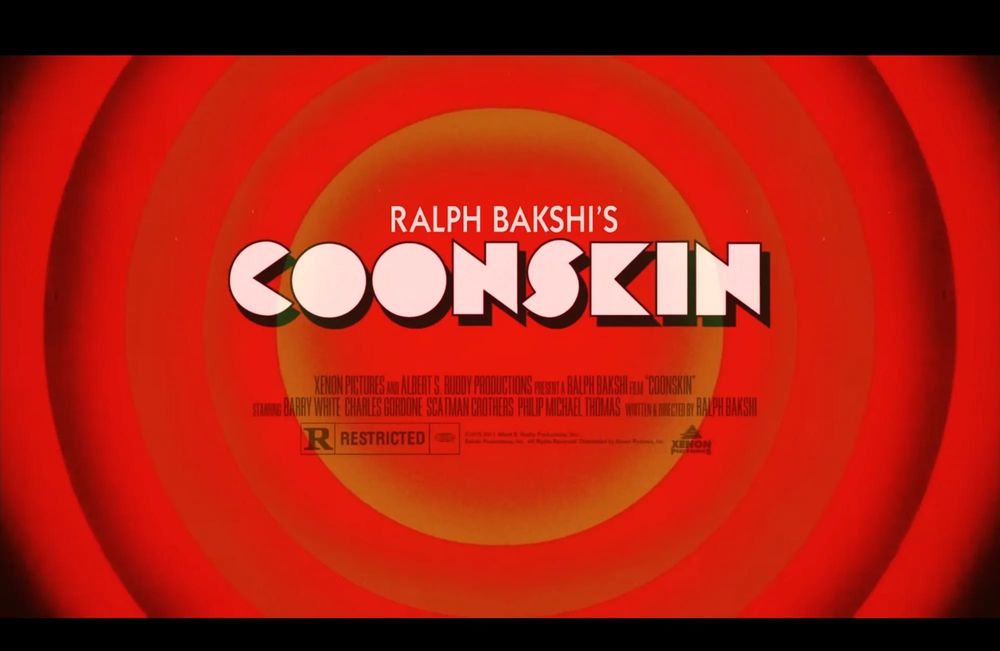
Most “Black” movies with white directors still have the smudges of the white director all over them. Sometimes the movie's messages are so potent, and the performances so out there that it is truly a shock to learn a director is white.
This was the case for my friend when I showed her Ralph Bakshi’s Coonskin for the first time.
Bakshi was born in 1938 and moved to a Black neighborhood early in his life. In Unfiltered: The Complete Ralph Bakshi, he says:
“All my friends were black, everyone we did business with was black, the school across the street was black. It was segregated, so everything was black. I went to see black movies; black girls sat on my lap. I went to black parties. I was another black kid on the block. No problem!”
Although I usually side-eye any white guy who calls himself another black kid, Bakshi’s experience is about as close as one gets. When we look at his work and factor in the time period, his influences are apparent.
However, a white guy creating a movie called Coonskin and filling it with minstrel imagery and Black stereotypes is going to be controversial at the very least.
WHAT'S IN A NAME
Coon is a racist term popularized in the 1800s through American minstrel shows, specifically with the character Zip Coon. Minstrel shows were racist performances that presented Black people as stupid and lazy.In many cases, white people would paint their faces Black, paint on big lips, and perform these stereotypical roles.
Minstrel shows were America’s favorite form of entertainment, and Zip Coon was one of the most popular. Calling a Black person a coon became an easy way to strip away their humanity. They are dumb, lazy, etc.
Eventually, the term evolves and is repurposed by the Black community. When we use coon today, it is usually in reference to someone who is a “sellout” to Black people. They spend their energy trying to please white people, usually by tearing down other Black people.
Coonskinwas released in 1975, before the shift in the term was solidified.Bakshi originally wanted to call his filmHarlem Nights,but rich white executives wanted something more controversial.
Bakshi came back with Coonskin No More before the executives shortened it to Coonskin. Even today, this title is racially charged and offensive, especially knowing it came from the minds of white men.
RECEPTION
I’m usually pretty annoyed by people who judge a film before watching it, but I can see why people did so when seeing previews of Coonskin. The racist imagery is prevalent.I’m sure racists were excited while some Black Civil Rights groupsprotestedagainst the film.
The Congress of Racial Equality (CORE) was a loud voice against the film. Once it was released, however, groups like the National Association for the Advancement of Colored People (NAACP) supported the film, describing it as “difficult satire.”
Intention matters, but is Bakshi’s vision successful? What is Coonskin?
“I’m a nigga man. Watch me dance!”
Coonskin is in direct conversation with the 1946 film Song of the South and the Br’er Rabbit stories. The popular Disney movie took Black stories about Br’er Rabbit and presented them through a lens of whiteness, using stereotypes and seemingly presenting a cleansed version of slavery.
In Song of the South, a little rich white boy runs away from the plantation because he is upset. He meets Uncle Remus, a Black man telling stories about Br’er Rabbit, Br’er Bear, and Br’er Fox.
Coonskin’s wrap-around story is about Randy trying to escape from prison and running across Pappy, who tells stories about Brother Rabbit, Brother Bear, and Preacher Fox. Like Song of the South, the story mixes live action and animation, but Coonskin creates a gritty, real-world feel, while Song of the South tried to create an illusion that never existed.
Our three characters decide to leave the South after the bank sells their home. Once in Harlem, the group meets Simple Savior, a con man who claims to be related to Black Jesus. Brother Rabbit picks up on the scam, prompting Simple Savior to attempt to kill him. In the end, the group kills Simple Savior, allowing Brother Rabbit to take over the conman’s racket. From there, Brother Rabbit must defeat his new enemies before they kill him.
The takedown of white America is the most obvious use of satire here.Every character is a stereotype, not just Black people.This is, unfortunately, America’s melting pot.
Jewish people, Italians, and gay people are all presented through the lens of American simplification. As for white America, she is literally a character in the story.
We usually see her between scenes, and instead of an Uncle Sam, we get a curvy, blonde woman with the American flag on her skin. The most notorious scene shows a Black man fighting back against America until she pleads and claims to give up.She spreads her legs and calls the man to her, promising he could receive America’s pleasure. The man moves to be intimate with America, and a gun from her vagina shoots him.
The analogy is clear. America promises Black people equity and equality, the American dream, only long enough to ensure Black people let their guard down and fall back into place.
Brother Rabbit’s first enemy represents another aspect of white America, a hatred for anything that doesn’t fit America’s “ideals”. In this case, it is a dirty, racist, homophobic cop named Mannigan. Mannigan is so racist that he won’t even bathe before dealing with Black people. This uncleanliness is paired with his dealings with the mafia. They are the ones who send him to take out Brother Rabbit.
Mannigan is drugged, painted in Black face, put in a dress, and put into a sexual situation with a gay man. For someone with illogical hatred, this is a nightmare. Mannigan goes wild, firing his gun only to be killed by the cops… well, overkilled, an outrageous number of bullets tearing through him because the cops thought he was Black. Again, the message about white America is clear here.
However, if you ask Bakshi what single message he wanted viewers to come away with in 1975, it was likely about criminal worship.
In a lot of ways, Coonskin is in direct response to the popularity of The Godfather. Bakshi was not happy with how “cool” people found the mafia after the film.
Bakshi’s Godfather character is a disgusting, disturbing depiction. He didn’t want anyone coming away with empathy or admiration for the film’s main antagonist. The mafia is mostly presented as inept and goofy, but their violence is never minimized. This is most apparent when the Godfather’s son dies trying to kill Brother Rabbit.
Like in The Godfather film, the Godfather’s wife cries over her dead son. However, in the film, the wife remains passive, something Bakshi couldn’t understand. In Coonskin, the wife immediately lashes out at her husband. Unfortunately, her revenge is unsuccessful. She is shot and slowly transforms into a butterfly while dying.
In stories, butterflies usually represent innocence and a desire to change. The wife wants out of the mafia life, but before she can escape, the Godfather crushes her, creating a devastating return to reality.
A focus on Black revolutionaries is the topic I find most fascinating in Coonskin, especially knowing it was created in 1975, right around the time that the idea of the “Black revolutionary” was dying down in America.
The fall of the Black revolutionary movement was mostly due to the government, but I would be lying if I didn’t point a finger at false revolutionaries and people motivated by money rather than actual change. Coonskin confronts this reality with Simple Savior, the supposed cousin of Black Jesus. He is presented as a naked, overweight, loud preacher who promises the power to kill any white man.
“White is pale! The cop is white! The rent is white! The landlord’s white! Your pain’s white! Yes! And white is pain. You have been kicked by whites! And God’s children are not all black. And change make that chain over your head! Deliver yourself from oppressors, for I’m the one sent here, by gods who deliver you! Deliver you! From the white oppressors! From the white oppressors. Join me! Join the Revolution! Join the Revolution! And I’m the Revolution!”
In a stage show, he cries out as symbols of white oppression like John Wayne and Elvis Presley beat him…before asking for donations. Brother Rabbit is able to take this same group of revolutionaries and turn them into a drug gang without much work once Simple Savior is dead.
It is important to note that revolutionary groups do still exist today, although they possess strong, passionate leadership that believes in their cause, and they have more complex messaging than “I’ll give you the power to kill white people.”
The idea of Black people turning on each other to gain power and proximity to Blackness also plays out when Brother Bear becomes a boxer after trying to leave the gang life.
Miss America tells Brother Rabbit:
“Your friend Bear won the championship tonight. He is working for the American mafia. Up from the ghetto and shit like that. Hey, you can’t let Bear get away with that. What are you going to do about it?”
America takes Brother Bear and has him brutalize other Black men in a white establishment for white people’s pleasure while simultaneously tempting Brother Rabbit to turn on Bear. Fight each other to receive America’s rewards.
In the end, Bear fights a fake opponent sent by Brother Rabbit. Our characters use the distraction to defeat the mafia, showing the strength of genuine Black unity against established power.
Ralph Bakshi hired Black animators, actors, and musicians. Despite the stereotypes, Coonskin drips with an authentic 70s Blackness. Still, it is understandable why people are critical of a white director making this movie. Sometimes, white people will take any excuse to say nigga, and this movie looks like that on the surface.
Big-lipped, jive-speaking minstrel characters parade across the screen for over an hour, but I personally think Bakshi’s heart was in the right place.
This movie isn’t for everyone. It is uncomfortable. It is harsh. I’m not even sure I would call it a good movie, but it is a piece of art. You don’t leave this work without feeling something. It is impossible to convey the experience in words, but after reading this, you know if this is a film for you.