
The title paraphrases the words of Kanye West about George W. Bush in 2005, following what he perceived as the failed response to Hurricane Katrina and the destruction of Black areas in New Orleans. Kanye West publicly apologized to former President George W. Bush in November 2010, five years after his famous remark. Odds are I won’t be apologizing to Donald Trump for not caring about white people. Trump doesn’t care about anyone, except other rich people who serve his purposes or feed his ego.
When I was 16, I went on a bike trip with a Minneapolis church group to a Youth Conference in St. Louis, Missouri. The ride took seven days, during which we rode through the entire state of Iowa from North to South. Riding a bike lets you observe much more than you can in a car, because of the slower speed and the need to stay awake the whole time. In the entire state of Iowa, I saw one Black person getting fuel at a gas station. That’s it. The University of Iowa and Iowa State campuses have a good number of minorities, and some cities like Waterloo, Davenport, and Des Moines have a Black side of town. I can attest that Iowa is pretty white, currently rated the 6th whitest state in America.
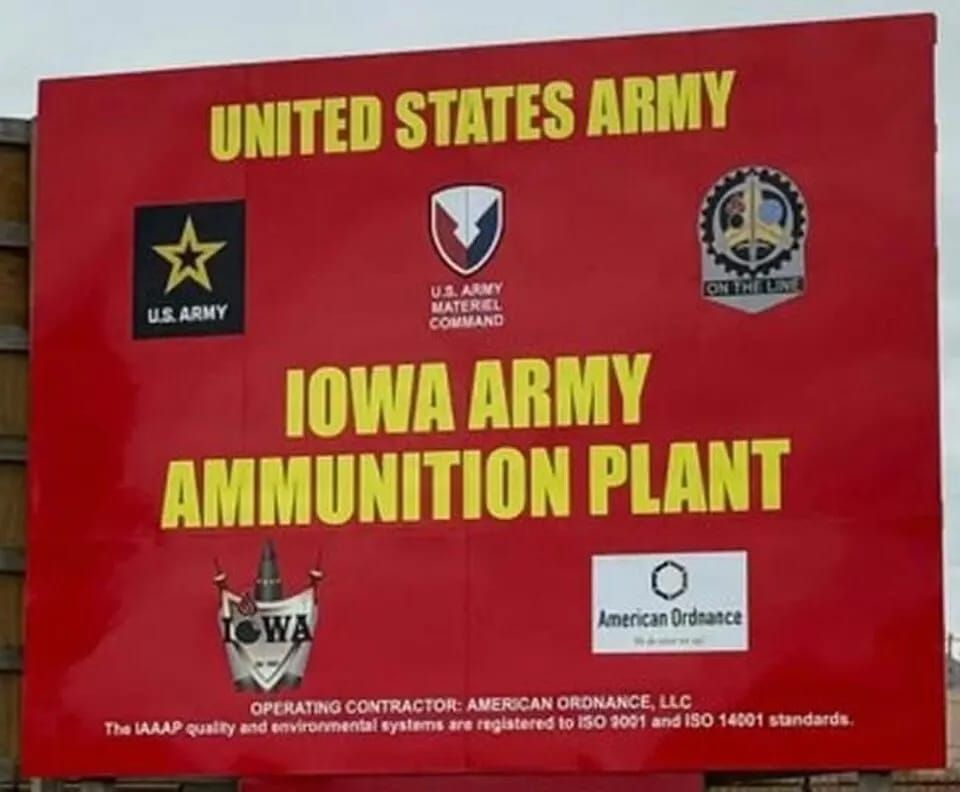
Middletown, Iowa, is the home of the Iowa Army Ammunition Plant, near Burlington in southeastern Iowa. The munitions at the plant near Middletown were destroyed because the Army considered them an immediate explosion hazard that had become too dangerous to handle or transport safely. The material was lead azide, a highly sensitive explosive used in detonators and other ammunition components.
The central problem was not simply that the material was old. According to the Army, it had deteriorated and crystallized inside 68 aging barrels. That condition made the explosive unusually sensitive to movement, friction, or other disturbance. Officials feared that opening, moving, or attempting to repackage the barrels could trigger an accidental explosion.
What alternatives were considered?
The Army says it evaluated several ways to eliminate the danger. The important distinction is that some options could theoretically destroy or neutralize lead azide. Still, officials concluded that getting the material into position for those treatments could itself set it off.
1. Chemical neutralization. This would use a chemical agent to render the lead azide non-explosive. A contractor, MuniRem Environmental, proposed this approach, and an Army expert panel initially recommended further consideration. The Army later rejected it, saying workers would have to open the barrels and mix the agent with the explosive. Crystallized material around the lids and inside the containers could detonate from that handling.
2. Thermal treatment. This would use heat to destroy or treat the explosive. The Army concluded that exposing the unstable material to the movement and handling required for this method created an unacceptable risk of accidental detonation.
3. Moving the barrels to another disposal site. The Army considered relocating the material, including to another disposal area at the plant. But even moving the barrels could produce vibration, impact, or friction. The Army said that risk was unacceptable.
4. Destroying the barrels elsewhere by controlled detonation. One possibility was to move the drums to an explosive-disposal area and detonate them there. That still required transporting and handling the unstable material. The Army rejected it for essentially the same safety reason.
5. Leaving the material in storage. This avoided immediate handling, but did not eliminate the danger. The Army argued that deterioration and changing temperatures could make an accidental explosion increasingly likely.
Why the decision remains controversial
One important complication: chemical neutralization was not an idea nobody had explored. Records reviewed by Iowa Public Radio and The Washington Post indicate that the plant’s operating contractor contacted MuniRem in September 2025 — months before the Army says it learned the material had become dangerously unstable. MuniRem proposed a chemical treatment process. An expert panel reportedly recommended chemical neutralization in March 2026, and the Army awarded MuniRem a contract to develop the approach. The Army canceled that contract about two months later.
MuniRem said its chemical method remained viable. The Army said laboratory tests showing the chemical could neutralize lead azide did not establish that workers could safely open the actual drums and introduce the chemical. The Army said crystals had accumulated around the lids, making even opening the containers dangerous. The public reporting leaves important questions about whether a full-scale pilot test was completed and precisely why the earlier chemical-treatment work was abandoned.
The Army ultimately chose to detonate the material where it was stored, using barriers, water mist, foam and other measures intended to limit the spread of lead particles. That approach eliminated the explosive hazard, but it also created a different environmental concern: the possibility of releasing toxic lead into the surrounding air, soil and water.
The Army’s planned explosion at the Iowa Army Ammunition Plant near Middletown was originally scheduled for Friday, November 20, 2026. But the date changed after residents protested, environmental groups challenged the EPA permit in court, and state and federal officials demanded more time for public notification and safety preparations.
It is important to distinguish the causes of the delays: public opposition helped force the issue into the open, but the postponements also involved a court-ordered pause, pressure from elected officials, weather concerns, and the Army’s decision to add protective measures. The explosion ultimately took place Wednesday, November 25.
How the postponements unfolded
November 15
The Army publicly announced that two controlled detonations were planned for November 20, around noon. Residents were told to leave the affected area temporarily, and the Army warned that lead-containing dust could linger for up to an hour, depending on wind conditions.
November 18–19
Residents protested the plan, raising concerns about lead particles entering the air, settling on homes and farmland, and potentially contaminating water, crops, and livestock. Environmental organizations — the Iowa Environmental Council and the Sierra Club’s Iowa chapter — challenged the EPA’s emergency permit in federal court. Iowa and Illinois lawmakers, along with Gov. Kim Reynolds, also called for a delay. On November 19, Acting Army Secretary Adam Telle announced that the Friday operation would be postponed until Monday, November 23.
November 20–23
The legal challenge resulted in an administrative stay that temporarily prevented the Army from proceeding under the EPA permit. The Eighth Circuit Court of Appeals subsequently lifted that stay, allowing the detonation to proceed. The Army nevertheless moved the date again, to Wednesday, November 25, saying it needed more favorable weather and additional time to install safety measures.
November 25
The Army carried out the controlled detonation at approximately 9 a.m. The operation produced two loud explosions and visible white plumes. The AP reported that EPA air monitors were not detecting airborne lead more than 30 minutes afterward. That was an initial monitoring result, not proof that no lead had settled on land or surfaces.
What protections were added or put in place?
The Army and federal agencies described a substantial set of measures intended to contain the blast, reduce airborne lead particles, and protect residents.
1. Concrete and sand barriers
The Army constructed additional barriers around the two storage bunkers. AP reported that the barriers were approximately two stories high.
2. Water, gels and foam
Ballistic gels and foams were placed to absorb dust and reduce particle dispersal. The Army planned to use more than 100,000 gallons of water to suppress the plume, including saturating the soil surrounding the earth-covered magazines.
3. A reinforced blast location
The explosives remained inside earth-covered magazines — reinforced concrete structures designed to store ammunition and explosives.
4. Wind and atmospheric modeling
Officials used dispersion and deposition modeling to estimate where airborne particles might travel and where lead could settle. The Army said it would update the maps as weather conditions changed.
5. Evacuation and temporary housing
FEMA supported relocation for residents in a five-mile evacuation zone extending southwest of the plant. Assistance included transportation, temporary hotel lodging, food, water, and other supplies.
6. Shelter-in-place instructions
Residents outside the evacuation zone were advised to close windows and doors, turn heating and cooling systems to recirculate air, turn off fans drawing outside air into homes, and keep children and pets indoors. Farmers were advised to protect livestock feed and water.
7. Environmental monitoring
EPA deployed more than 100 personnel and contractors, including mobile laboratories. The agency reported conducting more than 1,001 combined air, land, and water samples before the blast, with additional sampling planned during and afterward.
Initially, Trump supported the Army’s decision to detonate the explosives.
The administration said the 68 barrels of deteriorating lead azide had become dangerously unstable. Army officials argued that a controlled explosion, with protective measures, was safer than waiting for the chemicals to detonate spontaneously. Trump subsequently defended that reasoning, blaming the Obama administration for the alleged improper storage of the explosives in 2009.
On November 23, he suddenly ordered a temporary halt.
In a Truth Social post, Trump said he had ordered the military not to proceed until the Eighth Circuit Court of Appeals agreed the operation could go forward. He also made his decision conditional on approval from Iowa’s incoming governor, Democrat Rob Sand.
Trump wrote that he wanted to eliminate the long-term danger but would not proceed without those two approvals. He went further, saying that if the court or Sand refused, the government would have to stop the operation and that he would hold Sand responsible for any resulting death or destruction.
Trump continued to argue that the explosion was the safest option.
Even while ordering the pause, Trump did not embrace the environmental groups’ demand to stop the detonation permanently. He repeated the Army’s argument that a controlled explosion was safer than allowing the deteriorating explosives to remain in storage and potentially detonate on their own. He also blamed the Obama administration for the storage problem.
The court cleared the way, and the Army proceeded.
On November 23, the Eighth Circuit declined to block the operation, lifting the temporary legal obstacle. Sand, meanwhile, did not give Trump the unconditional political approval he appeared to seek. Instead, he said the administration should make the decision based on expert assessments while providing the public with more information and transparency.
The Army then proceeded with the November 25 detonation.
What makes Trump’s position noteworthy
There were three distinct elements to Trump’s public position:
- He supported the Army’s conclusion that controlled detonation was the safest disposal method.
- He temporarily ordered the military to stop until the court and Iowa’s incoming governor agreed.
- He threatened to hold the incoming governor responsible for deaths or destruction if the operation did not proceed.
The third point is particularly significant because Sand had not caused the storage problem, did not control the federal ammunition plant, and was not yet governor. Trump was placing political responsibility on an incoming state official for a decision involving federal military property and federal environmental authority.
Not Giving a Damn about White People
Black neighborhoods are accustomed to living with dangers and governments at many levels not caring. In addition to New Orleans after Hurricane Katrina, there is Flint, Michigan, and the tainted water supply; Memphis, Tennessee, living with Elon Musk’s data centers. Shiloh, Alabama, saw homes flooded after a botched highway widening. The westside of Atlanta, Georgia, still faces flash floods after decades of inadequate sewer maintenance. Jackson, Mississippi, experienced a major water-treatment failure in August 2022 that left nearly 200,000 residents without reliable access to safe drinking water. But the crisis was not sudden: the city had struggled with aging infrastructure and inadequate investment for decades.
Uniontown, Alabama, is mostly Black and 350 miles from Kingston, Tennessee. After the 2008 Kingston, Tennessee, coal-ash spill, millions of cubic yards of contaminated ash were transported to the Arrowhead Landfill near Uniontown. Residents objected to bringing the waste into their community and complained about odors and possible health effects. State regulators approved landfill operations despite those objections. Residents and environmental advocates argued that government agencies had failed to protect the community from becoming a disposal destination for waste generated elsewhere. Black communities aren’t surprised to be treated poorly. White people by and large expected Donald Trump to be a champion for whiteness. White Iowa residents have discovered he doesn’t care. Can you imagine Donald Trump approving such an explosion near Mar-a-Lago?
Donald Trump has demonstrated an ability to appeal to white Americans across income levels by combining economic promises with nationalism, strict immigration policies, and rhetoric that often draws sharp racial and cultural divisions. He has promised working-class voters restored manufacturing, lower prices, secure borders, and protection from economic change. His immigration agenda has included expanded deportation efforts, tighter asylum restrictions, suspension of refugee admissions, and efforts to limit entry from particular countries. These policies have been accompanied by language portraying immigrants as an invasion and, at times, as criminals or threats to American society.
His verbal attacks have also repeatedly involved Black and brown people. He spent years promoting the false claim that Barack Obama was not born in the United States. He questioned Kamala Harris’s Black identity, saying she had “happened to turn Black,” and claimed immigrants were taking “Black jobs.” He repeated the false allegation that Haitian immigrants in Springfield, Ohio, were eating residents’ pets, and in 2018 described African nations and Haiti as “shithole countries” — a characterization he later acknowledged using. These are not isolated examples; they form a documented pattern of rhetoric that critics have described as racially divisive.
Yet the economic benefits of Trump’s governing agenda tell a different story from the broad working-class appeal of his political message. The 2025 tax law directs a disproportionate share of its net tax reductions to the wealthiest Americans: the Institute on Taxation and Economic Policy estimated that more than 70 percent would go to the richest fifth of households in 2026, while the poorest fifth would receive less than 1 percent.
A factory worker and a billionaire may both respond to Trump’s promises about immigration, national identity, and cultural change, but they do not necessarily receive the same economic rewards from his policies. The central question is whether working-class voters benefit from the agenda they helped elect, or whether their political loyalty advances an economic program whose largest financial rewards go to people who are already wealthy. Throughout American history, people like Donald Trump haven’t cared about white people who weren’t rich. The fact that an Army munitions plant is in their neighborhood means a rich person, or someone paid by a rich person, didn’t care.
Major Army ammunition and munitions facilities
The following are particularly important because they manufacture explosives, ammunition, propellants, or artillery components.
Facility/Location/Principal activity
Holston Army Ammunition Plant Kingsport, Tennessee High explosives used in military munitions
Lake City Army Ammunition Plant Independence, Missouri Small-caliber ammunition
Milan Army Ammunition Plant Milan, Tennessee Ammunition production
Radford Army Ammunition Plant, Radford, Virginia: Gun and rocket propellants
Scranton Army Ammunition Plant Scranton, Pennsylvania Large-caliber artillery projectiles
Quad City Cartridge Case Facility, ty Rock Island, Illinois: large-caliber cartridge cases
Universal Artillery Projectile L,ines Mesquite, Texas: Metal components for large-caliber ammunition
Other important military munitions installations
There are also government ammunition storage, handling, demilitarization, and weapons-support facilities:
- McAlester Army Ammunition Plant — McAlester, Oklahoma.
- Pine Bluff Arsenal — Pine Bluff, Arkansas.
- Crane Army Ammunition Activity — Crane, Indiana.
- Hawthorne Army Depot — Hawthorne, Nevada.
- Blue Grass Army Depot — Richmond, Kentucky.
- Letterkenny Munitions Center — Chambersburg, Pennsylvania.
- Anniston Munitions Center — Anniston, Alabama.
- Tooele Army Depot — Tooele, Utah.
The vast majority of these facilities are not near Black neighborhoods; instead, they are in rural areas surrounded by white people, perhaps out of fear of Black people getting those guns. One of the primary objectives of the Denmark Vesey Revolt was to raid and control the Charleston armory. If one munitions center has fallen into disrepair and the explosives are volatile, what are the odds another isn’t approaching or already in the same state?
The November 25, 2026, explosion at the Iowa Army Ammunition Plant in Middletown presents two different kinds of potential danger: the immediate physical effects of the blast and the longer-term environmental and health consequences of releasing lead-containing dust.
The particularly troubling issue is that the Army deliberately detonated approximately 9,700 pounds (nearly five tons) of degraded lead azide, a highly sensitive explosive compound.
The explosion was intended to prevent an even more dangerous accidental detonation. But that does not automatically mean the surrounding environment is free of contamination.
1. Immediate damage and short-term health risks
The blast could produce several consequences:
- Dust and airborne lead: The explosion can disperse lead-containing particles into the air.
- Respiratory exposure: People who inhale contaminated dust could be exposed to lead and other combustion-related materials.
- Property contamination: Lead-containing particles can settle on roofs, windows, vehicles, gardens, playgrounds and outdoor furniture.
- Agricultural contamination: Dust settling on livestock, animal feed, crops and soil could create exposure pathways.
- Physical damage: Pressure waves and ground vibrations can damage windows and other vulnerable structures.
The Army specifically warned residents about noise, vibrations, dust, and possible localized window damage.
The potential geographic reach is also important. Before the explosion, University of Iowa public-health experts discussed the possibility of a dust plume traveling 40–50 miles southwest, depending on weather conditions. That was a modeled possibility, not a confirmed contamination boundary. Under perfect conditions, the dust plume might even reach a Black neighborhood.
2. Long-term environmental damage
The biggest unresolved concern is that lead is particularly problematic because it is an element. It does not biodegrade or disappear over time.
If lead particles escaped the containment measures, they could settle in several places.
Environmental location/Potential long-term consequence
Agricultural soil — Contamination that could remain for decades
Gardens and crops — Lead particles could enter food-growing areas
Livestock pastures — Animals could ingest contaminated soil or vegetation
Drinking-water sources — Contamination could require treatment or remediation
Homes — Lead dust could remain on surfaces and be tracked indoors
Rivers and streams — Sediment contamination could expose aquatic organisms. The Agency for Toxic Substances and Disease Registry explains that airborne lead can travel considerable distances before settling. That lead does not break down in the environment.
3. Potential long-term human health consequences
Lead exposure is especially concerning for children and pregnant women.
Children:
- Brain and nervous-system damage.
- Lower IQ and learning difficulties.
- Behavioral and developmental problems.
- Hearing and speech difficulties.
Adults:
- Kidney damage.
- Increased blood pressure.
- Memory and concentration problems.
- Anemia and nervous-system damage.
- Reproductive complications.
One particularly important fact: children exposed to lead may not show obvious symptoms. The CDC says no safe blood lead level has been identified for children.
What all these sites have in common is they aren’t located near clusters of rich people. Rural white people may have felt their whiteness would protect them from certain harms.But the callousness with which Trump ordered the explosion should tell you your whiteness didn’t matter; it was your income. It will be decades before the people of Middletown find out if the Army, the government, and President Donald Trump lied to them about their safety. Going ahead with the blast let them know that nobody cared.