
Opponents of diversity and inclusion efforts typically say that they’re interested in only one thing. A person’s merit.
We’ll save for another day what merit means and whether they really apply meritocracy across the board, but one thing’s for sure: they miss the mark on a major component of diversity.
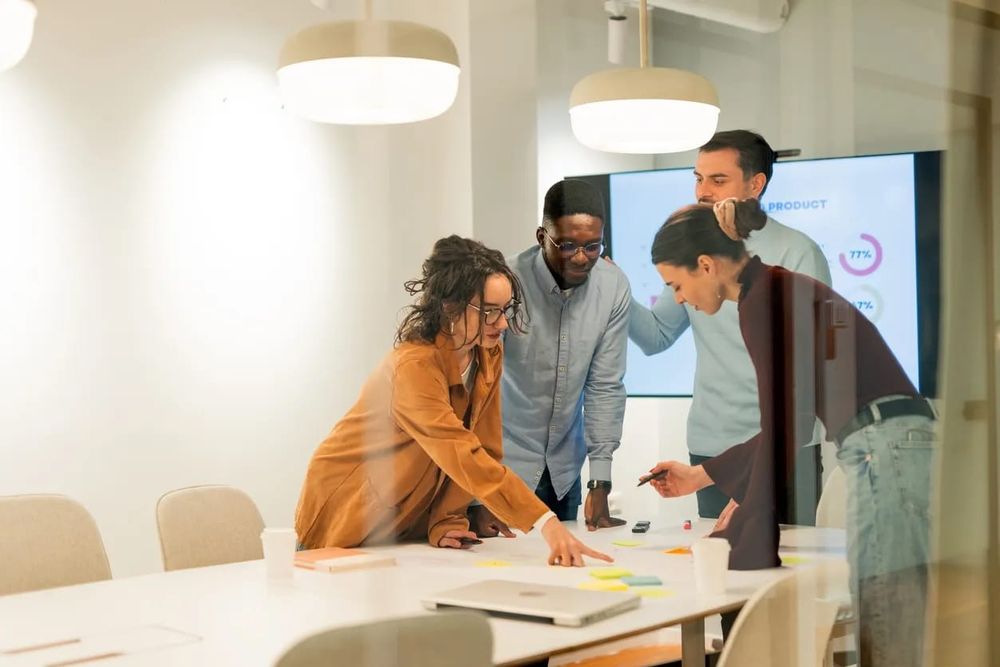
Diverse teams, more often than not, produce better results.
Short detour first.
I know of zero people who want a physician who isn’t qualified. Or a firefighter who can’t help lift a heavy ladder. Or a pilot who barely passed their flight tests.
Diversity doesn’t mean picking unqualified people and crashing planes. Nobody’s arguing for subpar architects and engineers to design the next skyscraper.
But part of being a material asset to any team — in medicine, marketing, psychology, law, or graphic design — is bringing minds to the table that aren’t all the same.
People with a wide variety of vantage points.
Every person’s life experiences, culture, geographies, economic upbringing, and interactions shape how our minds think. Our ideas. Our sense of humor. Our creativity. You name it.
When we bring together diverse people, most of the time they’ll come up with different and a wider array of solutions and ideas in every field of endeavor.
A reminder before we continue.
Diversity means all of us. Old and young. Left and right. Black and white. Jewish, Muslim, Hindu, Christian. New immigrant and fifth-generation American. Rural and urban.
I took this for a test drive myself recently.
I bought a 110-year-old home that needed 110 years’ worth of work and remodeling.
The landscaping was a disaster. The home still had a 100-year-old steam boiler and radiators. No central A/C.
The electrical system was woefully inadequate to power modern systems. Aged transformers. Corroded wires.
The kitchen barely had enough room for two people to stand in it, and had a tiny butler’s pantry in the adjacent room. The oven was an old brand I had never even heard of.
I wanted quality people to do the work at a price that fit my budget. With those requirements, I put together a diverse team.
My general contractor and quarterback for the project is Black.
My landscapers are Latino, from Guatemala.
My electrician and locksmith are both Jewish.
My furniture advisor and store owner is gay.
The appliance store where I bought my Italian oven, refrigerator and microwave is locally owned by two white men.
The HVAC people are white Christians.
My garage flooring company is Vietnamese-owned.
My kitchen designer is a white woman, and my custom cabinet supplier is Black.
I’m still knee-deep in the project, but what I’ve learned isn’t that a diverse team means there will be no issues.
Every construction project has them. This one has been no exception.
But the Guatemalan landscapers not only do exceptional work, they also bring tremendous humility, warmth, and kindness to the job. No doubt connected in some part to how welcoming and kind Guatemalan culture is known for. It comes across in how they communicate with me. When my vision of the yard differs, the conversations are easy, and the team pivots without complaint or frustration. And their work ethic is second to none.
My Black general contractor has, on more than one occasion, empathized with issues when they came up. Instead of telling me to take a hike or saying “sorry, it’s too late,” it’s always, “Don’t worry, I got you, brother.” And every time, he follows through, with no fear of saying sorry when the issue was on his team’s end. I don’t doubt for a second that his approach is partly connected to what he’s experienced in life. His learned empathy.
My kitchen designer wasn’t the first one I interviewed. But she was the one who listened to my ideas. Listened to my vision and dream for the kitchen. And then produced options that tracked what I spent an hour sharing with her. We know one feminine characteristic relates to listening so I am sure this played a part.
My electrician always speaks to me with genuine warmth, and it makes tackling this stressful and challenging project that much easier. But even more than his communication, he’s a true problem solver. It would be naïve to suggest that his Jewish ethnicity, which teaches a certain work ethic and encourages questioning and debate, isn’t playing some role in how he operates in this world.
And all of these teams have worked well together on top of it all.
The research backs this up.
Scott Page’s case, The Difference (Princeton, 2007), showed that a group of diverse math problem-solvers more often beat a group of the individually best performers on hard problems. That’s because the best performers tend to think alike and get stuck in the same places. In other words, in non-diverse settings, a crowd’s error oftentimes has the same impact as an individual error.
Katherine Phillips’s “How Diversity Makes Us Smarter” (Scientific American, 2014), sums up decades of experiments.
- Mock juries (Samuel Sommers, 2006): racially diverse juries deliberated longer, discussed more facts, and made fewer factual errors than all-white juries. White jurors themselves performed better in diverse groups.
- Phillips’s study (2009): small groups solved a murder mystery. Groups that brought in an outsider solved it correctly more often, but members felt less confident and found the discussion less comfortable.
- Business data she cites: one study (Dezső and Ross, 2012) linked women in top management of S&P 1500 firms to about $42 million more in firm value. Another study linked racial diversity to higher sales revenue. These are correlations.
Being around people who differ from us makes us prepare more, consider other views, and work harder. Diverse groups often start out less comfortable but perform better.
McKinsey also studied this. In Diversity Matters (2015) and follow-ups (2018, 2020, 2023), they determined that companies in the top quartile for gender diversity were about 15% more likely to have above-median financial returns. For racial and ethnic diversity, the figure was about 35% more!
Later reports found similar or stronger links (roughly 25% for gender and 36% for ethnicity in the 2020 report.
Look. Is it possible I could’ve gotten good service from a non-diverse team? Sure. Is it possible to encounter bad or rude people among any group? Obviously.
But it’s also true that diverse teams bring diverse ideas to the table. Diverse cultural skill sets. Diverse ways of communicating. Diverse approaches to empathy. Diverse listening skills.
Instead of treating your world as something to protect from outsiders, try inviting others in.
You’ll find that what you’re trying to accomplish will be enriched. As will the lives of the people you invite in.