
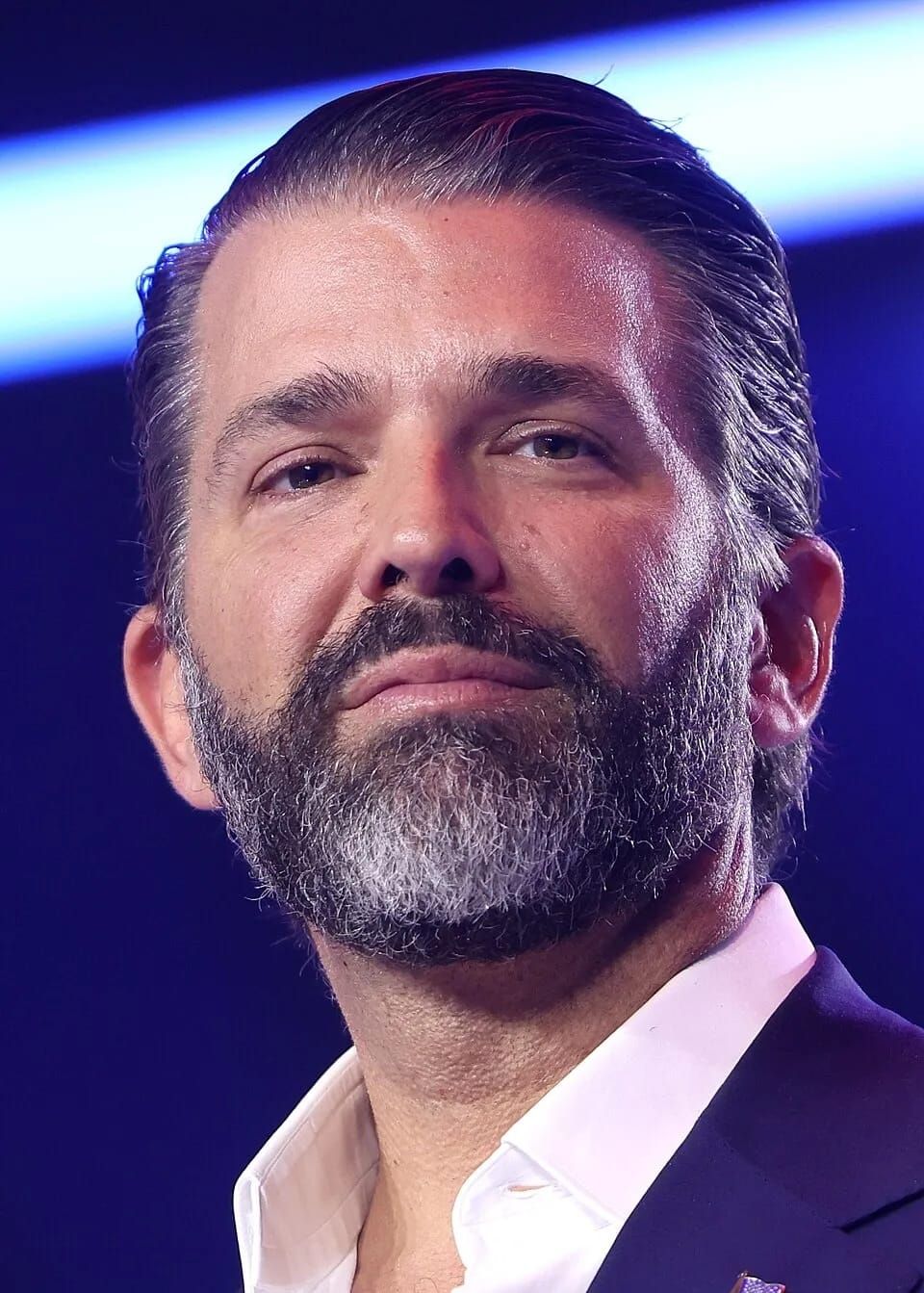
Forbes Magazine reported that Donald Trump Jr.’s net worth in November of 2024 was $50 million. Today he’s worth an estimated $300 million. When you add in his new wife’s money (Bettina Anderson), they are worth as much as $500 million. Donald Trump Jr. operates across real estate, media, venture capital, firearms, drones, mixed martial arts, prediction markets, and several emerging tech sectors (AI, aerospace, automation). His post‑2024 expansion is driven by advisory roles and his partnership at 1789 Capital, a rapidly growing “America‑first” investment firm. You might have asked yourself, “What the f**k does Donald Trump Jr. know about drones?” We’ll get to that later in the story.
In the year 2000, Trump Jr.’s net worth may have been negative. Right after graduating from the Wharton School, Donald Trump Jr. moved to Aspen, Colorado for roughly a year. He lived out of a truck, bartended, hunted, fished, and skied, in a deliberate escape from the Trump family orbit. He was pissed at his father and needed to get away. Junior still had access to money if needed, as his mother, Ivana, divorced from his father ten years earlier, was worth $100 million at the time. But Don Jr. was living one step up from being a bum.
The period after college wasn’t Junior’s first break from his father. His parents went through a nasty, public divorce, covered in the New York tabloids. Junior was reading about Senior’s affair with Marla Maples, seeing titles describing “The Best Sex I Ever Had!” Don Jr. reacted with anger and withdrawal. He reportedly accused his father of “not loving” him or his siblings and only loving “his money.” He probably got that part right.
To shield the children from the media frenzy, Don Jr. and Eric were sent to boarding school in Pennsylvania — a move that also physically distanced them from their father. During this period, Don Jr. refused to speak to Donald Trump for about a year.
An incident during his time at the Wharton School precipitated his move to Colorado. Donald Trump arrived at Don Jr.’s dorm to take him to a Yankees game. According to a classmate, Trump slapped Don Jr. across the face without explanation, knocking him to the ground. The moment reportedly deepened Don Jr.’s hostility and sense of humiliation.
September 11, 2001, was a psychological turning point for him and for the Trump family as a whole. Don Jr. returned to New York shortly after 9/11, due to a desire to be near family, a sense of responsibility, and a shift in national mood that made “escape” feel less meaningful. Being angry at his father was somehow less important. Plus, he was broke. He had trust funds he couldn’t access yet, so he was living off his bartending money and spending everything he made.
When Donald Trump Jr. returned to New York after his Aspen year (2000–2001), he went straight into the Trump Organization as a junior executive. His early responsibilities included property management, development oversight, internal operations, and learning the business structure he was expected to inherit. Junior had grown up knowing that, as the eldest son, he was the heir apparent. That didn’t mean he was good at it.
Michael Cohen testified that Donald Trump Jr. routinely made poor business decisions, launched deals that collapsed, and personally guaranteed obligations he couldn’t fulfill. Donald Trump repeatedly said Don Jr. had “the worst judgment of anyone he’s ever met.” Cohen was brought in specifically to “close down” Don Jr.’s failed projects — including a South Carolina business loan Don Jr. had personally guaranteed — and to unwind other Don Jr. ventures that had gone bust. Don Jr. initiated deals based on personal connections rather than due diligence, and they frequently collapsed.
Trump Jr.'s love life was stable, until it wasn’t. His marriage to Vanessa Haydon, beginning in 2005, was the quiet chapter — five children, a mostly apolitical home life, and a sense of stability that evaporated as Don Jr. became a political combatant during and after the 2016 campaign. After their 2018 divorce, he entered a more chaotic, celebrity‑adjacent period, including a highly publicized relationship with Aubrey O’Day, the singer from Danity Kane. Their affair — beginning while he was still married — was intense, emotional, and ultimately unsustainable under Trump‑family pressure. O’Day later described the relationship as a genuine connection cut short by dynasty politics, and her proximity to Sean “Puff Daddy” Combs, who managed Danity Kane and shaped her early career, added another layer of celebrity‑world complexity to the story.
Don Jr.’s next relationship, with Kimberly Guilfoyle, was the most turbulent: part romance, part political alliance, part branding exercise. Guilfoyle’s ambition, her polarizing presence inside the Trump orbit, and the couple’s relentless public performance created a relationship that was as strategic as it was volatile. Their years‑long engagement dissolved quietly in 2024, ending the MAGA “power couple” era. After that storm, Don Jr. pivoted sharply toward stability, marrying Bettina Anderson in 2026 — a relationship notably free of political theatrics, celebrity entanglements, or the volatility that defined the Guilfoyle years. Anderson was independently wealthy through her family.
Donald Trump Jr.’s present wealth is the product of a three‑stage evolution: inherited positioning, Trump‑Organization income, and — most importantly — a late‑career explosion driven by cryptocurrency ventures and tech‑sector equity. For most of his adult life, Don Jr.’s finances were modest by Trump‑family standards; even as an executive vice president at the Trump Organization, his wealth hovered in the tens of millions, built from salary, bonuses, licensing deals, and the predictable real‑estate income streams that come with being a Trump heir.
The transformation happened after 2024, when he became a central figure in the Trump family’s crypto ecosystem. His stake in World Liberty Financial, a Trump‑branded crypto project that reportedly generated over a billion dollars in token sales, delivered him tens of millions in cash and additional locked tokens valued in the tens of millions more. Most investors in World Liberty Financial lost money, but Trump family members earned money on every transaction and cleaned up. The biggest share of President Trump’s $2 billion windfall last year came from World Liberty Financial.
He also acquired equity in American Bitcoin, a mining venture whose valuation surged during the broader crypto boom, giving him another major wealth pillar. Layered on top of this are his board roles at Trump Media & Technology Group and PublicSquare, his partnership at 1789 Capital, and his media ventures — podcasts, books, and branded lifestyle projects — which add smaller but steady streams of income. The result is a net worth now estimated around $300 million, a six‑fold increase from his pre‑crypto baseline, driven not by traditional business success but by the Trump family’s pivot into digital finance and political‑adjacent tech investments.
I said we’d get to the drones, and it’s now that time. Donald Trump Jr.’s entry into the drone industry began in November 2024, when Unusual Machines — a niche Orlando‑based drone‑components maker — created an advisory board specifically to give him a seat and granted him millions in equity. His role was framed as helping “bring drone manufacturing jobs back to the USA,” aligning with Trump‑administration messaging on domestic production.
Almost immediately after his appointment, Unusual Machines began receiving military‑linked orders, including a $12.8 million purchase and a contract to supply 3,500 drone motors to the U.S. Army’s 101st Airborne Division, with potential follow‑on orders for an additional 20,000. By late 2025, the company had announced at least $15.2 million in defense‑related deals, and its stock price had risen more than 900%, a surge widely attributed to both political proximity and rapidly expanding Pentagon budgets for drones and counter‑UAS systems. Federal initiatives — including Executive Order 14307, “Unleashing American Drone Dominance” — prioritized American‑made drones and accelerated procurement, creating an environment in which Unusual Machines’ ties to Don Jr. drew scrutiny and attention. In short: Don Jr.’s involvement coincided with, and likely amplified, the company’s sudden access to government contracts, placing him at the center of a fast‑growing defense sector reshaped by national‑security concerns and political influence.
In the end, Donald Trump Jr.’s rise to extraordinary wealth and influence reflects the power of proximity, not performance. His fortunes did not grow out of business acumen, strategic discipline, or a record of successful ventures; they grew because he was positioned close to the machinery of Trump‑world — its branding, its political reach, and its access to lucrative opportunities. From crypto projects that exploded only after the Trump name was attached, to drone companies that secured government contracts immediately after adding him to their advisory boards, to media and tech ventures that rely more on his surname than his skill set, the pattern is consistent. His success is best understood as a product of inherited networks and political adjacency, not the kind of competence that builds empires from scratch. The bottom line is, he failed up!