
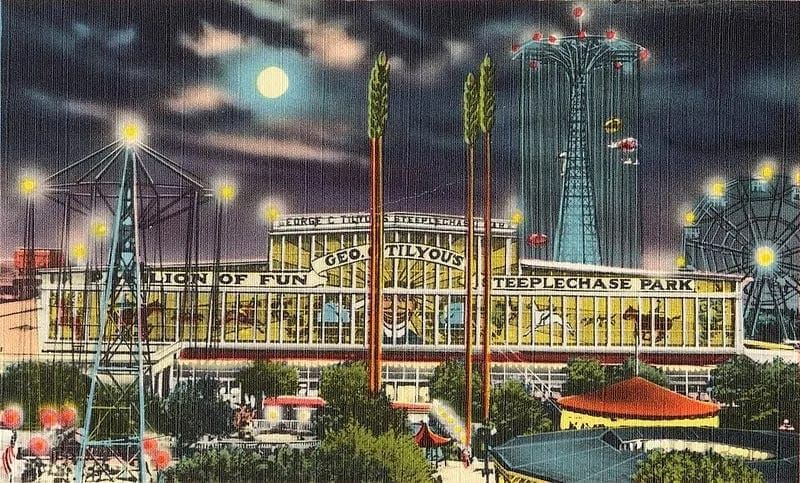
For more than half a century, Steeplechase Park was the beating heart of Coney Island — a place where New Yorkers of every class, color, and neighborhood came to forget themselves. It was the most democratic amusement park in America, not because it preached equality but because it practiced it. For the price of a ticket, anyone could ride the Human Roulette Wheel, laugh themselves breathless in the Pavilion of Fun, or climb onto the mechanical horses of the Steeplechase Ride and race strangers along the boardwalk. It was a place where joy was cheap, laughter was abundant, and the world outside — the world of work, poverty, discrimination, and politics — stayed mercifully distant.
And then, in the mid‑1960s, Steeplechase Park died. Not because people stopped loving it, and not because Coney Island lost its magic, but because a real‑estate developer named Fred Trump saw the land beneath it as more valuable than the memories above it. What followed was one of the most bitter land battles in New York history — a clash between the city’s working‑class culture and the ambitions of a man who believed fun was less important than profit.
This is the story of Steeplechase Park: how it rose, how it fell, and how its destruction foreshadowed the development battles that would define New York for decades to come.
I. The Birth of Steeplechase Park
Steeplechase Park opened in 1897, the creation of George C. Tilyou, a showman with a genius for spectacle and a gift for understanding what ordinary people wanted. Tilyou believed that amusement parks should be places of controlled chaos — places where people could be startled, delighted, embarrassed, and thrilled without ever feeling unsafe. His motto was simple: “Laugh and the world laughs with you.”
Steeplechase embodied that philosophy. It was built around the famous Steeplechase Ride, a mechanical horse race that sent riders careening along a steel track at exhilarating speeds. The ride became so iconic that the entire park took its name from it.
But Steeplechase was more than a single attraction. It was a sprawling wonderland of funhouses, slides, roller coasters, and bizarre contraptions designed to make people laugh at themselves. The Pavilion of Fun — a massive indoor hall — featured trick floors, spinning discs, air jets that blew up skirts, mirrors that distorted bodies, and attendants who delighted in gently humiliating guests. It was slapstick made architectural.
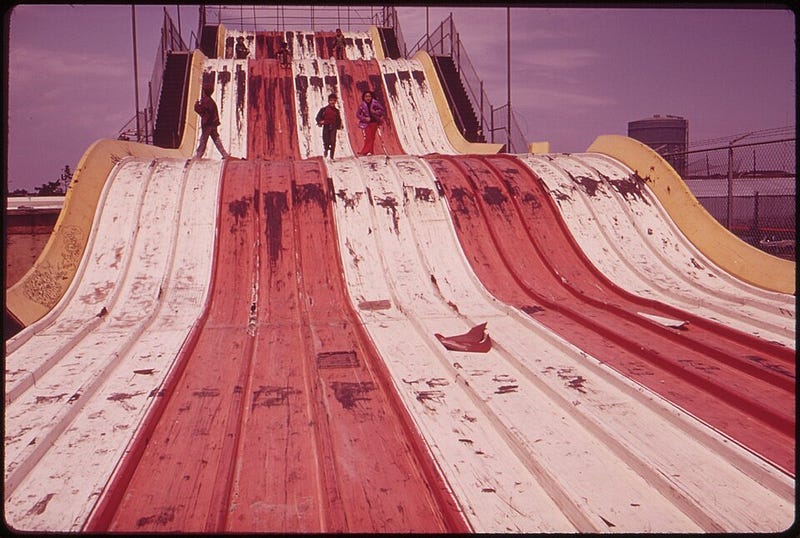
Steeplechase was also remarkably inclusive for its time. While other parks enforced racial restrictions or quietly discouraged Black visitors, Steeplechase was known for being open to everyone. It wasn’t perfect — no place in Jim Crow America was — but it was far more welcoming than its competitors. Immigrants, working‑class families, and Black New Yorkers all found a place there.
By the 1920s, Steeplechase was one of the most famous amusement parks in the world. It survived fires, storms, economic depressions, and changing tastes. It became a symbol of Coney Island itself — a place where New Yorkers could escape the pressures of modern life and rediscover the simple pleasure of play.
II. Decline and Vulnerability
By the 1950s, Coney Island was changing. The rise of television, suburbanization, and new entertainment options drew people away from the boardwalk. The city’s neglect of the neighborhood led to rising crime and deteriorating infrastructure. Steeplechase remained beloved, but it was aging. Its wooden structures required constant maintenance, and its business model — cheap thrills for the masses — struggled in a world increasingly obsessed with modernity.
When George Tilyou’s descendants inherited the park, they kept it running, but they also understood that the land beneath it was becoming more valuable than the park itself. Developers began circling, imagining high‑rise apartments, hotels, and luxury towers where the Pavilion of Fun once stood.
In 1964, the Tilyou family made a decision that would change Coney Island forever: they sold Steeplechase Park. The buyer was Fred Trump, patriarch of the Trump real‑estate empire.
III. Fred Trump Arrives: A Vision of Towers, Not Joy
Fred Trump did not buy Steeplechase Park because he loved Coney Island. He bought it because he saw an opportunity. The land was enormous — nearly 17 acres — and it sat on the waterfront. Trump envisioned a massive luxury development: high‑rise apartments, private clubs, and exclusive amenities that would transform Coney Island into a playground for the wealthy.
To Trump, Steeplechase Park was not a cultural landmark. It was an obstacle.
Within months of acquiring the property, Trump announced that the park would be demolished. He held a public “farewell party” in September 1966, inviting New Yorkers to watch the destruction of the Pavilion of Fun. He handed out bricks as souvenirs. He hired models in bikinis to pose atop the rubble. It was a spectacle — but not the kind George Tilyou would have approved of.
The demolition was not just physical. It was symbolic. Trump wanted to erase Steeplechase from memory, to make it clear that the era of cheap thrills was over and the era of luxury development had begun.
But Trump had miscalculated.
IV. The Battle for Coney Island
Fred Trump’s plan required city approval. He needed zoning changes to build the high‑rise towers he envisioned. He expected the city to cooperate — after all, he was one of the most powerful developers in New York.
But Coney Island residents fought back. Preservationists fought back. City officials fought back. Even Robert Moses, the master builder of New York, opposed Trump’s plan.
The city refused to grant the zoning changes. Trump sued. The city sued back. The battle dragged on for years.
Trump argued that Coney Island needed revitalization and that his towers would bring prosperity. Opponents argued that Trump’s plan would privatize the waterfront, destroy public access, and erase one of the city’s most beloved cultural spaces.
The courts sided with the city.
Trump was furious. He had demolished Steeplechase Park, but he could not build anything in its place.
For years, the land sat vacant — a scar on the boardwalk, a reminder of what had been lost.
V. What Became of Steeplechase Park
After Trump’s defeat, the land remained undeveloped. Trump tried repeatedly to revive his plans, but the city refused. Eventually, the property changed hands, and the site was incorporated into the redevelopment plans for the Coney Island amusement district.
Today, the area where Steeplechase Park once stood is home to:
- The Brooklyn Cyclones’ baseball stadium (MCU Park / Maimonides Park)
- Public parkland
- New amusement attractions
- The revived Coney Island boardwalk culture
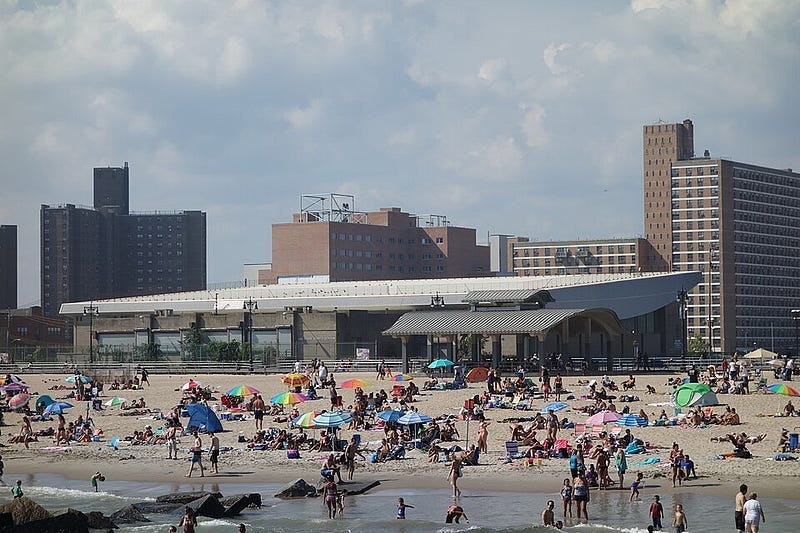
The spirit of Steeplechase — joy, accessibility, democratic fun — has returned in fragments. The stadium hosts community events. The boardwalk is alive again. New rides and attractions echo the old ones, though none quite capture the anarchic charm of the Pavilion of Fun. But Steeplechase Park itself is gone. Its destruction remains one of the most controversial development decisions in New York history.
VI. The Legacy of Steeplechase — and the Legacy of Its Destruction
Steeplechase Park represents two competing visions of New York.
1. The Vision of George Tilyou
A city where joy is accessible. A city where working‑class families can afford fun. A city where public spaces belong to everyone. A city where laughter is a civic good.
2. The Vision of Fred Trump
A city where land is valuable only when it can be monetized. A city where public spaces are expendable. A city where luxury replaces community. A city where profit outweighs culture.
The battle over Steeplechase was not just about an amusement park. It was about what kind of city New York would become.
Trump lost the zoning battle, but his philosophy eventually won in other parts of the city. The rise of luxury towers, the privatization of public spaces, and the erosion of working‑class recreation all reflect the development model he championed. Steeplechase Park’s destruction was a preview of the future.
VII. A Memory Worth Preserving
Today, Steeplechase Park lives on in photographs, postcards, oral histories, and the memories of those who rode its mechanical horses or laughed themselves breathless in the Pavilion of Fun. It lives on in the revived amusement district, in the echoes of children screaming on roller coasters, and in the stubborn resilience of Coney Island itself.
But it also lives on as a cautionary tale — a reminder that cultural landmarks can be erased not by neglect but by ambition. Fred Trump believed he was building the future. Instead, he destroyed a piece of New York’s soul.
Steeplechase Park was not just an amusement park. It was a promise — that joy belongs to everyone, that public spaces matter, and that the city is strongest when it remembers the people who built it. Its story is worth telling because its lesson is worth remembering.