
Luis Manuel Aviles Roa was driving his car to the mechanic on August 22 when the Border Patrol pulled him over. Forty-eight years old, Nicaraguan-born, roughly nineteen years in Florida. In his wallet: a driver’s license, a Social Security card, a work permit, and a pending green card. DHS said he had entered the country illegally at some point they could not specify and would remain in ICE custody pending removal. His son Joshua was nine months into a deployment aboard the USS Abraham Lincoln, in the middle of the war against Iran, when the call came through.
Joshua Aviles spent nine months on a warship in the Arabian Sea so a government that would not give him a port call could turn around and detain his father in Key West. That is the sentence the Pentagon and DHS need to sit with, not the sanitized one they put out through spokesmen. And this story does not need embellishment to indict the people running it.
I want to be precise here, because precision is the whole argument. Aviles Roa was not deported; he was detained, booked into ICE custody, and released three days later after an immigration judge dismissed the case at his first hearing. DHS has never explained the arrest, and it has never explained the release either. Nobody at that agency has said why a case strong enough to justify holding a deployed sailor’s father in custody collapsed the moment it reached a judge. And that gap, not some manufactured conspiracy, is the scandal. I will not tell you they ordered this as retribution for the growing uproar over conditions aboard the Lincoln. Nobody outside that building knows that, and neither do I. But an administration that spent two straight weeks insisting nothing was mistaken on that ship, then wound up holding the father of one of that ship’s sailors in a detention cell, has spent its own credibility. It does not get to demand the benefit of the doubt it never extended to the families who were begging for answers.
And those families had plenty to be begging about.
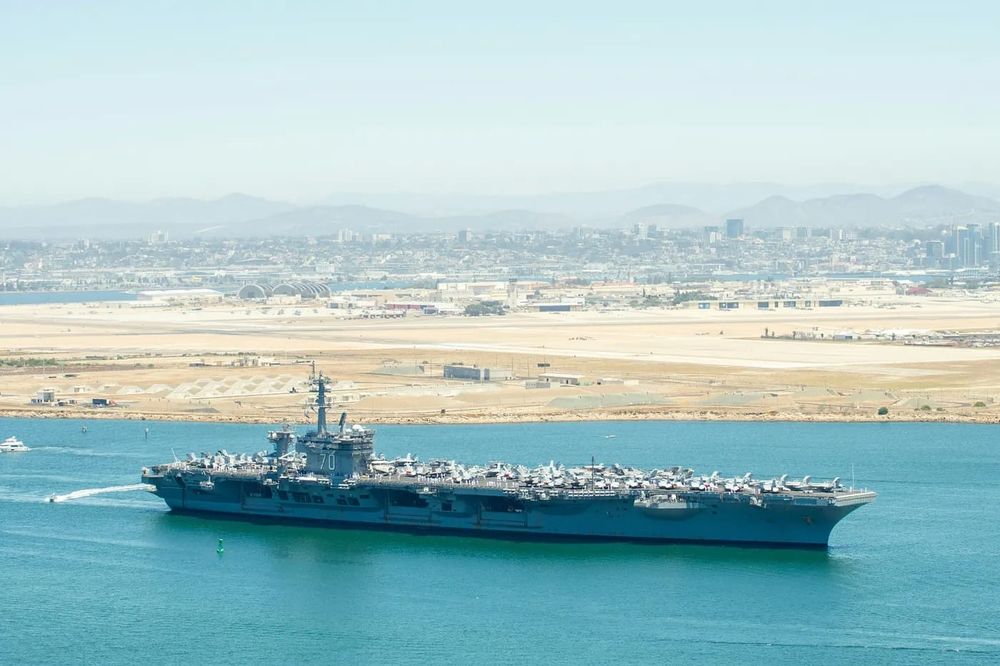
The Lincoln left San Diego on November 21 last year for what was supposed to be a seven-month Pacific deployment. It got rerouted into the Middle East, then swallowed whole by Operation Epic Fury and the broader war against Iran. Nine months turned into over 250 consecutive days at sea, with a single overnight stop at Guam in December and a short, restricted resupply call in Oman. A modern record for an American carrier, and not the kind of record anyone in the Navy should want. Roughly 5,000 sailors and Marines lived through it: mold in the showers, broken toilets, laundry down for weeks at a stretch, mail lost for months, a meal that on bad nights came down to half a cup of rice and two tortillas. Watchstanders stopped at least one sailor from going over the side. About 200 relatives confronted acting Navy Secretary Hung Cao at a San Diego town hall and told him, to his face, that leadership had broken trust with them.
Here is how the chain of command answered that. Central Command called the reporting false; Admiral Brad Cooper toured the ship and called the visit “awe-inspiring”; retired General Jack Keane went on Fox News to call the media reporting “insulting to these troops”; Secretary of War Pete Hegseth said the reports had been “completely misrepresented”; and the President, from behind a desk in Washington, called it a “CNN fake report.” That is the institutional response to sailors telling their government they were breaking: deny it, minimize it, and accuse the messengers of disloyalty.
Then Border Patrol pulled a handyperson off the road in Key West.
Call it isolated if you want. The numbers say otherwise. The Associated Press found over fifty parents and spouses of active-duty troops detained since January 2025, at least six of them deported and one who self-deported. Congressional investigators put the number of attempted removals of veterans and their relatives at 282. ICE has arrested sixteen non-citizen service members this fiscal year alone. Nearly fifty thousand foreign nationals are serving in the active and reserve components right now, and the services still recruit them in part by advertising immigration benefits for their families.
For decades, under presidents of both parties, there was a basic, unspoken agreement that you did not go after the mother or father of a deployed rifleman. Nobody voted to end that agreement. It just ended.
DHS’s actual defense, when pressed on the Aviles case, was that “military service by an immediate relative does not automatically grant parole, lawful status, or immunity from immigration enforcement.” That is technically true, and it is also a dodge. Military parole in place exists precisely for cases like this one: a discretionary benefit USCIS created specifically for parents, spouses, and children of active-duty troops, granted on a case-by-case basis for urgent humanitarian reasons. Nobody is asking for a free pass. The question is whether an agency holding that discretion arrested the father of a man fighting an active war on his country’s behalf. Call it enforcement without judgment. The difference matters more than the press release admits.
Now set that next to what the Navy has reportedly been doing with a hull number.
CNN and NBC News, citing officials familiar with internal discussions, reported that the Navy has been weighing whether to strip the name Doris Miller from the future aircraft carrier CVN-81 and replace it with Donald Trump’s. The Pentagon says it has nothing to announce. Officials have reportedly stopped calling the ship the USS Doris Miller internally and now refer to it only by hull number. Miller’s own family found out from the news. Great-nephew Thomas Bledsoe told CNN it was “quite a shock” that nobody at the Navy had told them.
Doris “Dorie” Miller was a mess attendant on the USS West Virginia, one of the only jobs the segregated Navy of 1941 would let a Black sailor hold. On December 7, when the bombs started falling at Pearl Harbor, he helped carry Captain Mervyn Bennion, mortally wounded on the bridge, through the oily smoke to a sheltered spot on the deck behind the conning tower. Amidst the attack, two officers trained him on a fifty-caliber Browning machine gun, which he then operated and fired until his ammunition was depleted. He became the first Black American awarded the Navy Cross. Two years later, he was dead, killed when a Japanese torpedo sank the USS Liscome Bay out from under him. He was twenty-four years old.
In January 2020, under this same president in his first term, the Navy announced that CVN-81 would carry Miller’s name: the first aircraft carrier ever named for a Black American, the first ever named for an enlisted sailor’s valor instead of an officer’s rank. That announcement happened at Pearl Harbor, on purpose, on a day meant to mean something. Taking his name off that ship to put a living politician’s name on it would not just be an insult to one family’s memory. It would tell every enlisted sailor on every ship in the fleet exactly where they rank against the man in the Oval Office.
This would not even be the first name Hegseth’s Pentagon has scrubbed. In June of last year he ordered the Navy to strip Harvey Milk’s name from a fleet oiler and rename it for a World War II Medal of Honor recipient, insisting at the time that the move was about “taking the politics out of ship naming.” Say that line again with CVN-81 in front of you and see if it still holds up.
None of this happened by accident. Navy Secretary John Phelan was fired in April in the middle of the Hormuz blockade; Vice Admiral Nancy Lacore was dismissed after thirty-five years in uniform, with no explanation ever offered; and at least seven Navy officers selected for promotion by their own boards, disproportionately women and minority officers, were blocked outright. This is not a good look at all.
Reporters from the AP, the Times, and Fox News turned in their Pentagon badges rather than sign restrictions a federal judge later ruled unconstitutional, walking out in a line with boxes in their arms rather than sign away the job. Every one of those decisions teaches the same lesson down the chain of command: loyalty runs up, and consequences run down.
The Lincoln finally got a real port call. Thailand, the first week of September, after nine months without one. And it took senators, reporters, and furious military spouses to force it. Senator Richard Blumenthal had already written to Hegseth and Cao in August, demanding to know who authorized each extension of that deployment and why, and asking the harder question beneath it: whether the Navy can sustain this operational tempo at all while this administration keeps choosing new wars to fight. Send the bipartisan delegation Senator Ruben Gallego asked for. Put it on that flight deck. And while it’s there, get three things on the record that the Pentagon and DHS have so far refused to put anywhere near a press release.
Who ordered the arrest of a deployed sailor’s father, and on what evidence, given that a judge threw the case out within hours of booking? A written policy, the kind that used to be understood rather than written, that the immediate family of a deployed service member does not become a target while the service member is standing watch in a combat zone. Secretary Hegseth signed a document confirming that CVN-81 would be commissioned as the USS Doris Miller, without ambiguity.
Joshua Aviles wrote from the deck of that ship that he was still “fighting for a country that has given me everything” when the call came through about his father. He kept his end of the bargain. It is a long pastime for somebody in Washington to keep theirs.