
My twelve-year-old granddaughter called me to ask if segregation was returning. I don’t know if it’s good or bad, but she thought I would be the one to ask that question. She’d seen five separate videos on YouTube from white people wanting segregation to return. I explained she shouldn’t worry about it. Just because some people feel that way, it isn’t likely to happen. I also talked to her mother about how much time my granddaughter spends on YouTube.
After we hung up, I considered all the forces trying to segregate America in various ways, let alone those wanting to start a race war. The widespread resistance began with Reconstruction and has advanced in fits and starts, sometimes going backward. The battle must continue, or the Redemption movement might have the last word. I realize I just discredited hundreds of individual and group acts of resistance that occurred earlier, including the German Coast Rebellion, the Nat Turner Revolt, the Gabriel Prosser Rebellion, the Denmark Vesey Revolt, and the Stono Rebellion. I submit that the Reconstruction Era was the first national effort to promote equality and integrate Black people into most facets of society. Christian organizations and the Republican Party mainly supported these efforts in what could be described as diversity, equity, and inclusion for lack of better words.
Understanding Reconstruction requires an appreciation of what things were like at the end of the Civil War. Approximately four million enslaved people were purportedly freed across the South at the end of the war. Some were technically freed with the Emancipation Proclamation on January 1, 1863, provided they could reach free territory. Many of the freed people were illiterate due to an intentional effort to keep them from reading and communicating. In particular, slaves were meant not to know of the successful Haitian Revolution and the attempts throughout America to gain freedom. Enslaved people weren’t meant to know of things like Lord Dunsmore’s offer of freedom to enslaved people who joined the British Army or that Spain offered liberty to slaves reaching its borders.
To avoid starvation, the majority of enslaved people stayed in place, continuing to work for their previous owners. Laws called the Black Codes were quickly passed, making vagrancy a crime. Free Black men could not publicly gather in groups of fewer than three. Black people were under a curfew and initially could not vote. Mass incarceration began after the Civil War, and the penalty was often leased to a plantation. Sometimes the same one they were freed from. The Black Codes were an attempt to reenslave the recently freed. A rose by another name is still a rose.
The Civil War effectively ended on April 9, 1865. Texas got the word on June 19, 1865 (Juneteenth). Some people were still legally enslaved in parts of Delaware, Kentucky, and New Jersey until the passage of the Thirteenth Amendment on December 18, 1865. Even then, there was that pesky exception in the 13th Amendment allowing enslavement of prisoners, which is still used today. My point is that freedom was a fluid concept, and free wasn’t always free.
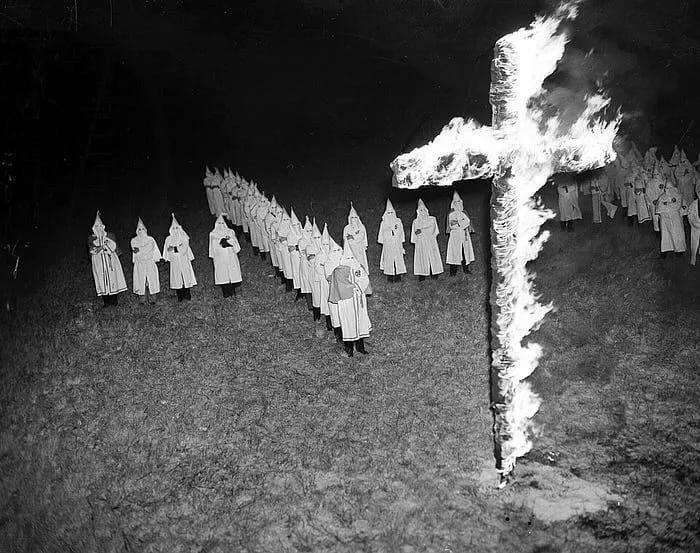
In Texas, when Major General Gordon Granger read General Order #3 on Juneteenth in Galveston, he told the newly freed to return to their plantations where they would now work for wages. He also said not to show up at Army bases because the government would not support them. Across the South, many slaves stayed in place while others wandered around with no place to go. Over a million slaves contracted diseases or suffered severe food shortages. Over 60,000 died from smallpox alone, and several thousand died from starvation. Many went to Washington, DC, where they were herded into concentration camps. In December 1865, a group of disgruntled former Confederate soldiers in Pulaski, Tennessee, formed a social club they called the Ku Klux Klan.
What started as a bunch of ex-soldiers whining about losing not only the war but a way of life soon evolved into something much more. They became what they viewed as the loyal opposition to the Republican Party, which they saw as the face of the enemy. The Republican Party was barely a decade old when the war ended, and they had already successfully elected Abraham Lincoln to the office of President twice. The Party rose from the ashes of the Whig Party, and its leaders were staunch abolitionists. When Lincoln was assassinated soon after his second inauguration, he was replaced by strict segregationist Andrew Johnson, but Republicans controlled Congress and pressed on with their policies.
The Klan quickly spread, especially after making former Confederate General Nathan Bedford Forrest their first Grand Wizard. Membership increased exponentially, as did their reign of terror that included cross burnings, lynchings, and murders.
The Republican Congress got busy passing the three Reconstruction Amendments: the Thirteenth, abolishing slavery; the Fourteenth, granting most of them citizenship; and the Fifteenth, granting them the right to vote. The Klan was opposed to all of that, spurring a wave of violence that didn’t go unnoticed by Congress. In 1870 and 1871, they passed strict Anti-Klan Acts, which almost wiped out Klan activity in the South, ending what would later be referred to as the First Wave of the Ku Klux Klan.
The other major political party at the time was the Democratic Party. While America once had multiple political parties with a chance of winning the presidency, every president since the 13th President, Millard Fillmore, in 1853, has been either a Democrat or a Republican. The Democratic Party was aligned with states’ rights, especially when it came to slavery.
While the Klan was active at night, the Democratic Party in the South, often comprised of the same members, did what they could through civic organizations and law enforcement. Democrats created poll taxes and literacy tests, along with more violent methods, to curtail voting. Many of their members wore a badge in daylight and a hood in the dark. When Congress directed the federal troops to go after the Klan and enforce voting rights for Black people, it was then that the Reconstruction Era gained a stronghold.
Another critical front of the Reconstruction movement was education. White and Black churches, notably the American Missionary Association and the African Methodist Episcopal (AME) Church, were instrumental in creating learning institutions. The Freedmen’s Bureau was established to help the newly freed connect with family members separated by the war (and their former owners). They advocated for freed men and women in court, attempted to negotiate wages while working on plantations, and established schools for those who had been denied the ability to read and write.
The Freedmen’s Bureau was initially intended to exist for a single year. When the states’ resistance became clear, Congress voted to renew its charter, having to override President Johnson’s veto. Johnson’s version of Reconstruction was how to restore white Southerners after the Civil War, giving them reparations and restoring them land lost during the war. After Union General Sherman granted up to 40 acres (no mule) to formerly enslaved people along the Atlantic coast in Field Order 15, President Johnson restored almost all that land to its pre-war white owners, along with granting them the improvements made by the formerly enslaved.
Despite the continued existence of many of the Black Codes, White Leagues, Red Shirts (Klan-like chapters that came out during the day), mass incarceration, and voter suppression. The Reconstruction Era saw many advances for the formerly enslaved. There was a semblance of political power as Black men were elected to multiple state government positions, even winning statewide races in Mississippi and Florida. Black men were elected to Congress, though being seated was sometimes a problem. Black townships formed in the South, and as Americans expanded westward, Black Americans followed, often establishing Black communities in the West.
The only reason Black progress in the South occurred was the continued existence of federal troops. These troops kept the peace when otherwise Black voting would be prevented, Black leaders would be threatened, or killed. There would have been no recourse in the courts for transgressions against Black people, though sometimes the troops themselves were the violators. Soldiers raping Black women was a common occurrence. The presence of federal troops was a thorn in the side of white Southerners who wanted their way of life returned.
Their opportunity came in 1876 during a contested presidential election. Four states, Florida, South Carolina, Oregon, and Louisiana, disputed which electors would be certified. The Democratic Party was one Electoral College vote shy of winning the Presidency, with twenty votes disputed. In a literal smoke-filled room, the Compromise of 1877 was worked out, where all twenty of the disputed votes would go to Republican Rutherford B. Hayes in return for the removal of the federal troops. Democrats sacrificed a presidency they wanted badly for what they desperately needed: the soldiers’ removal.
Even before Rutherford B. Hayes took office, Ulysses S. Grant removed the troops from Florida. When Hayes took office, he removed the rest. Hayes did the South one more favor the following year, signing the Posse Comitatus Act of 1878, ensuring the troops would never return to protect the former slaves. It may be unclear when Reconstruction officially began, between 1863 and 1867. There’s no question Reconstruction ended in 1877 with the removal of federal troops.
REDEMPTION
At the end of the Civil War, much of the South, including major cities like Atlanta and Richmond, was in ruins. Plantations were in ruins, and an occupying force forcibly dismantled the political structure. Even worse, pride had been decimated, and the honor soldiers were told they were fighting for was lost. In order to return to the Union, states had to agree to the Fourteenth Amendment and recognize the emancipation of enslaved people. Shortly afterward, some of those same people were winning elections and enforcing laws.
Henry Louis Gates described the Redemption period as “when the gains of Reconstruction were systematically erased, and the country witnessed the rise of a white supremacist ideology that, we might say, went rogue, an ideology that would long outlast the circumstances of its origin.” Most people have heard of Reconstruction; Redemption often lurked in the background, described by different names to make it more palatable.
Part One of Redemption was erasing the gains. The federal troops’ leaving kick-started that process. The Black representatives to Congress were either forced to resign, serve out their terms, and not run again, or defeated at the ballot box, as Black voters were mostly unable to vote. Then came the systemic enactment of Jim Crow laws and the enforcement of segregation. In the same manner as the Black Codes recreated slavery, Jim Crow did what it could to replicate the Black Codes. Unlike the Black Codes, which were generally limited to Southern states, Jim Crow spread across the land, establishing segregation everywhere, especially in public schools.
Segregation was enforced for public pools, hospitals, jails, drinking fountains, and residential homes for the elderly and handicapped. You may have heard of separate but equal? Segregation fostered no such thing, as facilities and institutions for Black people were always inferior. Without regard for the Fifteenth Amendment, Black people were discouraged from voting, whether by enforcement of special laws or threats of bodily harm.
The courts, including the United States Supreme Court, joined in dismantling rights for Black people. Before 1865, the Supreme Court had struck down Congressional Acts only twice as unconstitutional. Between 1865 and 1872, the Court did so thirteen times, negating most of the Anti-KKK Acts along the way. The Republicans who once fought for diversity, equity, and inclusion of Black people ignored their plight. Sometimes white supremacy is defined by looking the other way when injustice occurs, as long as it doesn’t happen to you.
Part Two of Redemption was about restoring the glory of the Confederacy. It was about discrediting the gains of Reconstruction and making heroes of the Southerners who allegedly fought not to preserve slavery but for heritage and states’ rights. All of the Articles of Secession from each state made clear that leaving the Union was about slavery. Virginia mentions “the oppression of the Southern slaveholding States.” Georgia discusses its “dispute with Northern states over African slavery.” Alabama met the “other slaveholding states of the South,” while seceding. South Carolina describes “an increasing hostility on the part of the non-slaveholding States to the institution of slavery.” Specifically mentioning refusal to comply with the Fugitive Slave Act. Redemption was/is about diminishing the importance of enslavement altogether.
Slavery is often considered America’s original sin, though descendants of Native Americans might disagree. Redemption requires the erasure or rewriting of history so that America can continue to promote American values and American Exceptionalism. The wrongs in history continue to be erased, as are the stories of those who managed to overcome tremendous obstacles.
The granddaughter I mentioned at the beginning of this chapter will be spending much of the summer with my wife and me, and she’ll be getting unexpected history lessons. I think when she asks me questions like the one about segregation, it’s to change the subject from her performance in school and not staying on top of her homework. I don’t expect her to know many of the terms I’ve mentioned, like Red Shirts, and names like Gabriel Prosser and Denmark Vesey. We will read this chapter together,r and when she gets to something she doesn’t know, she’ll be required to research it and explain what it is. She’ll pretend she understands to avoid looking it up, but I’m prepared to question her knowledge when I suspect she’s faking. I encourage all readers to research as needed; explaining each term would turn this chapter into a book, and I haven’t been allocated the word space.
I will simplify this chapter by describing the transition from Reconstruction to Redemption, by sharing what happened in Camilla, Georgia, not far from her great-grandmother’s home in Americus, Georgia, where her maternal grandmother was born.
By July 1868, Georgia had fulfilled the requirements of Congress’s Reconstruction plan and been readmitted to the Union. President Andrew Johnson, an avowed segregationist, considered Georgia’s commitment met and removed the federal troops. That September, white Republicans joined with the Democrats in expelling the newly elected Black senators and Black representatives in the lower house from the General Assembly because they were at least 1/8th Black.
Black Republicans and a few whites in Albany, GA, planned a march and rally in response. The march began in Albany and was to end at a Republican rally at the Camilla courthouse, 25 miles away. Mitchell County whites, however, were determined that no Republican rally would occur. Sheriff Mumford Poore met the marchers on the city’s outskirts, asking them not to enter and to give up their guns. Unable to get the protesters to stop the march or disarm, Sheriff Poore returned to town and arranged a “posse” to greet them.
According to all reports except the sheriff’s, when the marchers neared the courthouse, armed white men began shooting at the protesters from positions on roofs and doorways to shops and other buildings. A dozen marchers were killed, and over thirty were wounded. The marchers were harassed on their way back to Albany. News of the event was sent by telegraph, and newspaper articles appeared nationwide. The Camilla Massacre is credited with suppressing Black votes in the November election. In Albany, white leaders committed fraud at the polls, deliberately misplacing many Black votes or changing them to Democratic ones. White Democrats, the racial minority in southwest Georgia, carried the election in Georgia.
Sheriff Poore ultimately gave an affidavit where he claimed the shooting began when his friend James Johns fired a shot into the ground, as opposed to the witnesses who saw him shoot into the crowd — Freedman’s Bureau sub-assistant commissioner O.H. Howard conducted what passed for an investigation. He took a few affidavits, which were filed. No one was prosecuted, and life in Camilla went on. Military rule was reestablished in Georgia. Troops would remain in several states until their withdrawal became a bargaining chip in resolving the disputed 1876 presidential election through the Compromise of 1877.
Camilla was the massacre nobody openly talked about. Laws were passed in Georgia that would have prevented people from carrying guns to a courthouse or public gathering, but not the posse that attacked the Camilla marchers. Sheriff Poore continued serving, and no arrests were made. There was no public acknowledgment by the city of Camilla or Mitchell County that the massacre even happened until 1998. A marker was placed, and people returned to not talking about it.
Reconstruction lasted between 10 and 12 years. Redemption, the plan to change history and idolize whiteness and the Confederacy, is forever. Each civil rights movement has been accompanied by a wave of new Confederate monuments and statues and efforts to rewrite history into a kinder, gentler experience. Portions of American history can no longer be taught because it might make white teachers and children feel bad. Black heroes are being erased from government websites, and books focused on race are being removed from libraries. Articles contributed to the Smithsonian National Museum of African American History and Culture. An Executive Order has been issued targeting the museum. The whitelash to Black recognition and advancement is real.