
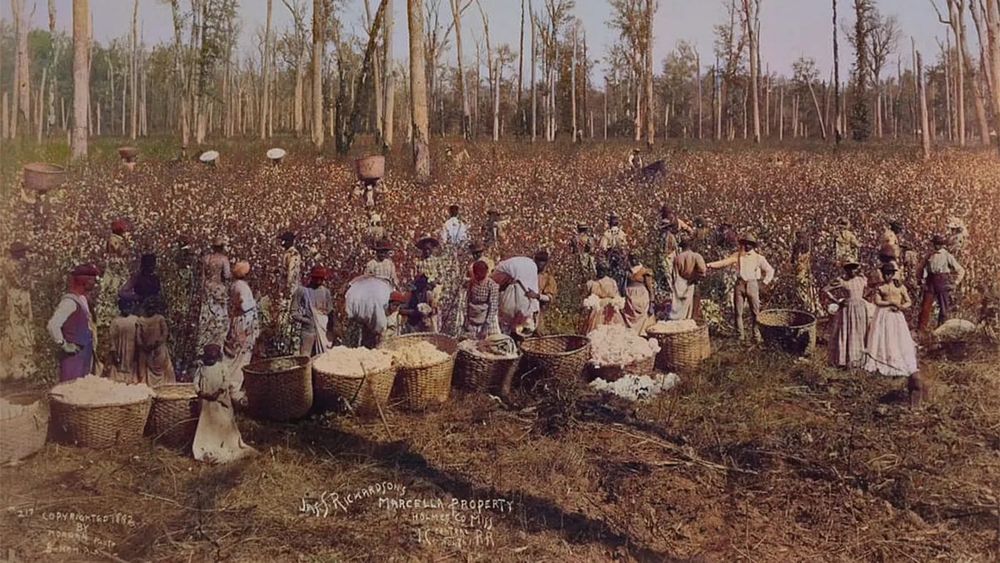
When America was founded in 1776, the vast majority of Black people were enslaved. So, it is only fitting that many of their descendants refuse to celebrate the nation's 250th anniversary. What may feel like a joyous, unifying moment to some can feel cringeworthy to others. Consider that a recent poll found that "most Black Americans say they never fly the American flag." While the red, white, and blue flag evokes patriotism for some, this is a painful "reminder of what we could be and how" the country has "failed to live up to that for Black people, for Indigenous people, and people of color." While the country has long asserted itself as the "land of the free" and "home of the brave," such narratives overlook the injustices marginalized groups have endured and continue to face in this country.
The Fourth of July is a day when most Americans reflect on the nation's founding, but to do so honestly, Black historical perspectives must be included. Take, for instance, a speech given by the abolitionist Fredrick Douglass in 1852, a blistering critique of this celebration. Before a mostly White audience, the formerly enslaved abolitionist asked, "What to the Slave is the Fourth of July?" For those denied freedom, witnessing this celebration felt like rubbing salt in an open wound. While White Americans rejoiced, having won their political and economic independence from Britain, the irony of this arrangement wasn't lost on those in bondage. Indeed, in her autobiography, Harriet A. Jacobs, a Black woman who escaped her enslavers and hid under the floorboards, wrote about the absurdity of proclaiming "liberty to the captive." White colonists bemoaned "taxation without representation" while at the same time depriving Black people of the very liberty they sought.
Fredrick Douglass noted that the Fourth of July is "a day that reveals to him, more than any other day in the year, the gross injustice and cruelty to which he is the constant victim." He called their "boasted liberty" "an unholy license" and their so-called "national greatness" "swelling vanity." Given that Black Americans today continue to endure racial discrimination in courts, hospitals, and schools, when searching for housing and employment, in financial institutions, and within the political process, many feel a deep discomfort as the holiday approaches. There's a social expectation that all Americans should celebrate the anniversary of this country's founding, but what to the descendants of slavery is the Fourth of July? The uncomfortable truth is that America has failed to reckon with the legacy of racism, which seems to flow like a faucet without a shut-off valve. Today, many feel as Douglass once did that this holiday represents a deep-seated hypocrisy.
After asking some Black people why they plan to abstain from America's 250th anniversary, one respondent stated, "It doesn't feel right to celebrate a country built on the blood of Black people," citing the history of slavery as a reason to abstain from the revelry. Another noted that "freedom cannot be celebrated when people have fewer freedoms now than they did years ago." For them, recent attacks on civil rights make this an especially inappropriate time to praise the nation. The Trump administration has rolled back the "disparate impact" standard for addressing racial discrimination against Black people, dismantled diversity, equity, and inclusion in government agencies, and even the Equal Employment Opportunity Commission (EEOC) backpedaled on decades of precedent in promoting an equitable workplace. Some felt the holiday wouldn't make them feel "included or a part of this conflicted land." After all, Black people are still told to "go back to Africa" when they express discontent with the conditions here. This is something I experienced firsthand. After reading their perspectives, I reflected on my own reasons for sitting this one out. For me, celebrating the Fourth of July gives the false impression that this country is something we should all feel proud of. Yet, in a nation where racism persists, this celebration feels off, perhaps just as much as it did during Fredrick Douglass' life.
As a descendant of enslaved people, I can't help but imagine how those in bondage felt in the early days, witnessing White people honor a holiday celebrating their independence. Surely, as Douglass and others suggested, it was a reminder of the vast chasm between themselves and those who robbed them of their freedom. More Black people fought on the British side during the American Revolution because Dunmore's Proclamation promised freedom to those who served. What many White colonists saw as a victory, many Black people experienced as a painful loss. White cheers were set against Black tears. Many Black people feel that while the Fourth of July should be commemorated, it shouldn't be celebrated, a distinction often overlooked. After the British lost, chattel slavery persisted for eighty-nine years. When this context is omitted from the national conversation, people are misled into believing this holiday represents freedom for all, as if it were a blanket covering people from every walk of life. But this whitewashed narrative overlooks the fact that many remained enslaved for nearly ninety years after July 4, 1776.
=Black patriotism has always felt like a double-edged sword. For instance, during the Civil War, Black soldiers were denied fair pay by the Union Army and were disproportionately assigned to the front lines. During World War II, despite the bravery Black soldiers showed fighting the Nazi regime, they came home to face racism from terrorist groups such as the Ku Klux Klan and racist laws that excluded them from the full benefits afforded to White veterans. As the civil rights leader Medgar Evers noted, "some of these same persons who were beaten and terrorized by the Nazis are assisting the die-hards of the Citizens' Councils in bringing about economic pressure on Negroes who pay their poll taxes and register in Humphry County." James G. Thompson, a cafeteria worker, penned a letter to the editor of The Pittsburgh Courier questioning whether he should sacrifice his life to live "half-a-American," noting that Black people needed a double victory, "the first V for victory over our enemies from without, the second V for victory over our enemies within." Today, there is still a need for Black people to confront racism from their fellow countrymen.
The Fourth of July promotes a form of blind patriotism that is offensive to many Black people. While some point to Grace Wisher, an indentured servant in Baltimore who, at the age of thirteen, played a critical role in sewing the Star-Spangled Banner, many leave out key parts of her story. She was signed over to Mary Pickersgill, a White woman, because of her mother's poverty, and during that period, refusing to labor was considered a crime, punishable by jail. Thus, it's ahistorical to claim that Grace helped create this flag with 15 stars and 15 stripes out of pure patriotism. Despite being used as an example of a Black person giving themselves over to this country, her service was involuntary. While Grace played a major role in sewing the flag in 1813, Black people didn't become American citizens until 1868, with the ratification of the 14th Amendment. While her story is often shared under the premise that we should maintain an inclusive portrayal of America, it's also essential for us to acknowledge that Black people were considered subordinate to White people and often forced or coerced into labor. Enslaved Black people built The White House, creating the literal foundation for the official residence of the president. They toiled in the difficult work of creating the U.S. Capitol building and Wall Street, the foundation of America's economic strength. Yet, for much of this country's history, they've been excluded from the benefits of society.
In a similar spirit, others point to Crispus Attucks, a mixed-race Black and Indigenous man who became the first to be killed by British soldiers during the Boston Massacre. Some describe his death as a tragic but important sacrifice by someone who loved their country. Yet few note that Crispus Attucks escaped slavery in 1750, and that his former owner, William Brown, placed an advertisement for his runaways that described him as a 27-year-old, 6-foot-2-inch-tall "Mulatto." To remain free, Crispus Attucks repeatedly changed his name because admitting who he was would mean returning to bondage. Does that sound like freedom to you? Also, Crispus Attucks never enlisted in the military to serve America because, at the time, the country didn't exist and thus had no formal armed forces. Rather, he joined other dockworkers to challenge British soldiers, motivated by economic conditions. Off-duty British soldiers were taking opportunities away from day laborers, causing friction between the groups. While rooted in financial concerns, the narrative often portrays Crispus Attucks as a soldier willing to die for America, even though he wasn't a soldier and the nation was yet to be founded.
While millions see the nation's 250th anniversary as an opportunity to celebrate America's founding, many Black people plan to skip the celebration. They may enjoy some BBQ with family and friends to make the most of the time off that accompanies the federal holiday, but this revelry is not a sign of their undying patriotism, as it may be for other groups. America is a country where Black people were enslaved longer than they've been free, where racial segregation divided the nation for nearly a century, and where civil rights legislation is often seen as an inconvenience rather than an essential step toward equity. Today, Black Americans live in a country where the motivation to confront racial injustice is waning, like an image of someone so far away they appear to disappear into the horizon. It's one thing to express hope for what this nation could be, as we're capable of evolution; it's another matter entirely to celebrate the nation's founding, in spite of slavery, land theft from Indigenous tribes, and modern-day racism that continues to plague the nation's spirit. For many, this is a bridge too far.