

And for my next act, I’m working on becoming more Jamaican.
Mi wan tun rude-bwoy. Or something close.
I’m pained by how American I am. So at this book-writing crossroads, I’m writing about my dead father and his Rasta origins, but I’ve also begun to measure my Yard-ness against all things Jamaica. All things Clarendon. All things May Pen. All things Barbican Beach.
Not that it’s a cleansing process. I love the Black American upbringing that tempered me, taught me how to move in global rhythm and how to feel showy.
Yet to be from Jamaica is a special artistic prize I didn’t know I’d won at birth.
I want to know each waterfall, the national flora, not just in 90-second short form. I want to bootstrap and hike and sweat. I want to pore over books and reclaim road signs.
Last time I went up to Reach Falls, I decided to walk, against anyone’s better judgment. Jungle heat is snug in your pocket and lives in the collar, at the roots of hair, like my long-grown locs has told me on too many July days.
At one point, snaking up the hills, I checked the heart rate reading on my Apple Watch and it was in a red zone. My pulse had hit something like mile-high exertion, though I was nearly at sea level or no more than a few hundred feet above it. I had an ice-cold “WATA” I was initially nursing but it had heated to the temperate of my insides so I gulped the rest of it down before taking a beat at the side of the single-lane road.
Reach Falls is a national park with admissions hours that I’d ignored by starting the 100-minute trek only 30 minutes before closing. Like Jamaicans, I believe that nature should be free.
Me nah pay no fifteen U.S. fi run dung ah riverbed. When mi used to play up deh so since mi a bwoy pickney? You mussi mad!
Nearby Boston Beach started charging a $5 USD entry fee for the upkeep of the grounds. I don’t care how socialist I am at heart, or how much the long-term theory says this works, I’m not about to be paying à la carte for strips of paradise.
That’s a problem of my Americanness: too much pioneering, too much possession of stolen or established land. There’s also the simultaneous problem of my Jamaicanness there: too stubborn, too entitled, too unruly to cede rights to governance. Soul rebel vibes. I have to find a way to work out cognitive resistance in each of my nationalities. Cultural identity only works if I submit to something. I can’t be open and accepting of every Jamaican custom and also stay rude when it’s one I don’t like.
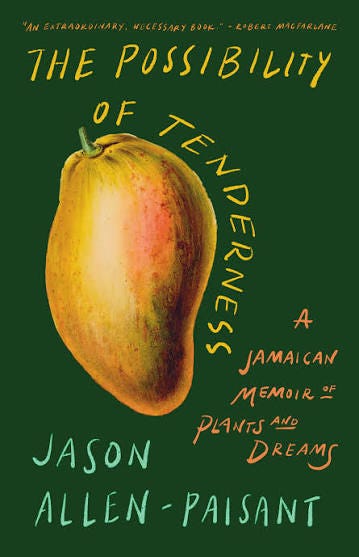
My inner mission has led me to biographies, memoirs, and glossaries. Speeches, dissertations, and pamphlets. I’m tallying points, trip by trip, until my wounds bleed green, black, and yellow. The beautiful part of having a shared mission is how much I get referred to moving titles like Jason Allen-Paisant’s The Possibility of Tenderness. It’s a Jamaican memoir that everyone should read. But it’s especially beautiful for a third-culture child, born in one place, raised in another, searching for meaning in the Old Country.
Allen-Paisant’s writing is a tear into a freshly fried dumpling heaped with a forkful of ackee and saltfish. He luxuriates on the homecoming theme, bringing the narrative essence of Jamaica’s plant species and fuzzy land history to the fore. That narrative wraps around his relationship with his mother, the surviving record-keeper of his family’s oral history and land ownership, and the author’s tenuous ties to a Jamaica that keeps shifting with each year he’s living his life in the UK.
Last night, I dreamt a new Jamaica, one I hadn’t seen before and in the dream I was older. I remember little except I felt the heft of my locs snatching my head backward, pushing my nose skyward. I had been to the beachfront so this idea of boxy condo development kept swimming in my mind. I wanted to cry because I ran into the same messy dilemma, like, will I always miss this place because I don’t live here? Chunks of it change that I can’t pin down because I haven’t inhabited any of it long enough to feel sure of its existence. With time rushing behind me at unreal speed, I must instead establish a Jamaican imaginary. Allen-Paisant’s book helped me to do so with his process so closely mapping the one I’m following to write my story.
He moves into a space of tender receptivity, allowing a combination of his family’s sparse artifacts and mysteries to wash over him. He walks trails, inhales humid air, and, literally, touches grass. By exploring the idea of a “cast garden,” where the cultivator simply tosses seeds at random in their yard, he comes to more fully grasp what Jamaica is. A bearer of eternal fruits and an ultra-rich terrain from which to birth his tale and reconsider his mum and grandma.
Whether his travelogue leads him to sure conclusions like which herb to take for kidney ailments and addiction, or it shows him the rough outline of his granny’s ambition, he presses the limits of his country’s tenderness. He stalks the land like a constable seeking clues until someone permits him membership. Congolin, a local farmer he follows ‘til he knows more about natural generosity toward soil than he does about farming technique, gives him access. The national archive and records offices at first look at him with a cut-eye, as they say, until he persistently defers. He has to let them be rude to him. Then he can enter. Then he can become a Yardie.
It’s the famous social media meme about Jamaican restaurants and their lack of food and the rudeness you get for even asking.
“You’re a restaurant!” you think, “You should be happy I’m here!”
But no, you must be invited to get service and receive these gifts. Jamaica understands its value, between the richness of the bauxite and limestone deposits, and the willingness of the country to be a way station for wanderers, hope is the wealth. There’s unique possibility in the island sunrise but we are still clamped to our worry about drainage.
Yes, another way to look at it is rudeness is the guardian of a tender existence. We’re too rude to quit or bend, which makes us ample when we could be depleted, and headstrong when we should be spent. When the floods wash the homes away, we are too rude to die. I confess I have not been tender the way I ought to be for my family. I haven’t held up the bargain where they fought for me so I could fight for them. I have no children and I need to start taking care of the elders more actively. They need to soften, to witness more of their tenderness before they die. It’s up to me to show them that possibility, to be rude on their behalf.