
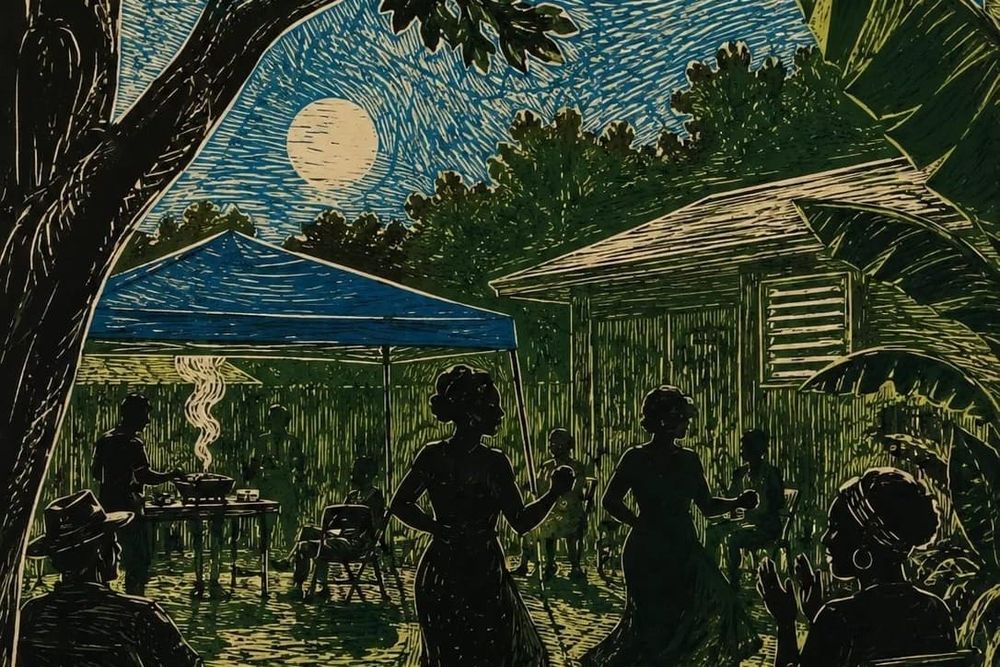
I’m in the armpit of summer so the cookouts smoke a-plenty — three weekends straight of graduations and anniversaries. Love and country and a Knicks championship.
I can celebrate more life by just living. I imagine my kin dearly, dollar-winin’ as our days get long and then short again. I see Brooklyn sunrises ruing the feeling that our overall day count also shortened a little.
A while ago, I was in Rahway, New Jersey with my girlfriend’s family. They’re a proud Dominican bunch with jet-fueled Spanish and thick-curled grandmothers. A mean margarita pitcher. Playful jabs with warmth wrapped around.
“I haven’t seen you in forever, mi amor. You got thick! Don’t tell me you hiding a baby under there!”
Then to me: “You know I’m the one who taught her to dress. Don’t let them tell you any different.”
A younger cousin was graduating high school. She calls them all ‘the baby.’ The baby just started sophomore year of college. That baby is driving down from D.C. to finish her med school program. The baby got married and they’re talking about having a baby!
I keep saying these ain’t babies you’re talking about and she resists.
“Everyone under 30 with no kids is a baby,” she says to me.
“But then I can’t tell who it is you’re talking about when we meet your family. One baby is in the military about to do his first tour and one is in fourth grade and starting his own YouTube. Those is different kinda babies, baby,” I say.
But she’s right. The passage of time is cruel and unjust, and I don’t want to imagine any of these younger people enduring the hardships that we start to call life as a means of getting used to it.
The World Cup is on. Uncle is the DJ, and he loves it, but I suspect it keeps him out of the spotlight too, providing the seasonal groove.
“He keeps playing Bel Biv Devoe and this party is more Hector Lavoe, dique!” someone yells. Then he switches it up and he’s dancing by himself a little while the others give him the best possible approval: wordless dancing in the grass out back. Some have taken off shoes and closed eyes to get further into their two-step bag.
I’m one in a quartet of grown men, half of us not really useful in this setting. The women have made the food, set up the tents, chilled the ice, slid the chairs outside, everything. One dad is on the grill, quietly attending to his half of the family, the non-Spanish speaking Black side. DJ has his place, as described. I’m in a frightening purgatory of half-overhearing and roughly translating Dominican Spanish chatter, and bobbing to salseros I don’t know well enough to name. The memories of their tunes not yet ingrained in my hips or feet.
“Do you think your uncle’s family is off in the cut because they don’t speak Spanish?”
I front-load my question.
“They’re just like that,” she says.
“How many of the kids speak it? They’re all second generation at this point. They have each other, I guess.”
“I know the eldest daughter might understand a little, but you’re right they don’t speak it. Trust me though, his family is, like, stone-faced. It gives ‘not my culture’ vibes.”
“Well, it’s not.”
“Fair point but you don’t gotta be sitting around like that,” she offers. I know the discussion is over because we don’t see eye to eye.
I imagine her, who has not yet met my Jamaican family, especially with tongues syruped in patois, folding her body inward, obscuring her light so she doesn’t cross sun rays.
Or, maybe that’s how I’m feeling. Either way, I shut up, which is the best way to enjoy this party.
Soon, the swells of each song support an all-cousin dance break or an all-auntie laugh-scream. The waists are rocking, and the flesh is searing in the midday sun. But no one feels anything, not even the sweat trickling down our spines and into our shorts. Much less the crunch of the dry grass or the barks of dogs.
The story stops there because dancing and smiles and laughter wash out the discomfort of a two-hour commute to the sticks. The fatigue of the NJTransit ride with drunken fans fades. We get back to my place too full, perfumed with charcoal and lover’s fondness.
The following week was more of a heatwave, but with the advantage of our good fortune, my mother’s house to cool us off. I have relatives from Jamaica who go back and forth from the country there to Long Island, New York — the country here, in a sense. The humidity stifles in New York without the sea breeze to relieve the sun’s quick lashes.
Plus, mom’s fridge broke down during an outage the previous day. We took a ride out to pick up forty-pound ice bags. At one point, after assigning pounds to each cooler, shuffling sodas into place, freezing personal spray bottles for the DJ, I laid on a lawn chair with the last of the ice pack on my chest. My locs have grown too long to have even a minute of respite in New York’s highest temps. I begin to shrivel at the first sign of 80-degree weather. I must be put on ice or in a pool or I’ll perish.
But as the dehydration headache set in, and I found my way to the basement den where I could hoard my own ice and plate, I got teary eyed.
I heard the identical laugh-scream rolling in from outside that I’d submitted to at the Dominican party. The air had cooled enough so three generations of women in my tribe were dancing to reggae hits from the 90s. Getting lower and lower and defying space. The religious pair were seated in plastic chairs in long skirts but clapped along. Granny has her shortest haircut but her dress flowed long and wrapped her in wind enough to glue a placid smile on her. She’d been up since 5 a.m. cooking for this moment. (Lord be damned if anyone helps her, she’s getting these pounds of fish fried and pickle-peppered.) I tried grabbing my phone and my other camera but stopped on the staircase instead. The moment was better.
I paused and watched my mother, replenished from seeing her younger sister dance, her cousins mouthing holy curse words, and her mother giggling they’d pulled it off. I froze myself in time to stop guilting over whether I’d done enough or sufficiently taken over this tradition.
They don’t want me taking over yet. They are living their lives just as fully as they had hoped or something close to it. They’re able to understand suffering, under a thick layer of warming Earth or under oppressive regimes, is relative.
We have house and home; we have music and dance. We had those uncles who are now gone for long enough to know they would’ve tapped a foot to this tune.
We had language for each other, for school days past, for dropped plates and melted ice baths from the cooler as the rhythm closed. We had sunglasses and sun dresses, cargo shorts and linen shirts, towels draped over the shoulder.
We had each other. We were a poem, soaking in the last of our flesh, spreading our molecules among millions. We were recipes charred. We were light.
How could anyone write about this, I thought.