
On April 29, 2026, the Supreme Court (SCOTUS) twisted the knife and finally killed the Voting Rights Act of 1965, after wounding it seriously in multiple previous attempts on its life. In his opinion for the conservative majority, Justice Samuel Alito wrote that “ plaintiffs must now show a 'strong inference' of intentional racial discrimination, not just discriminatory effect.” He added, “Courts must avoid interpretations of Section 2 that force states to engage in the very race‑based discrimination the Constitution forbids.” The Court indicates that proof of racist impact is meaningless; the only concern is whether the racial discrimination is intentional, creating a bar that can never be met. Alito says race can, in some circumstances, still be considered, as long as you don’t use race when considering a case.
Alito suggested, “the VRA is not dead,” but the new “strong inference” standard is seen as functionally impossible to meet in modern redistricting cases. SCOTUS paralyzed the VRA in the 2013 Shelby County v. Holder ruling, ending preclearance for states and communities with long histories of discrimination. The day after Shelby was announced, several states immediately enacted new laws restricting voting. In 2018, Husted v. A. Philip Randolph Institute weakened the National Voter Registration Act of 1993, making voter registration easier and uniform across states. Also in 2018, Abbott v. Perez said Courts must presume legislatures are acting in good faith, no matter what your lying eyes and ears tell you. It is impossible to look at the actions of Texas, California, Wisconsin, Virginia, Mississippi, Florida, and Louisiana and find any good faith.
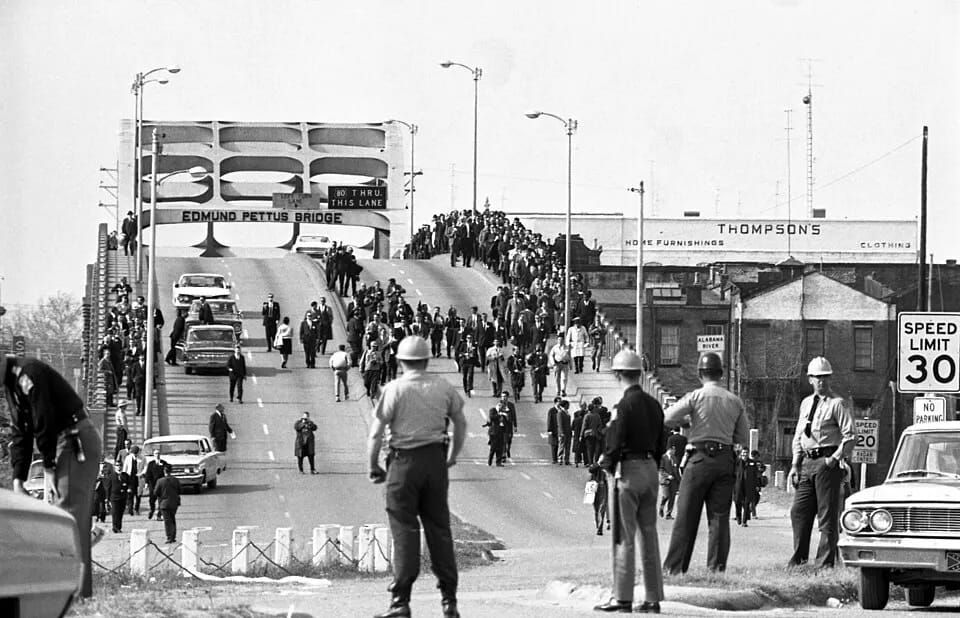
The Voting Rights Act of 1965 will be replaced, though I worry about what must happen first for that to happen. The Voting Rights Act of 1965 had been in the works for 8 years and was only passed after Bloody Sunday. On Sunday, March 7, 1965, about 600 Black citizens of Selma, Alabama, began a peaceful march to Montgomery to demand what the 15th Amendment had promised, but Alabama had denied for nearly a century: the right to vote.
The march was organized because Sheriff Jim Clark’s deputies had beaten and arrested Black residents trying to register. Only 2% of eligible Black adults in Dallas County were registered to vote. An Alabama state trooper had killed Jimmie Lee Jackson during a voting‑rights protest two weeks earlier.
Led by John Lewis and Hosea Williams, the marchers crossed Selma’s downtown and approached the Edmund Pettus Bridge, named for a Confederate general and Ku Klux Klan leader. At the crest of the bridge, they saw a line of Alabama state troopers, Dallas County sheriff’s posse, and mounted officers.
Major John Cloud ordered the marchers to disperse. Before they could respond, troopers advanced. What followed was a state‑sanctioned assault on unarmed citizens. Troopers charged with clubs, mounted officers rode into the crowd, and tear gas filled the air. Dozens were injured, including John Lewis, who suffered a fractured skull. All that wouldn’t have mattered, except that the violence was broadcast on national television that night. Americans saw Black citizens beaten for attempting to walk to their state capital to demand the right to vote. That’s what it took to pass the Voting Rights Act of 1965.
American history is one of restricting the vote and then partially granting it. The Constitution of the United States left it to the states to determine who could vote. In 1776, voting was limited almost entirely to white, property‑owning men over 21. Each branch of government has played a role in expanding and restricting votes ever since. Sometimes it was inaction that carried the day.
Between 1865 and 1869, the 13th, 14th, and 15th Amendments were passed. The so-called Reconstruction Amendments slowly led to temporary voting rights for Black men; women wouldn’t be addressed until later. The 13th Amendment freed the enslaved, but didn’t give them the right to vote. The 14th Amendment made Black people citizens and provided for a penalty to states if they weren’t allowed to vote, which was never enforced. It took the 15th Amendment to guarantee the right of Black men to vote, which was only enforced in the South by federal troops responding to Klan violence. Black men first appeared on ballots in 1870, only then, when protected by the army.
Additional protections were provided by the Enforcement Acts of 1870–71 (The Anti-Klan Acts) and the Civil Rights Acts of 1875. Jim Crow began in 1877 after a secret deal between Republicans and Democrats in 1877 to remove the troops after a disputed presidential election (the Compromise of 1877). No significant federal voting protections happened between 1875 and 1965, though in places in the South, like Dallas County, Alabama, only 2% of eligible Black voters were registered. America has a long history of restricting the vote involving both current major political parties.
The John Lewis Voting Rights Advancement Act (often shortened to the John Lewis Act) was a major voting‑rights bill proposed repeatedly in the 2020s to restore and strengthen the parts of the Voting Rights Act of 1965 that the Supreme Court weakened in Shelby County v. Holder (2013) and Brnovich v. DNC (2021).
The John Lewis Voting Rights Advancement Act
Purpose
To restore the full power of the Voting Rights Act of 1965, especially:
- Section 5 preclearance (gutted by Shelby)
- Section 2 protections against discriminatory voting laws (narrowed by Brnovich)
It was named after Rep. John Lewis, who nearly died on the Edmund Pettus Bridge fighting for voting rights.
Why It Was Needed
After Shelby County v. Holder (2013), states with long histories of discrimination no longer needed federal approval to change voting laws. Many immediately enacted:
- strict voter ID laws
- polling‑place closures
- voter‑roll purges
- reduced early voting
- racially skewed redistricting plans
The John Lewis Act was designed to rebuild the dismantled enforcement machinery.
What the Bill Would Have Done
1. Restore Preclearance (the heart of the VRA)
It created a new, modern coverage formula requiring federal approval for voting changes in states with recent histories of discrimination — not just 1960s data.
2. Expand Federal Oversight
It required preclearance for specific practices known to be discriminatory, such as:
- polling‑place closures in minority areas
- strict voter ID laws
- aggressive voter purges
- changes to multilingual voting access
3. Strengthen Section 2
It reversed the Supreme Court’s Brnovich decision by:
- restoring the ability to challenge discriminatory effects
- lowering the burden of proof
- preventing states from hiding racial discrimination behind “partisan” explanations
4. Increase Transparency
States would have to publicly disclose proposed voting changes, allowing communities to respond before harm occurred.
When It Was Proposed
Versions of the bill were introduced in:
- 2019
- 2021
- 2022
- 2023–2024
It passed the House of Representatives multiple times but never passed the Senate, largely due to the filibuster.
Why It Didn’t Become Law
The bill required 60 votes in the Senate. Supporters argued that protecting voting rights was essential; opponents argued that it gave the federal government too much control over state elections. Because the Senate did not change filibuster rules, the bill stalled.
Summer 2020: The George Floyd protests create the largest civil‑rights mobilization in U.S. history
George Floyd was murdered on May 25, 2020. His death was just one more Black man killed by police, but when a video was recorded and posted to Facebook, the country and the world were outraged. More widespread than the events of Bloody Sunday, the almost 9 minutes of Derek Chauvin’s knee on Floyd’s throat was a metaphor for America’s treatment of Black people. There were:
- nationwide and worldwide protests
- demands for racial justice
- calls for federal action on policing and voting rights
The protests weren’t only about policing — they triggered a broader reckoning with structural racism, including voter suppression.
Members of Congress explicitly framed voting rights as part of the same struggle.
June–July 2020: House Democrats introduce the John Lewis Act as part of a “racial justice legislative package.”
In late June 2020 — just weeks after the protests began — House leadership announced that restoring the Voting Rights Act would be part of the federal response to the national uprising.
Key moments:
- June 2020: The House Judiciary Committee held hearings on modern voter suppression, explicitly referencing the George Floyd protests as evidence of systemic racism.
- July 2020: John Lewis died (July 17).
- July 27, 2020: The House renamed the bill the John Lewis Voting Rights Advancement Act and passed it shortly after.
Members of Congress said openly that:
- The protests had “changed the political climate,”
- The country was demanding structural reforms,
- and voting rights were inseparable from racial justice.
The bill’s momentum in 2020 was directly tied to the George Floyd protests.
The political logic: “If the country is demanding racial justice, Congress must restore the VRA.”
The argument made by civil‑rights groups and many lawmakers was:
- Police violence and voter suppression are both tools of racial control.
- Voter-ID laws, purges, and closures were targeting the same communities protesting police brutality.
- Restoring the VRA was part of addressing systemic racism.
This framing helped push the bill through the House.
Why the linkage mattered — and why the bill still failed
The protests created enough political pressure for:
- House passage
- National attention
- Renaming the bill after John Lewis
But the Senate filibuster remained the barrier. Even with the moral force of the protests and Lewis’s death, the bill never reached 60 votes, never overcame the filibuster, and never became law. What Black people got instead was the Juneteenth federal holiday, which I would argue was a poor substitute.
 William Spivey
So here we are in 2026. Not only was there no John Lewis Act, but the Supreme Court has also finished the job they started in 2013 and killed the Voting Rights Act of 1965. The Act will be replaced, because circumstances will require it. Several states had acted in anticipation of the SCOTUS decision, and others are already reacting.
I. Actions States Took Before the Callais Decision (Anticipation Phase)
1. Passing an aggressive redistricting map, expecting reduced federal scrutiny
States such as:
- Alabama
- Georgia
- Texas
- South Carolina
- Florida
Passed maps that:
- Reduced or eliminated minority opportunity districts
- converted majority‑minority districts into “coalition” or “influence” districts
- used partisan explanations to mask racial effects
These states were betting the Court would raise the bar for proving racial discrimination, which Callais ultimately did.
2. Filing briefs urging the Court to limit Section 2
Multiple states (mostly Republican‑led) filed amicus briefs arguing:
- Section 2 should not require the creation of majority‑minority districts
- Race-conscious map‑drawing is unconstitutional
- plaintiffs should have to prove intentional discrimination
These arguments appear almost verbatim in Alito’s majority opinion.
3. Halting or slowing compliance with lower‑court Section 2 rulings
Some states delayed implementing court‑ordered maps, expecting the Supreme Court to bail them out.
Examples:
- Alabama resisted drawing a second Black district even after losing in Allen v. Milligan.
- Louisiana delayed compliance with its own Section 2 ruling, which is the case that became Callais.
4. Passing new voting restrictions while litigation was pending
States anticipating a weaker Section 2 passed laws affecting:
- early voting
- absentee voting
- drop boxes
- voter‑ID requirements
- voter‑roll purges
These laws were designed to be harder to challenge once the Court raised the burden of proof.
II. Actions States Took After the Callais Decision (Reaction Phase)
Once Callais was decided, states moved quickly to take advantage of the new legal landscape.
1. Redrawing maps to eliminate or weaken minority districts
Several states began or announced plans to:
- dismantle existing majority‑minority districts
- convert them into “race‑neutral” districts
- reduce Black or Latino voting strength while claiming partisan motives
Because Callais requires a “strong inference” of intentional discrimination, these maps are now far harder to challenge.
2. Withdrawing or challenging existing Section 2 settlements
Some states have already:
- moved to reopen old cases
- asked courts to dissolve consent decrees
- argued that Callais changes the legal standard retroactively
This mirrors what happened after Shelby County in 2013.
3. Passing new election laws with reduced fear of litigation
States have begun advancing bills that:
- close or consolidate polling places
- tighten voter‑ID rules
- Restrict mail voting
- Expand voter‑roll purges
- Limit language‑access requirements
These are the types of laws Section 2 litigation previously targeted.
4. Arguing that race‑conscious remedies are unconstitutional
States now cite Callais to argue:
- Courts cannot order the creation of majority‑minority districts
- Race cannot be used even to remedy proven discrimination.
- Any race‑aware remedy violates the Equal Protection Clause
This is the most consequential shift: remedies themselves are now under attack.
The madness that is ensuing, partially in the hopes Republicans can avoid a wipeout in the 2026 midterm elections, will not stand. There is no hope that SCOTUS will rectify what they’ve done. The chaos created is the Executive Branch's wet dream. Only Congress can hope to restore order, and I have a few ideas as to what a new Voting Rights Act should look like:
Elements of a New Voting Rights Act
Preclearance
This was an element of the Voting Rights Act of 1965 and the rationale for SCOTUS striking down Section 5, which contained the preclearance requirement. The Court thought it unfair to single out single states and communities for preclearance based on their proven history. I agree with them in that it isn’t right to label Alabama and Georgia as racist, suggesting that Texas and Florida are not. The entire nation should undergo preclearance, as almost every state has enacted restrictive laws since Shelby v. Holder, and there’s nothing to suggest the others won't. Maks every state, county, or city wishing to enact major changes to voting laws or redistricting outside the Constitutional guidelines undergo preclearance.
Expand Federal Oversight
- Require polling‑place access in populated areas and on college campuses
- Review voter ID laws, including those that impose illegal poll taxes or don’t accept certain state-issued photo IDs like college student IDs.
- Pre-clear aggressive voter purges
- Review any changes to multilingual voting access
Reverse Louisiana v. Callais
- Restore the ability to challenge discriminatory effects
- Lower the burden of proof
- Prevent states from hiding racial discrimination behind “partisan” explanations.
Increase Transparency
Require any changes in voting laws and redistricting to be voted on by the affected citizens, not pushed through in emergency sessions of state legislatures like the new map Florida just passed.
Many of my suggestions are similar to the John Lewis Act, which the Senate has failed to pass for a decade now. I do not doubt that none of these things will occur without people taking to the streets once more. The current president will likely order federal troops to confront American citizens. I can only hope we don’t settle for less, like when Juneteenth was a substitute for justice.