
During World War II, roughly half a million Black women contributed to the U.S. war effort in ways that were both indispensable and largely unrecognized. Without them, the outcome of the war, or at least the speed and strength of the American war machine, would have looked very different.
Some served in uniform.
About 6,500 Black women joined the Women’s Army Corps, often assigned to segregated units, despite being fully capable of more.
The most famous of these was the 6888th Central Postal Directory Battalion, the only all-Black, all-female unit deployed overseas. They were sent to Europe to deal with a massive backlog of undelivered mail, millions of letters and packages that had been sitting untouched, cutting off soldiers from their families.
Working around the clock in harsh conditions, they cleared a six-month backlog in roughly half the time. They knew that no mail meant low morale so they went into action. They understood that keeping soldiers connected to home was a necessity to the success of the war. Imagine being an 18 year solider fighting half way across the world and the only way to connect with a spouse, kids or parent was by mail. Black women made that happen.
But the much larger story occurred off the battlefield.
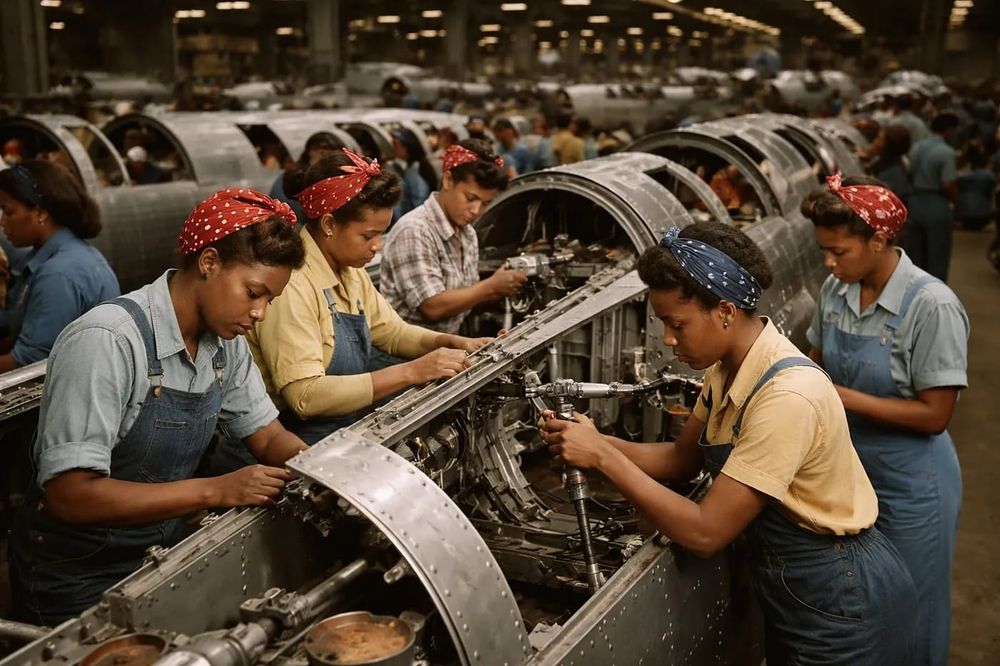
Nearly 500,000 Black women entered the industrial workforce for the first time at scale. They worked in factories, shipyards, and aircraft plants across the country, building the physical backbone of the war effort.
They welded ships, assembled aircraft, packed ammunition, inspected machinery, and kept production lines moving at lightning speed. Many of these women had been shut out of industrial jobs before the war. Now, with millions of men deployed overseas, they stepped into roles the country suddenly couldn’t function without.
And they did it under conditions that were anything but equal.
They were paid less than white women doing the same work. They were assigned the most dangerous or least desirable jobs. Many factories were segregated, with separate facilities, separate lines, and limited opportunities for advancement.
Some employers resisted hiring Black women altogether until the federal government told them they needed these women for the war. Even still, Black women had to fight for access to training, promotions, and basic dignity on the job.
Despite all of that, they showed up. And delivered.
They also served in a wide range of support roles that kept the war machine running smoothly and efficiently. As nurses caring for wounded soldiers. As clerks managing military records. Drivers transporting supplies. Communications operators relaying critical information. And as logistics workers ensuring that materials, equipment, and personnel moved where they needed to go.
At home, they stabilized families and communities under strain. With husbands, brothers, and sons overseas, Black women often became the primary economic and emotional anchors of their households. They raised children, supported extended family, and held communities together during a period of enormous uncertainty.
The United States fought World War II as an industrial war. Victory depended on production of planes, ships, weapons, fuel, and supplies moving continuously and at large scale.
Black women were a critical part of that production system.
And yet, their story is almost never told.
To be clear, their story isn’t about what people like to call wokeness or inclusion for its own sake. It’s about accuracy of a critical piece of American and indeed world history.
Without these women, production would’ve slowed, supply chains weakened, troop support faltered, and morale would’ve suffered.
Black women have always been essential to the success of America.
World War II was no exception.
The country couldn’t ignore their necessity to America’s success defeating Hitler, even if history later tried to.
Thank God for the American Black Women.