
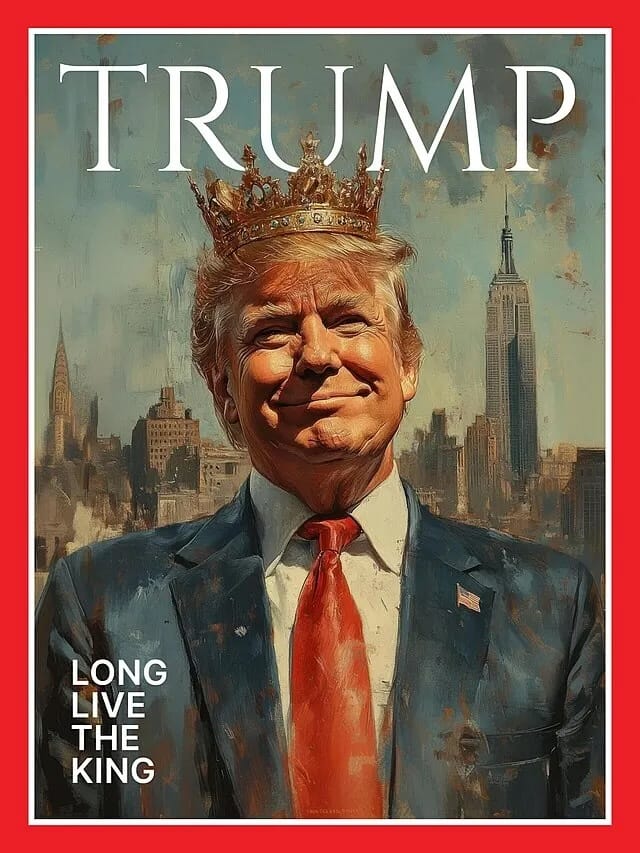
The United States was founded in explicit rejection of monarchy. The Revolution was fought against King George III’s perceived tyranny, and the Constitution was designed to prevent the concentration of power in any single branch of government. Yet, over two centuries later, the unitary executive theory (UET) has emerged as one of the most controversial doctrines in constitutional law. It asserts that the President possesses exclusive authority over the executive branch, including the power to remove and direct subordinate officials without interference from Congress or the courts. Donald Trump must not have been paying attention to the “No Kings” rallies, where an estimated 7 million people turned out in October to protest his actions.
I will explore the origins, development, and implications of the unitary executive theory. It argues that while the theory has historical roots, its modern expansion risks undermining checks and balances, thereby moving America closer to the very system of concentrated executive power — akin to kingship — that the Founders sought to avoid.
Origins of the Unitary Executive Theory
During the 1787 Constitutional Convention, debates centered on whether the executive should be plural (a committee) or singular. The Virginia Plan emphasized a single executive for efficiency and accountability. Alexander Hamilton argued for “energy in the executive,” stressing decisiveness and unity. He believed that a single executive would ensure accountability, whereas a plural body would diffuse responsibility.
The First Congress debated whether the President had the authority to remove executive officers. The “Decision of 1789” suggested that the President did, though the issue remained contested. In 1926, in Myers v. United States, the Supreme Court held that the President has exclusive authority to remove executive officers, thereby reinforcing the unitary executive view.
Humphrey’s Executor v. United States (1935): Limited Myers by ruling that Congress could create independent agencies insulated from presidential removal. This is the case recently discussed by the Supreme Court in oral arguments. The six conservative justices appear poised to throw out Humphrey’s Executor and grant Trump more executive power, giving him the right to fire people from independent agencies and theoretically remove any federal employee not exhibiting total fealty.
Morrison v. Olson (1988): Upheld the independent counsel statute, rejecting a broad unitary executive claim. Decisions like Seila Law v. CFPB (2020) revived unitary executive arguments, striking down structures that insulated agency heads from presidential removal.
Both the Reagan and George W. Bush administrations advocated a strong unitary executive, particularly with respect to control over regulatory agencies and national security. The Bush administration used UET to justify expansive presidential authority in surveillance, detention, and military action in the post 9/11 era. Donald Trump has asserted sweeping executive control, challenging congressional oversight and resisting subpoenas. The disregard for subpoenas is critical, especially since Congress and the Supreme Court have been generally unwilling to rein in his tyrannical instincts.
How the Theory Resembles Monarchy
By claiming sole authority over the executive branch, the President becomes less constrained by Congress or independent agencies. If courts defer to executive authority and Congress cannot limit removal power, oversight collapses. Presidents have used UET to justify unilateral war powers, echoing royal prerogatives.
A President who controls all executive functions resembles a monarch, wielding unchecked power over administration, law enforcement, and even quasi‑judicial functions. Even the existing checks and balances are relatively meaningless. Administration members appear before Congress and refuse to answer questions they don’t like and are disrespectful to members. The federal courts are often ignored and, when challenged, overridden by the Supreme Court to grant Trump additional powers. For his part, Trump is increasingly demanding that private businesses and individuals do his bidding, lest he turn the MAGA hordes upon them.
Criticisms of the Unitary Executive
Scholars argue Hamilton’s call for “energy” did not mean absolute control. The Constitution does not explicitly grant the power of removal or exclusive control over subordinates. Concentrating power undermines republican principles and risks authoritarianism. Independent agencies provide expertise and stability; presidential micromanagement could politicize them. Ask yourself if any of the independent agencies have escaped pressure from Trump? Certainly not the Federal Reserve Board, the FCC, and the Federal Trade Commission.
Supporters’ Arguments
- A single executive ensures swift decision‑making.
- Voters can hold one person responsible.
- Article II vests “the executive power” in the President, suggesting unity.
- Early presidents exercised the power of removal, thereby setting a precedent.
America’s Drift Toward Kingship
The Founders designed a system of separation of powers to prevent tyranny. Yet, the unitary executive theory erodes this balance by:
- Expanding presidential control over agencies.
- Allowing unilateral action in foreign policy and war.
- Undermining congressional oversight.
- Weakening judicial independence when courts defer excessively.
This drift mirrors monarchical systems in which the king controlled administration, the military, and justice. While the U.S. President is still elected and limited by term, the concentration of power risks creating an “elected monarch.”
Case Studies
- Watergate (1970s): Nixon’s assertion of executive privilege highlighted the dangers of unchecked power.
- Iran‑Contra (1980s): Reagan officials bypassed Congress, citing executive authority.
- Post‑9/11 Surveillance: The Bush administration claimed inherent executive power to conduct warrantless surveillance.
- Trump’s Resistance to Oversight: Refusal to comply with congressional subpoenas reflected unitary executive claims.
The unitary executive theory began as a constitutional debate over efficiency and accountability. Over time, it has evolved into a doctrine that risks undermining the very principles of republican government. By concentrating power in the presidency, it moves the United States closer to a monarchy—an elected king wielding unchecked authority.
The challenge for the future is to balance the need for executive energy with the preservation of checks and balances. Without vigilance, the unitary executive could transform the presidency from a republican office into a quasi‑monarchical institution, betraying the Revolution’s legacy.
I watched a video last night of an American citizen being chased by ICE into her home, screaming, “I’m an American citizen.” Being an American citizen means less and less these days, but you’ll be able to watch televised events from Trump’s new ballroom. Instead of “Let them eat cake,” the new phrase will be “Watch us dance!”
This post originally appeared on Medium and is edited and republished with author's permission. Read more of William Spivey's work on Medium. And if you dig his words, buy the man a coffee.