
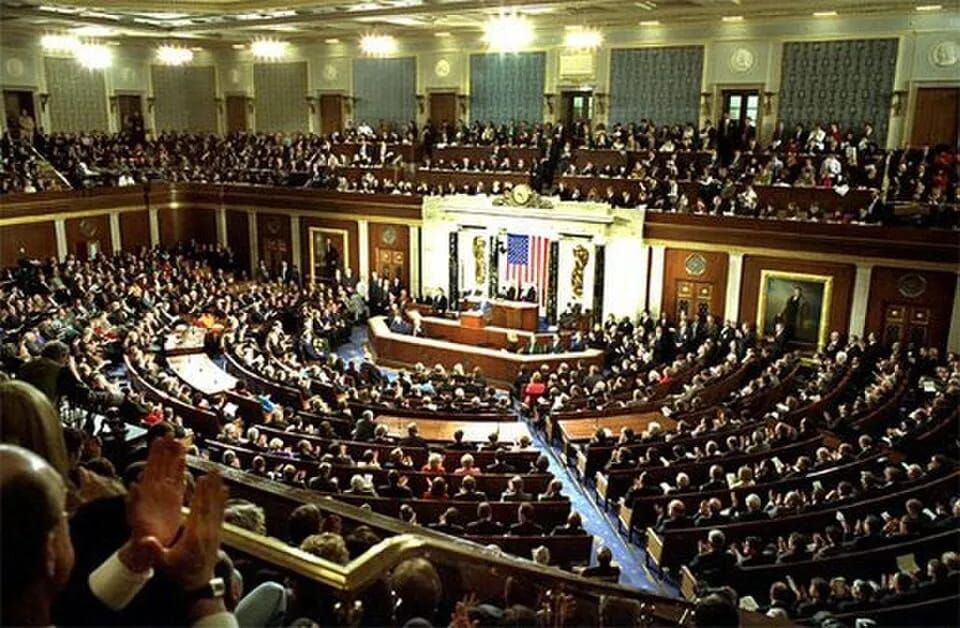
The 119th Congress, which began on January 3, 2025, was the most diverse in American history. It continued a decades-long trend toward greater representation of racial and ethnic minorities in the House and Senate. That doesn’t mean Congress reflected the nation’s population. White Americans remained substantially overrepresented, particularly in the Republican Party’s congressional delegation.
The votes are still being counted, determining who will serve in the 120th Congress, beginning January 3, 2027. But overall, it will be a little more diverse. As planned, the partisan gerrymandering the Supreme Court won’t acknowledge is race-based, ended up reducing the number of Black Representatives in the House of Representatives, but not in the way Republicans hoped. Despite districts being redrawn in an attempt to harm Black candidates. There will be at least one more Black member in the House, possibly two depending on the results of a runoff in Louisiana.
Black Republicans in the House didn’t do so well. All four of the Black men in the 119th Congress are gone. One failed in a primary for a Texas Senate seat. One chose not to run after seeing what his newly gerrymandered seat looked like. One ran for Governor in Michigan and lost. There was a success story, if you can call it that. Byron Donalds, a former drug dealer also convicted of fraud, will be the next Governor of Florida. No Black Republican woman has served in the House of Representatives since 2019. Mia Love (2015–2019) was the only Black Republican woman to serve in the House in history. No Black Republican woman has ever served in the U.S. Senate.
The 120th Congress, which convenes in January 2027, will reflect another important chapter in the gradual diversification of American political representation. Although the racial and ethnic composition of the House will not improve in every category, the 2026 midterms produced several historic breakthroughs, particularly for women and historically underrepresented communities. The most notable development is that the new Congress will have a record number of women, including record representation for Latina women and a historic increase in Black women serving in national political office.
One of the most significant developments will be the growth in Latina representation. According to the Center for American Women and Politics at Rutgers University, the number of Latinas in Congress will increase by approximately one-third between the 119th and 120th Congresses. Ten new Latinas will enter the House, including Denise Powell, the first Latina elected to Congress from Nebraska, and Teresa Benitez-Thompson, the first Latina to represent Nevada in the U.S. House. These victories expand Hispanic women’s representation beyond the states and districts that have historically sent Latinos to Congress.
Black women will also achieve important milestones, although the number of Black voting members of the House overall is projected to decline from 61 to 58. Among the newcomers is Melat Kiros, who will become the first Black woman Colorado has sent to Congress. Meanwhile, Illinois Democrat Juliana Stratton will enter the Senate, increasing the number of Black women senators to three when she joins Angela Alsobrooks of Maryland and Lisa Blunt Rochester of Delaware. The Senate will have at least six Black members, potentially seven depending on the outcome of Mississippi’s Senate race.
Native American women will also reach a historic milestone. Peggy Flanagan will become the first Native American woman to serve in the U.S. Senate, while Claire Valdez will become the first Native American woman to represent New York in Congress. The number of Native women serving in the 120th Congress will reach an all-time high. These developments are particularly noteworthy given the historic underrepresentation of Native Americans in the federal government.
The increase in women’s representation is not limited to racial and ethnic milestones. Rutgers researchers report that the 120th Congress will have a record number of women overall, including a new record in the House of Representatives. More than 40% of non-incumbent women elected at the federal and statewide levels in 2026 came from historically underrepresented racial and ethnic communities. The incoming class also includes younger women, military veterans, a physician, and a Ph.D. in microbiology, bringing a broader range of professional and personal experiences into congressional policymaking.
Taken together, the 2026 elections demonstrate that the diversification of American political leadership is continuing, although not uniformly across every racial and ethnic group. The 120th Congress will feature record numbers of women, Latinas and Native American women, alongside historic representation for Black women in the Senate. The significance extends beyond simply adding new faces to Capitol Hill. It means communities historically excluded from the halls of national power will have more representatives participating in the legislative process.
I theorize that as Republicans campaigned against DEI, portraying diversity initiatives and minority representation as examples of unfair preferential treatment. People revolted, especially those constantly told they didn’t merit inclusion and representation. The 2026 elections produced historic victories for Black, Hispanic, Native American, Muslim, and other historically underrepresented candidates.
The 120th Congress will represent another step forward in the long struggle to make American democracy look more like the country it governs, but nobody should mistake progress for equality. Congress still has a long way to go before it genuinely reflects the racial and ethnic composition of the American population. It remains overwhelmingly white, despite generations of civil rights struggles, voting-rights legislation, political organizing, and the determined efforts of communities that have fought to gain a seat at the table. The 2026 elections produced historic victories for Black, Hispanic, Native American, and other underrepresented Americans, but those achievements have not fundamentally changed the imbalance in Washington.
While Democrats have continued to send increasingly diverse delegations to Capitol Hill, the Republican Party has moved in the opposite direction. Its congressional ranks have been stripped of nearly all Black representation, leaving Tim Scott as the lone Black Republican in Congress, and even that distinction applies only to the Senate, not the House. Scott’s political survival presents an interesting paradox. He has spent years defending Republican positions on race, insisting that America is not a racist country, supporting Donald Trump and, in many instances, providing a Black face and voice to a political movement whose policies and rhetoric have been criticized for diminishing the importance of racial inequality. One could argue that Scott has done enough to defend the Republican Party’s conception of American whiteness to earn himself a temporary exemption from the political purge of Black Republican representation. Whether that is fair to Scott or not, the larger irony is difficult to ignore: a party that once competed for Black voters and elected Black representatives now finds itself with virtually no Black presence in its congressional ranks.
The 120th Congress will be more diverse in important respects, and those victories deserve recognition. But representation is not simply about celebrating the occasional first or counting how many minority lawmakers manage to win elections. It is about whether the institutions that make decisions for 340 million Americans actually reflect the people whose lives those decisions affect. By that measure, Congress still has a long way to go.