
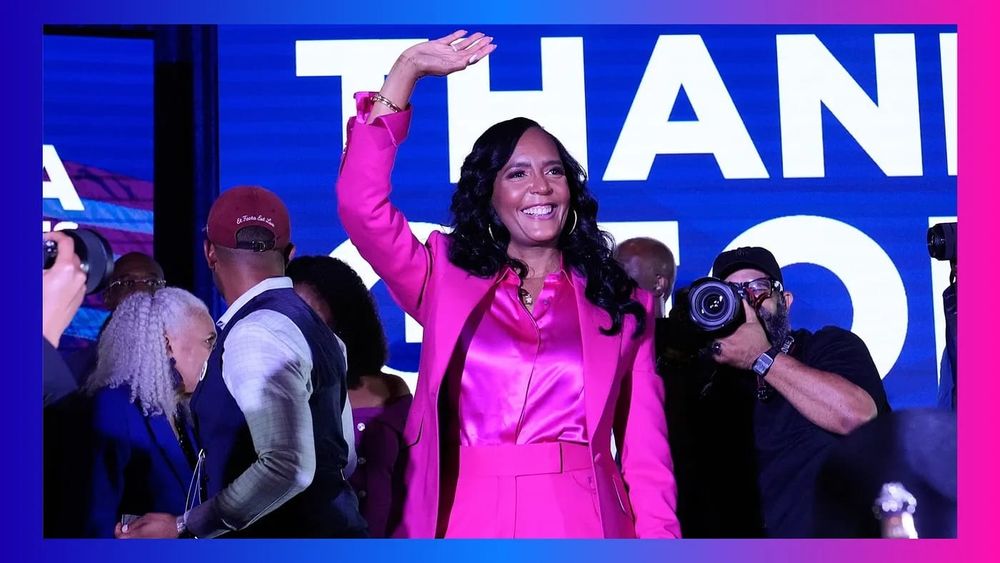
The news that Keisha Lance Bottoms will become America’s first Black woman governor has shaken the country to its core. Her victory, alongside a historic lineup of leaders from diverse backgrounds, signals a major shift in American culture and politics. Depending on who you ask, Democrats flipping the House and Senate on Nov. 3 was either a blue wave or a tsunami. While celebration is certainly warranted, we mustn’t lose sight of how long it took this country to reach this milestone, or that even in 2026, many more “firsts” still lie ahead.
The scholar Ibram X. Kendi explained the myth of racial progress in The 1619 Project. “When the long sweep of American history is cast as a constant widening of equity and justice, it overlooks this parallel constant widening of inequity and injustice.” Yet this is exactly what white people do when they present racism as a thing of the past, a shadow of the nation’s former self. When asked about reparations in 2019, Senate Majority Leader Mitch McConnell said, “We’ve elected an African American president. Of course, the irony wasn’t lost on Black Americans that he voted against Obama, or that his family once owned slaves.
While representation matters, and electing the nation’s first Black president, as well as the first Black Vice President, Kamala Harris, represented racial progress, this was only one leg of the journey.Those who’ve studied abolitionist and civil rights movements know that the true goal of Black liberation is racial equity, a society where skin color no longer limits access to opportunities and resources. While the first goal satisfies only aesthetically, the second addresses racial injustice head-on. Black children need to see Black people lead, but more importantly, they need equal opportunities to do so.
Why did it take so long to elect a Black woman as governor?
Now that we’ve put the champagne flutes away, as I’m sure many found themselves in rare spirits counting the wins, driven significantly by Black voting power, we should soberly consider the status of Black people in American society. Those interested in why it took hundreds of years to elect a Black woman as governor should look to history. When this country was founded in 1776, only White landowning men could vote, while every other group was subjected to their rule. Under this system, Black women were considered chattel and, as a result, were not eligible to vote or petition the government for grievances, let alone become governor of a state.
During the Reconstruction Era (1865–1877), over 1,500 Black men, many of whom were formerly enslaved, served in the U.S. Senate, House, and state legislatures. While their victories marked a substantial shift away from the political exclusion they endured as enslaved people, Black women could not participate because the 15th Amendment, ratified in 1870, granted Black men the right to vote but not women of any race. Even after Congress passed the 19th Amendment in 1919, this legislation came during the Jim Crow era. So, while Black women technically had the right to vote, they were subjected to grandfather clauses, poll taxes, and literacy tests designed to disenfranchise Black people. It wasn’t until the Voting Rights Act of 1965 that they gained more consistent access to the ballot box. In that respect, their journey is unique.
While the first Black man, Hiram Rhodes Revels, from Mississippi served in the U.S. Senate, and Joseph Hayne Rainey from South Carolina served in the U.S. House of Representatives in 1870, it wasn’t until 1968 that Shirley Chisholm from New York became the first Black woman to serve in the House, and not until 1992 that the first Black woman, Carol Moseley Braun from Illinois, served in the Senate. While the first Black man to become governor, P. B.S. Pinchback, served in Louisiana in 1872 after the impeachment of the former governor, L. Douglas Wilder from Virginia became the first Black man elected as governor in 1989, Black women lagged behind Black men politically due to misogynoir, a term the author Moya Bailey coined to describe the interrelated effects of racism and sexism.
In America, many are hesitant to support Black women in leadership roles. This is in part due to racist stereotypes. A classic example would be the late white nationalist, Charlie Kirk, who claimed in 2023 that Black women “do not have the brain processing power to otherwise be taken seriously.” According to him, they had to “steal a white person’s slot,” directly referencing leaders such as Supreme Court Justice Ketanji Brown Jackson, former First Lady Michelle Obama, Joy Reid, a well-known political pundit, and Sheila Jackson Lee, the late U.S. Representative of Texas. Chipping away at these negative public perceptions has taken hundreds of years.
Black women today are carrying the torch lit for them long ago. For instance, during the Jim Crow era, Ida B. Wells, a journalist and anti-lynching advocate, suggested women “could use our vote for the advantage of ourselves and our race,” after co-founding the Alpha Suffrage Club. Despite their best efforts, discrimination against Black voters persisted. In a 1939 speech, educator and activist Mary McLeod Bethune stated that “the democratic doors of equal opportunity have not been opened wide to Negroes.” And Fannie Lou Hamer, a Black sharecropper, founded the Mississippi Freedom Democratic Party in 1964 after officials banned Black residents from participating in the political process.
Shirley Chisholm once said, “If they don’t give you a seat at the table, bring a folding chair.” Given the racial and gender-based discrimination that Black women have endured, it’s fitting that their political ideology has emphasized persistence. “ If there are no opportunities, we will create them" has been the prevailing idea among Black women in politics. In the last presidential election, the organization Win With Black Women encouraged Black women and others to organize, register, and make a plan to vote. Also, Stacy Abrams, a Black attorney, author, and activist who empowered voters in Georgia through her organization, Fair Fight Action, and ran for office, laid the groundwork for America’s first Black governor.
In addition to Keisha Lance Bottoms’ historic victory on Tuesday, the results included Stacey Plaskett becoming the first Black woman elected governor of a U.S. territory, Abdul El-Sayed becoming the first Muslim U.S. Senator from Michigan, and Texas, with Gina Hinojosa, and California, with Zavier Becerra, electing their first Latino governors. New Mexico made history by electing its first Native American governor, Deb Haaland. Peggy Flanagan from Minnesota will be the first Native American woman to serve in the Senate, and Denise Powell became the first Hispanic member of Congress after winning her Nebraska seat. Nevada, with Aaron Ford, and Wisconsin, with David Crowley, had their first Black governors. Florida did too, with Byron Donalds, though his association with Trump kept him from winning a majority of Black voters. Change is underway. Perhaps even the nation’s political tectonic plates are shifting, but we should tread lightly. Black Americans cannot afford to accept representation in lieu of racial equity. One hand washes the other.