
For those who are unaware, South Africa under Apartheid was a racially restrictive country that policed every aspect of life for South Africans who were Black, Indian, and colored (a multiracial classification created by the government). There were repressive restrictions on where non-white others could live, attend school, work, and travel. Laws enforced this segregation, and partaking in politics was criminalized. This racialized system of oppression ended in 1994, culminating with Nelson Mandela’s election as the 1st President of South Africa, and the A.N.C. (African National Congress) becoming the ruling party of the country. However, Black South Africans have not enjoyed the economic fruits of political emancipation. For example, by one measure, the World Bank has ranked South Africa as the most unequal country in the world. According to the World Bank, ten percent of the population holds about 71 percent of the country’s wealth, while the bottom 60 percent holds just 7 percent of assets.
Moreover, the wealth disparities created under the settler colonial regime of Apartheid remain, cloistering the majority of Black South Africans in some of the most deplorable living conditions in the Global South. However, the Black middle class, though small, has expanded, and Blacks have made inroads in the mining industry that was once restricted by Apartheid.
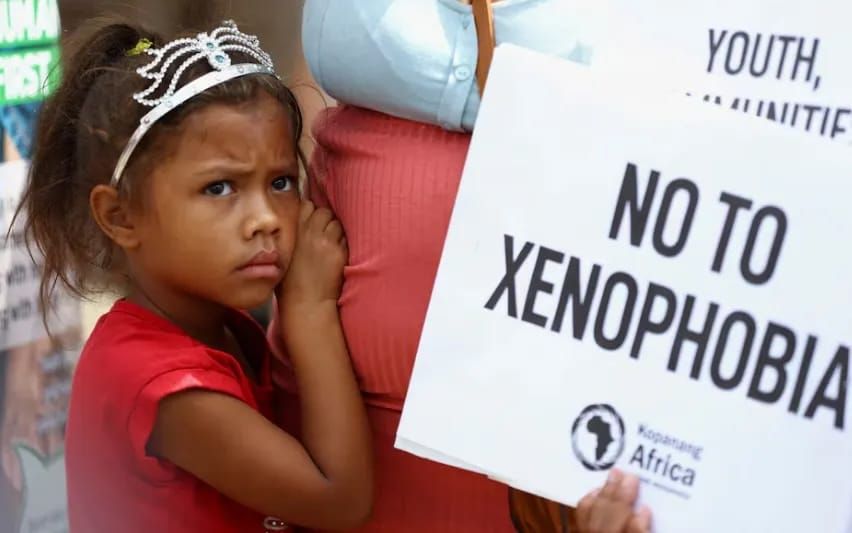
Nevertheless, contemporary events (abuse of Black African migrant workers) have shed light on Black xenophobia in South Africa. The issue of xenophobia in South Africa is primarily rooted in the resource deprivation suffered by Blacks in South Africa. This deprivation, unfortunately, contributes to xenophobic microaggressions and violence against itinerant Black African migrant workers (who are politically and socially vulnerable; lack the social, class, and political protections of Whites and scapegoated as the cause of social problems), who they believe are threatening their access to scarce resources due to the hoarding of capital by White South Africans, aka Afrikaners. This issue is prevalent throughout the Global South (developing nations), where formerly colonized peoples fight amongst themselves for resources rather than against the social actors (neo-colonizers and neo-colonial puppets) responsible for their social, political, and economic quagmire (political corruption, lack of industrial and material development). This phenomenon, known as punching down (attacking the socially vulnerable) rather than punching up, serves to insulate contemporary neo-colonizers and neo-colonial puppets from the iconoclastic wrath of their neo-colonial subjects, while providing Black South Africans a false sense of superiority that serves as an ersatz to their socioeconomic woes.
We (African people) must learn to turn toward each other, not on each other, in times of need. To do so, we can rely on our practices of agency, self-determination, and adaptive vitality, drawing on the African concepts of susu and Ujamma, as well as the African American practice of Rent Parties, to provide an immediate respite from the socioeconomic pressures we face as a people. If not, we will continue to suffer by defining ourselves through the arbitrary national identities imposed by the Berlin Conference. We must consider that the system of anti-Blackness makes no distinction in regard to nationality, ethnicity, creed, or clan
We must heed the influence of Dr. Kwame Nkrumah, who warned against the folly of dogmatic nationalism, stating, “If we are nationalistic in our outlook, we will be played against each other like pawns on a chessboard.”