
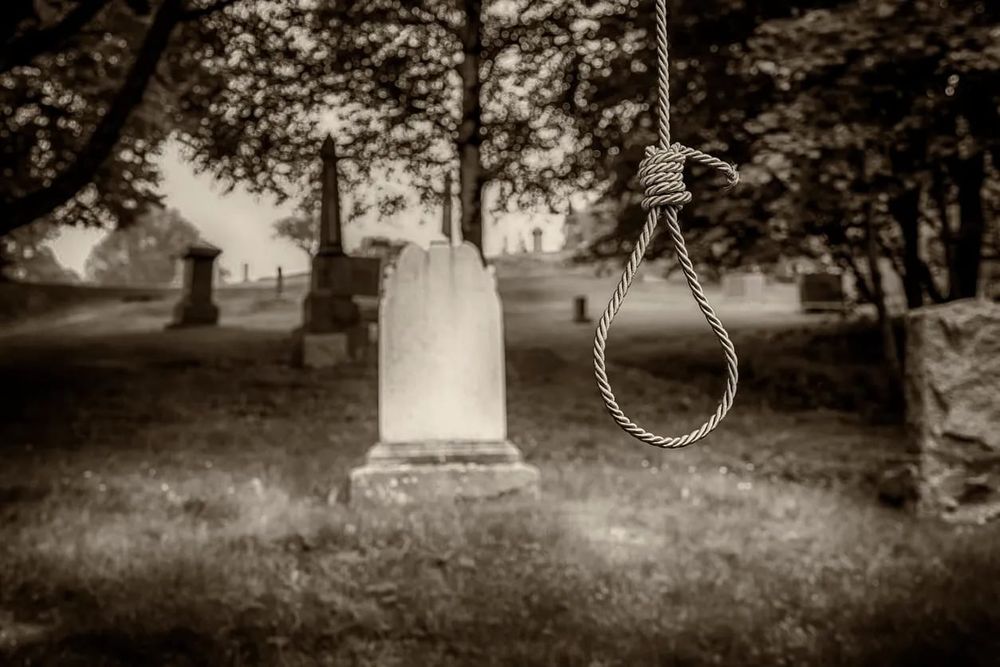
Publicly reported cases of Black people found hanged from trees were rare for decades. In the last two years, the number has risen sharply, and it doesn’t appear to be a coincidence.
Since January 20, 2025, there’s been a national onslaught of policies designed to harm Black people, coupled with the administration’s passion for fighting so-called racism against white people.
The facts are not in dispute. Mass firing of Black women from federal government jobs. An end to diverse government contracting. No more equity or inclusion. Threats to sue companies that dare to want a diverse workforce. The “they’re coming to take your jobs” nonsense. Rounding up and deporting Black and Brown people who haven’t committed any crimes. Removing decorated Black military heroes from government libraries and websites.
The message is loud and clear. And the cumulative effect of all of that is a government stamp of approval and a free pass to say and do whatever overt hateful thing a racist’s heart desires.
Enter lynchings.
Over a dozen Black men and women found hanged, most of them from trees, in just two years.
In Alabama, Mississippi, Georgia, North Carolina and Florida. But also up north in Wisconsin, New York and Michigan.
Almost all ruled suicides, often before a full investigation even took place.
Suicide, of course, is a sad and serious thing that impacts people of all backgrounds. Including Black people.
But the idea that Black people are resorting to hanging themselves, mimicking the racist lynchings that went on in this country all the way through the 1960s, reeks of a cover-up, and of more government silence and tacit approval of racism at the local, state and federal level.
Javion Magee was just 21 when he was found at the base of a tree with a rope around his neck in September 2024 in North Carolina. The state medical examiner ruled it a suicide.
Dennoriss Richardson, 39, of Sheffield, Alabama, was found September 28, 2024, hanging in an abandoned house miles from his home. Richardson had sued local police in federal court for unlawfully assaulting him.
Then he ended up dead.
The Colbert County Sheriff’s Office ruled the hanging a suicide despite the suspicious circumstances of his death. The FBI opened an investigation two months later, and an independent second autopsy reached a different conclusion than the state’s.
An unnamed 58-year-old Black man was found hanging from a tree in Albany, New York, in June 2025. The medical examiner ruled it a suicide, and police to this day refuse to release the man’s name.
Demartravion “Trey” Reed, 21, of Cleveland, Mississippi, was found September 15, 2025, hanging from a tree at Delta State University. The Mississippi State Medical Examiner ruled it a suicide. Cleveland police turned their files over to the FBI and the U.S. Attorney’s Office, and an independent autopsy funded by the family’s advocates has never been released.
Torrance “Tory” Medley, 39, of Brookfield, Wisconsin, was found November 13, 2025, kneeling beside a tree at Brookfield Hills Golf Course with a strap around his neck. Brookfield police called it a suicide the same day they found the body. Before an investigation.
Kyle Bassinga, 21, a Georgia State student, was found February 18, 2026, hanging from a tree in Fair Oaks Park in Marietta, Georgia. The Cobb County Medical Examiner ruled it a suicide because there were “no signs of foul play.”
Juliana Umba Nzita, 16, of Charlotte, North Carolina, went missing in late April 2026 and was found May 8 in a north Charlotte churchyard, suspended by a ratchet strap with her feet near a toddler-size chair. The county medical examiner ruled it a suicide within a mere three days. And the police department closed the case four days later. Without a full autopsy, without locating her phone, and without interviewing the man who found her.
To’Nea Nicole Miller, 27, of Flint, Michigan, was found June 18, 2026, near Gwen Cherry Park in Miami. The Miami-Dade Sheriff’s Office called the findings “consistent with suicide” — because there was, wait for the familiar chorus, no evidence of foul play. Case closed.
Justice Kai James, 21, of Albany, Georgia, was found June 21, 2026, at the Turner Job Corps center. He was widely described online as hanging from a tree on campus, but Albany police said he was found unconscious outside the campus cafeteria and initially classified the death as suspicious. On July 20, 2026, the medical examiner ruled it a suicide and police ruled out foul play.
Jerard “Jay” Jackson, 28, went missing June 29, 2026, and was found June 30 in a wooded area about 150 feet off the Hart–Montague trail in Michigan after attending the Electric Forest festival. Michigan State Police stated, “It appears Jackson died by suicide” — because they found, drum roll please, “no indication of foul play.”
Tasia Fortune, 29, was found August 3, 2026, hanging from a tree behind a vacant house in Jackson, Mississippi. The state medical examiner has released no cause or manner of death.
An unnamed 32-year-old man in Raleigh, North Carolina, was found hanging from a tree with an electrical cord on August 15, 2026. Police Chief Rico Boyce announced a finding of suicide within days because video showed the man approaching the tree by himself. Before any other investigation. The North Carolina NAACP has called for more transparency.
And then on August 21, 2026, another Black man was found hanging. Demetrius Fleming. Just 38 years old. Found about 85 miles from the last hanging in North Carolina.
None of us can say that not one of these deaths was a suicide. But the pattern has grown too consistent, and the investigations too thin, to leave the obvious unsaid.
Black people are being lynched again.
And just like 60 years ago, the government is turning a convenient blind eye.
Every case that has drawn a ruling has been ruled a suicide. Fortune’s and Fleming’s remain open.
Homicide or lynching just isn’t considered a cause of death.
But the history of anti-Black lynching, coupled with the speed at which most of these determinations have been made — sometimes within hours, other times within days, and long before autopsies are completed or surveillance footage is reviewed — tells us that Black lives again don’t matter.
It’s time to bring in the full weight of the FBI, fully investigate these deaths, and put killers away for life.
And to send a strong message that violence and hatred against Black people will no longer be tolerated.
On a deeper level, we need to reverse the national rhetoric and trend on the value of Black lives. They matter. In boardrooms. In colleges. As colleagues. In federal government. In contracting. In all aspects of American life.
When the government prioritizes policies that harm Black people, literally the first act on January 20, 2025, it sends a powerful negative message that once again Black people and their racial struggles in America don’t matter.
The natural consequence of that message is open season on Black people.