
Chief Justice Roger B. Taney wrote what is likely the most notorious paragraph in the history of Supreme Court opinions.
“They had for more than a century before been regarded as beings of an inferior order… and so far inferior, that they had no rights which the white man was bound to respect.”
Taney’s opinion in Dred Scott v. Sandford (1857) is widely regarded by historians, legal scholars, and even modern Supreme Court justices as the worst Supreme Court decision in American history. Not because it was merely wrong, but because it was catastrophically wrong in every dimension: morally, legally, constitutionally, historically, and politically. It helped push the nation into civil war and attempted to lock white supremacist hierarchy into the Constitution itself.
Taney held that no Black person, free or enslaved, could ever be a U.S. citizen. He believed that Black people were not part of the political community and the Constitution was written for white men only.
Taney ruled that Congress had no power to ban slavery in the territories. This meant slaveholders could take enslaved people anywhere in the country. The Missouri Compromise was unconstitutional and the federal government was required to protect slavery, not restrict it.
This was the Court siding with the most extreme pro‑slavery faction. Only two Supreme Court decisions in U.S. history have been overturned by constitutional amendment, and Dred Scott was one of them. For the first time in U.S. history, a Supreme Court decision was widely seen as partisan and corrupt. The Court’s reputation collapsed. Even moderate Northerners stopped treating it as a neutral arbiter. Dred Scott was the law of the land for 11 years, until the Civil War and the 14th Amendment overturned it.
Taney held a wide range of racist views beyond the infamous line in Dred Scott. He believed Black people were inherently inferior, could never be citizens, should not testify against whites, could be excluded from states, and that slavery was a constitutionally protected institution.
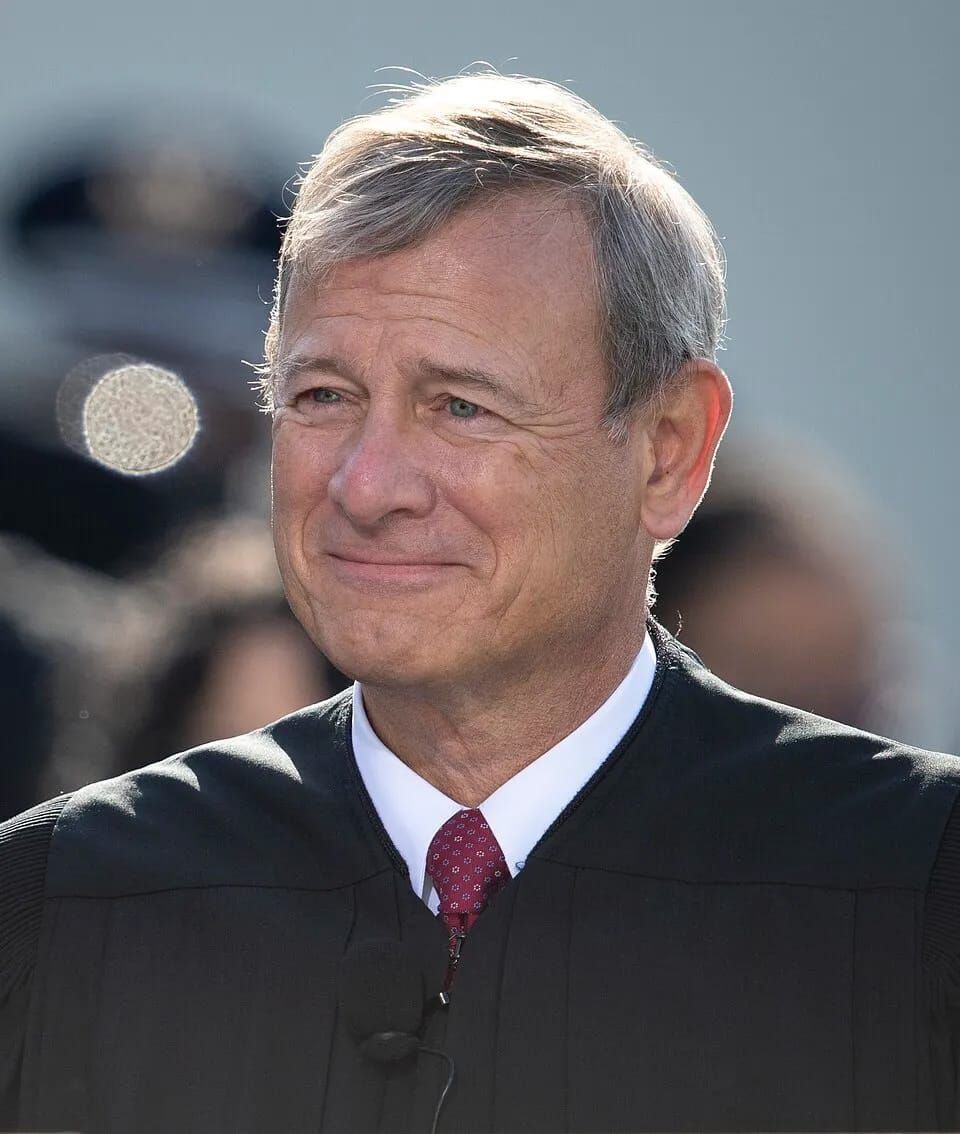
You might think a comparison of John Roberts to Roger B. Taney is a major stretch, but Roberts has shown less respect for the rights of Black people than Taney and has been more effective at disenfranchising them. Even though Roberts has authored some of the most consequential conservative rulings of the last 20 years, major media outlets often frame him as a moderate, institutionalist, or guardian of the Court’s legitimacy.
For years, Roberts occasionally did not take the most extreme conservative position in a handful of high‑profile cases. In 2012's NFIB v. Sebelius (201s) he upheld the ACA’s individual mandate. June Medical (2020) saw him strike down a Louisiana abortion restriction. And he blocked Trump's Commerce Department with the Census citizenship question.
These moments were exceptions, not a pattern — but they created a media narrative that Roberts is a “centrist” trying to keep the Court balanced. Roberts frequently talks about protecting the Court’s legitimacy, avoiding the appearance of partisanship, and preserving judicial independence. He gives speeches about the Court not being “politicians in robes.” He chastises political actors for attacking the judiciary.
Roberts sometimes slows the pace of conservative change, not because he disagrees with the outcome, but because he prefers incrementalism, institutional stability, and avoiding public backlash. He seems “moderate” compared to Thomas or Alito, but only by contrast. In truth, Roberts has been the most effective Justice in his lifetime, perhaps in history, in protecting the rights of white people by removing those of Black ones. Taney would be proud.
Chief Justice Roberts has been more effective than anyone in disenfranchising Black people. Most of what Taney accomplished can be traced to a single decision that remained in place for 11 years before being reversed. Roberts has spent an entire career whittling away at the Voting Rights Act of 1965, affirmative action, and, most recently, DEI. He couched his attacks in calm, supposedly anti-discrimination language, but what he did is more important than what he said.
“The way to stop discrimination on the basis of race is to stop discriminating on the basis of race.”
Efforts at affirmative action, the Voting Rights Act of 1965, and DEI only existed because of the rights Black people in America were systemically denied. These were all attempts, not to provide an unfair advantage to Black people but to level the playing field. In Dallas County, Alabama, where peaceful marchers were beaten and bitten by dogs on Bloody Sunday, only 2% of eligible Black voters were registered to vote. This is what the VRA was designed to help cure, and John Roberts was determined to end it.
Most people think Roberts began dismantling the VRA with Shelby County v. Holder (2013). But his campaign started in the early 1980s, when he was a young lawyer in the Reagan Justice Department. When Congress moved to renew and expand the Voting Rights Act in 1982, Roberts, then a 26‑year‑old lawyer in the Reagan DOJ, wrote dozens of memos arguing:
- The VRA was too protective of minority voters
- Section 2 should NOT be amended to prohibit discriminatory effects
- Only intentional discrimination should be illegal
- Stronger VRA protections would lead to “quotas” and “racial preferences.”
Congress rejected his arguments and passed the stronger VRA anyway, with a bipartisan supermajority.
Roberts argued fiercely against adding the “results test” to Section 2, which allowed plaintiffs to win VRA cases without proving racist intent. This test became the backbone of vote‑dilution cases, redistricting challenges, and minority representation protections. Roberts wanted a proven racist impact from the start. It took him 44 years, but he accomplished his goal. His memos warned that the results test would “intrude too deeply” into state election systems, the same logic he later used in Shelby County.
In the early 1980s, Roberts questioned the constitutionality of preclearance (Section 5), the legitimacy of federal supervision of state election laws, and whether Congress had the power to impose such oversight. These arguments reappear — almost verbatim — in his 2013 opinion striking down Section 4(b).
Roberts repeatedly warned that strong VRA protections would “mandate racial balance,” “force racial gerrymandering,” and “undermine race neutrality.” This early rhetoric is the ancestor of his later “color‑blind Constitution” doctrine.
Roberts was part of a broader Reagan‑era push to narrow civil‑rights enforcement, limit federal oversight, oppose race‑conscious remedies, and reinterpret the 14th Amendment as color‑blind. His VRA memos were a key part of that project.
The one figure who has done more than anyone else in the last half‑century to dismantle the legal infrastructure of racial equality in the United States is Chief Justice John G. Roberts Jr. His fingerprints are on every major rollback of race‑conscious civil‑rights law in the 21st century. And unlike the bombastic culture‑war politicians who dominate headlines, Roberts has done it quietly, methodically, and with the institutional legitimacy of the Supreme Court behind him.
Roberts’s project has two pillars: ending affirmative action and weakening the Voting Rights Act. Together, these decisions form a single constitutional vision, a “color‑blind” America in which the law is forbidden from acknowledging the existence of racism, even when racism shapes every measurable outcome.
Roberts didn’t arrive at the 2023 Students for Fair Admissions decision by accident. He spent nearly two decades laying the groundwork. In Parents Involved v. Seattle (2007), Roberts wrote the line that would become the rallying cry for dismantling affirmative action:
“The way to stop discrimination on the basis of race is to stop discriminating on the basis of race.”
With that sentence, Roberts reframed race‑conscious remedies — designed to address centuries of exclusion, as themselves discriminatory. It was an inversion of the logic of the Civil Rights Movement, and it became the doctrinal foundation for the Court’s eventual ruling that race could not be considered in college admissions.
By the time Roberts wrote the majority opinion in SFFA v. Harvard/UNC (2023), the outcome was already baked in. He declared that diversity was no longer a compelling interest, that race could not be used even as one factor among many, and that universities could not consider the structural realities of racism in any form. The decision didn’t just end affirmative action; it delegitimized the entire legal rationale behind DEI programs, corporate diversity initiatives, and race‑conscious policymaking.
Roberts didn’t simply close the door. He locked it, bolted it, and welded it shut.
Roberts’s campaign against the Voting Rights Act began long before he put on the black robe. As a young lawyer in the Reagan Justice Department in the early 1980s, he wrote memo after memo arguing against strengthening the VRA, opposing the “results test,” and warning that robust civil‑rights enforcement would lead to “racial quotas.” Congress rejected his arguments, but Roberts never abandoned them. Once he became Chief Justice, he finally had the power to act.
In Shelby County v. Holder (2013), Roberts gutted Section 4(b) of the VRA, effectively ending the preclearance regime that had protected Black voters for half a century. He insisted that “things have changed in the South,” ignoring mountains of evidence to the contrary. Within hours, states previously covered by preclearance began passing laws that disproportionately targeted Black voters.
Then came Brnovich v. DNC (2021), where Roberts’s Court weakened Section 2 — the last major tool for challenging discriminatory voting laws. And in Rucho v. Common Cause (2019), Roberts declared partisan gerrymandering a “political question” beyond the reach of federal courts, even as racial gerrymandering increasingly hid behind partisan labels. Most recently came Louisiana v. Callais, where the last remaining power in Section 2 was gutted. The result is a landscape where racial discrimination in voting is harder to challenge, easier to disguise, and nearly impossible to remedy.
This worldview dismantles the tools created during the Second Reconstruction, the Civil Rights Movement, and replaces them with a 21st‑century version of the logic Roger Taney used in Dred Scott: that the Constitution cannot see race, even when the country is structured by it.
Roberts doesn’t use Taney’s language. He doesn’t need to. His rulings achieve the same effect: removing Black Americans from the center of constitutional protection and placing them back at the mercy of states, institutions, and political majorities.
By ending affirmative action and hollowing out the Voting Rights Act, Roberts has reshaped the racial landscape of American law more profoundly than any figure since the end of Reconstruction. He has limited access to higher education, weakened protections for minority voters, empowered partisan gerrymandering, undermined DEI programs, and shifted racial policymaking from Congress to the Court. He has done it all while being praised in the media as a “moderate” and “institutionalist.”
John Roberts will never write a sentence as blunt as Roger Taney’s declaration that Black people had “no rights which the white man was bound to respect.” He doesn’t have to. His project has been quieter, procedural, and wrapped in the language of neutrality, but its consequences land in the same historical neighborhood. By hollowing out the Voting Rights Act, ending affirmative action, insulating partisan gerrymandering, and elevating a “color‑blind” Constitution that refuses to see the structures that racism built, Roberts has done what Taney attempted and failed to do: he has rewritten the rules of American democracy without ever admitting that race was the point.
The story of American law is not a straight line, but it does have a pattern. Every time the country expands the meaning of citizenship, a generation of judges emerges to narrow it again. Taney did it after the Founding. The Redemption Court did it after Reconstruction. And Roberts, with a polite smile and a reputation for moderation he has never earned, is doing it in our own time. The language changes. The outcomes do not. The Court keeps returning to the same question: who counts, and who doesn’t? Roberts has given his answer in a series of decisions that quietly move millions of people back outside the circle of constitutional concern. History will recognize the continuity even if he never says it out loud.