
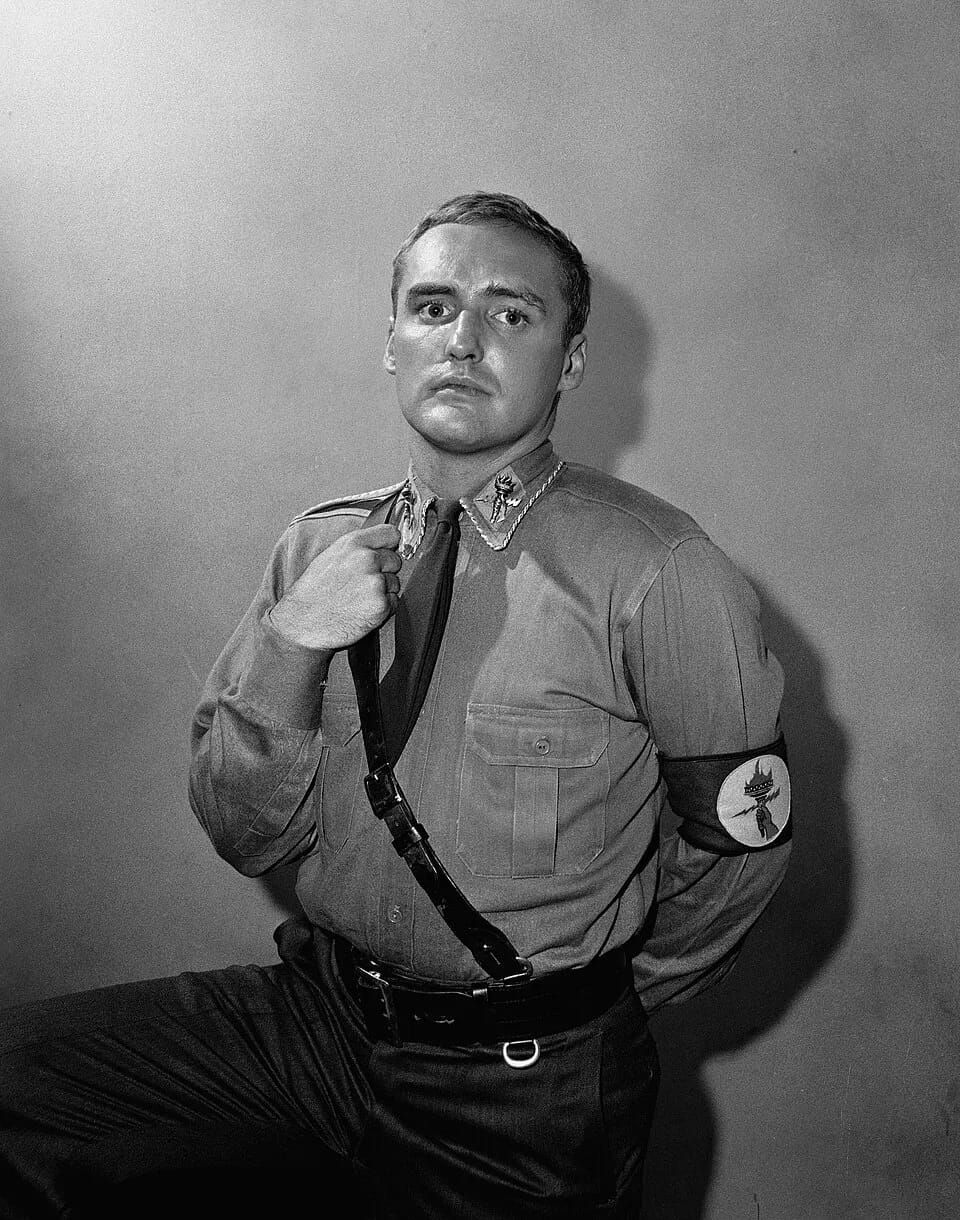
On January 24, 1963, CBS aired Episode 4 of Season 4 of The Twilight Zone, named“He’s Alive!” Back then, only three national networks existed: ABC, CBS, and NBC. When "He’s Alive" aired at 10 pm, it competed with The Andy Williams Show on NBC, and ABC aired local programming.
The show featured an American Hitler-wannabe named Peter Vollmer with delusions of greatness, having little success with street corner speeches trying to inspire crowds to hate immigrants, Palestinians, Jews, and Black people. The story was set around 1960 in New York City. Donald Trump was 16 when the show aired. If he was watching television that night, would he have chosen The Andy Williams Show or The Twilight Zone?
A stranger, only shown in the shadows, approached Vollmer after an unsuccessful speech where he was beaten by the crowd who didn’t like his message of hatred. The shadowy figure presented himself as a friend, telling Vollmer, “You have need of friends. Allies!”
I’ll spoil the ending by revealing the figure was actually Adolf Hitler. Hitler. I’ll let the dialogue speak for itself:
Vollmer: “You said you had something to talk about.”
Hitler: “I do, I do indeed. I have you to talk about, and the things you believe in. Which are the things I believe in, as well. Your success, Mr. Vollmer, will be my success.”
Vollmer: “Go on.”
Hitler: “Good! Let us start by your learning, what are the dynamics of a crowd? How do you move a mob, Mr. Vollmer? How do you excite them? How do you make them feel as one with you?
Vollmer: “I don’t know. How?”
Hitler: “Join them first, Mr. Vollmer”
Vollmer: “Join them?”
Hitler: “Yes, when you speak to them, speak to them as if you are a member of the mob. Speak to them in their language, on their level. Make their hate, your hate! If they are poor, talk to them of poverty. If they are afraid, talk to them of their fears. And if they are angry, give them objects for their anger. But most of all. The thing that is most of the essence, Mr. Vollmer. Is that you make this mob an extension of yourself.Say to them things like. . . things like. . . “They call us hatemongers. They say we’re prejudiced. They say we’re biased. They say we hate minorities. Minorities, understand the term, neighbors. Minorities. Should I tell you who are the minorities? Should I tell you? We. . . ! We are the minorities! That way, Mr. Vollmer. Start it that way.
Vollmer: I. . . I understand, I think I understand!
We next see Peter Vollmer in Nazi uniform, speaking to a receptive crowd in a room filled with chairs. Vollmer proves he did understand what Hitler taught him about inciting a mob.
Vollmer: “They say that we hate the minorities! The minorities. Understand the term, neighbors. The minorities . Shall I tell you who the minorities are? We, we, we are the minorities.
Because. . . patriotism is a minority.
Because love of country is the minority.
Because to live in a free White America seems to be of a minority opinion.
Well. . . if it’s a minority opinion, that we have to survive. Then we are the minority, and this minority will not stop until it is the majority! This minority will not give up the fight. This. . . is the promise. And this (Vollmer pointing to a large portrait of Hitler), this is the legacy!”
The crowd cheered like it was a Trump rally. Vollmer had learned how to incite a mob to hate, and his formula might have turned his minority into a majority, but for his arrest on a murder charge. He’d ordered the death of a supporter to create a martyr to grow the movement.
Rod Serling wrote this show in 1962, 17 years after the real Hitler committed suicide in a Berlin bunker. When the show aired, CBS received more viewer mail — overwhelmingly hostile — than any other Twilight Zone installment; the minority shown in the episode existed in real-life America, disturbed at the anti-Nazi sentiment expressed.
Rod Serling wrote He’s Alive in 1962 as a warning, not a prophecy — yet the language he put in Peter Vollmer's mouth now echoes through American political rallies with unsettling clarity. Serling understood that fascism doesn’t reappear wearing old uniforms; it resurfaces through familiar cadences of grievance, victimhood, and rage. His script insisted that authoritarianism is not a relic sealed in 1945 but a recurring American temptation, waiting for someone charismatic enough, angry enough, or ambitious enough to give it shape.
What Serling framed as a fringe street‑corner movement in 1962 has, in our moment, climbed podiums, won primaries, and secured committee chairs. Today's Vollmers do not shout from alleys—they legislate, broadcast, and fundraise. They speak of “enemies,” “purity,” “replacement,” and “strength” in ways that would have been recognizable to Serling’s viewers in 1963, and chillingly familiar to anyone who has watched the last decade of American politics unfold.
Serling’s closing narration warned that hate “can live anywhere, at any time.” The uncomfortable truth is that it now lives where he hoped it never would: inside institutions, inside national movements, and in the rhetoric of people who hold real power. The episode’s title — He’s Alive — was never about Hitler’s ghost. It was about the endurance of the ideas he embodied. And in 2026, Serling’s warning feels less like allegory and more like a diagnosis of a country still struggling to recognize how quickly a Vollmer can rise when the crowd is ready to listen.