
The Republican caucus in the House of Representatives is full of Great White Hopes. The expression “Great White Hope” gained traction as white people sought a challenger to defeat Jack Johnson, the first Black heavyweight champion in boxing history. Johnson won the title in 1908. His dominance triggered a national panic among white Americans who believed the heavyweight crown symbolized racial superiority. White promoters, politicians, and newspapers openly declared the need for:
“a Great White Hope to restore the honor of the white race.”
Republicans once described themselves as the Party of Lincoln, capturing between 85–95% of Black voters during Reconstruction. The first eight Black Congressmen, seven in the House and one U.S. Senator, were Republicans. What they need is a Great Black Hope to save them from becoming a Party with no Black representation, as both Parties were before Reconstruction.
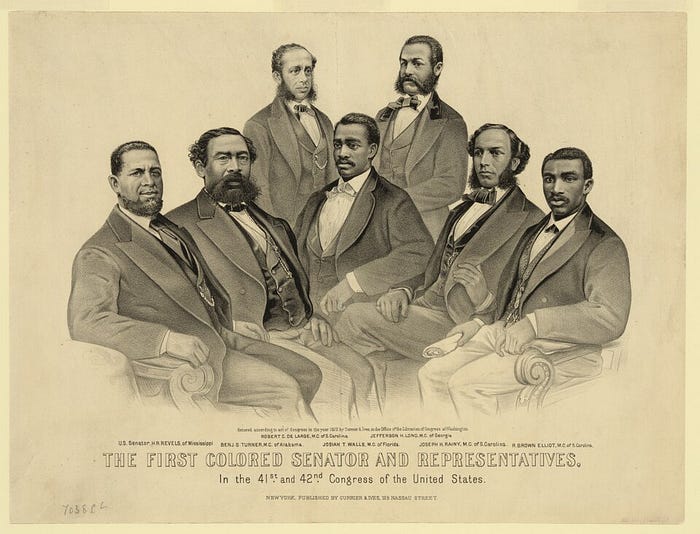
Currier and Ives, Public domain, via Wikimedia Commons
Suffice it to say, the Republicans are no longer the Party of Lincoln. They are the party of killing all the programs designed to level the playing field between everyone else and white men. Affirmative Action, DEI, and Black History have all suffered under the Republican Party, and they are about to introduce legislation to end birthright citizenship after the Supreme Court wouldn’t do it. SCOTUS may have thought its work was done after gutting the 13th, 14th, and 15th Amendments.
While the Republican Party once had the only Black representation in Congress, they now have fewer Black representatives than in the 1879s. They still have one Black Senator, Tim Scott of South Carolina, whom they can count on to tell us that America isn’t a racist country.
It’s the House of Representatives, where Republican membership may soon be as it was before Reconstruction, with no Black members. There are four Black members today, none of whom are running for reelection. Three decided to run for higher office, and one saw the writing on the wall after redistricting.
1. Wesley Hunt (Texas)
- Not running for reelection
- Ran for U.S. Senate in 2026 but lost the primary
- Part of Kevin McCarthy’s diversity‑recruitment wave (Isn’t that DEI?)
2. John James (Michigan)
- Not running for reelection
- Running for governor of Michigan
- Behind in polling to John James in Republican primary
3. Byron Donalds (Florida)
- Not running for reelection
- Running for governor of Florida
- Former drug dealer is leading in most general election polls against David Jolly
4. Burgess Owens (Utah)
- Not running for reelection
- Retiring after redistricting created a Democratic‑leaning district
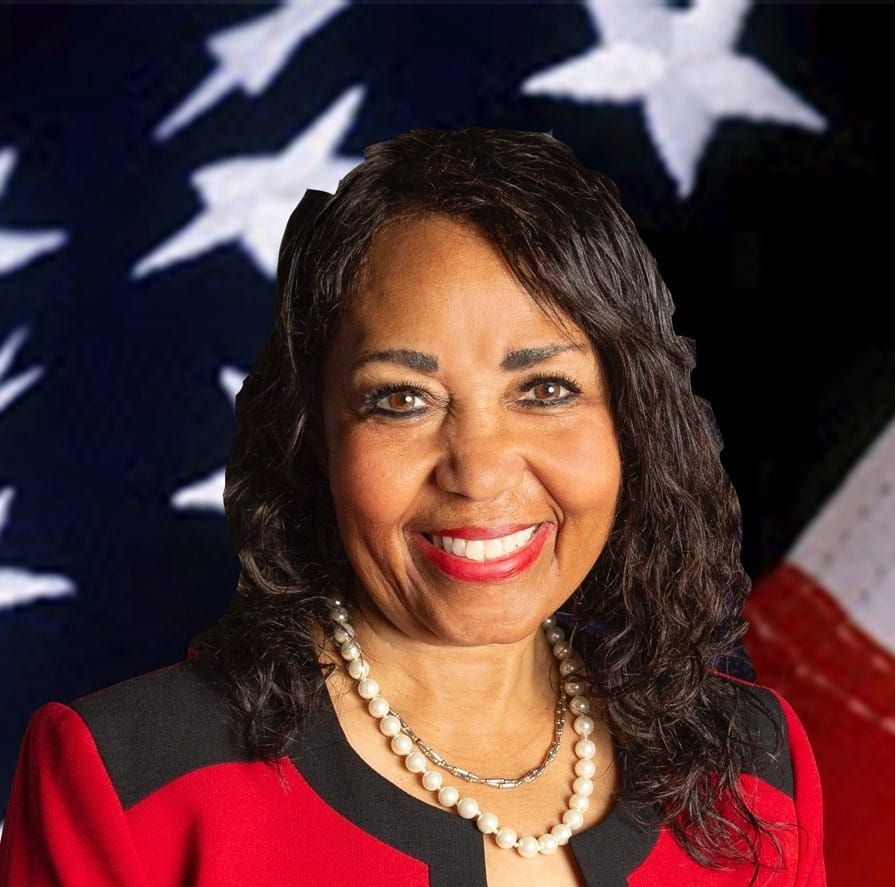
Republicans have one last chance for a Black member in the House in Charlotte Bergmann, who has been running for Congress since 2010. Charlotte Bergmann is one of the most persistent Black Republican figures in modern Tennessee politics. This Memphis activist has spent more than a decade trying to become the GOP nominee in one of the most heavily Democratic, majority‑Black districts in the country. Her political identity is built around two pillars: Black Republican representation in a district where the GOP has almost no institutional presence, and community‑based outreach framed around entrepreneurship, faith, and conservative social values.
Bergmann’s earliest political and civic work came through Memphis’s Black church networks. She positioned herself as a conservative voice within majority‑Black congregations, emphasizing: personal responsibility, anti‑abortion advocacy, traditional family structures and Christian moral framing
This gave her a base of supporters who were socially conservative but not necessarily Republican. Bergmann frequently highlighted her background in business management and IT project work (including time at FedEx). She used this to promote entrepreneurship among Black Memphians, small‑business development and job‑readiness programs.
She argued that economic empowerment — not federal intervention — was the path to Black advancement.
For years, Bergmann was one of the only Black Republicans consistently visible in Memphis. She organized Republican meet‑ups in majority‑Black neighborhoods and recruited Black conservatives to local GOP events
This made her a symbolic figure for Tennessee Republicans, even though she never came close to winning. Bergmann frequently spoke about violent crime in Memphis, support for law enforcement, stricter sentencing and community‑police cooperation
Her messaging aligned with national Republican themes but was tailored to Memphis’s specific public‑safety concerns. Charlotte Bergmann is one of the most persistent congressional candidates in Tennessee history. She has run eight times for the U.S. House in TN‑9. That seat was one of the safest Democratic seats in the nation, and Bergmann often ran unopposed in Republican primaries.
For years, Black Republicans were the only ones willing to run in TN‑9 because they understood the district’s demographics and saw value in representing conservative Black voters even in a losing cause. White Republicans stayed out because the seat was unwinnable.
But once the district was redrawn. Once Memphis’s Black voters were cracked and submerged into a majority‑white, majority‑Republican electorate. The race suddenly became winnable for the first time in modern history. And the moment winning became possible, white Republican men flooded in.
Not because they had been serving Memphis. Not because they had built relationships in the city. Not because they had any history with the district’s Black communities. They entered because the map finally made victory mathematically plausible.
This is the same pattern seen across the South after Reconstruction. When a district is majority‑Black, Black candidates, Democrat or Republican, carry the political burden of representation. When a district is redrawn to favor white voters, white candidates appear instantly, claiming the seat as newly “competitive.” The shift is presented as neutral redistricting, but the effect is unmistakable: Black political opportunity contracts the moment white political opportunity expands.
In the 2026 Republican primary for Tennessee’s 9th Congressional District, Charlotte Bergmann is running against three white male Republican candidates: Brent Taylor, Todd Warner and Jeremy Thompson
She is the only Black candidate in the race and the only Black Republican running for any U.S. House seat this cycle. Should Bergmann lose, Republicans will have come full circle, with no Black representatives in the House. That should make for a telling group photo.
When Tim Scott first ran for Senate, he publicly stated that he believed in term limits and would serve only two terms. Scott did not retire after two terms. Instead, he ran again in 2022, won reelection, announced he intends to run again in 2028, reversing his earlier pledge.
Scott later said that he felt called to continue serving, the political moment required his leadership, and that he no longer believed strict term limits were necessary for himself. I wonder if somebody told him what a bad look it would be if Republicans in the House and the Senate had rid themselves of Black people. Then again, isn’t that just what they want?