
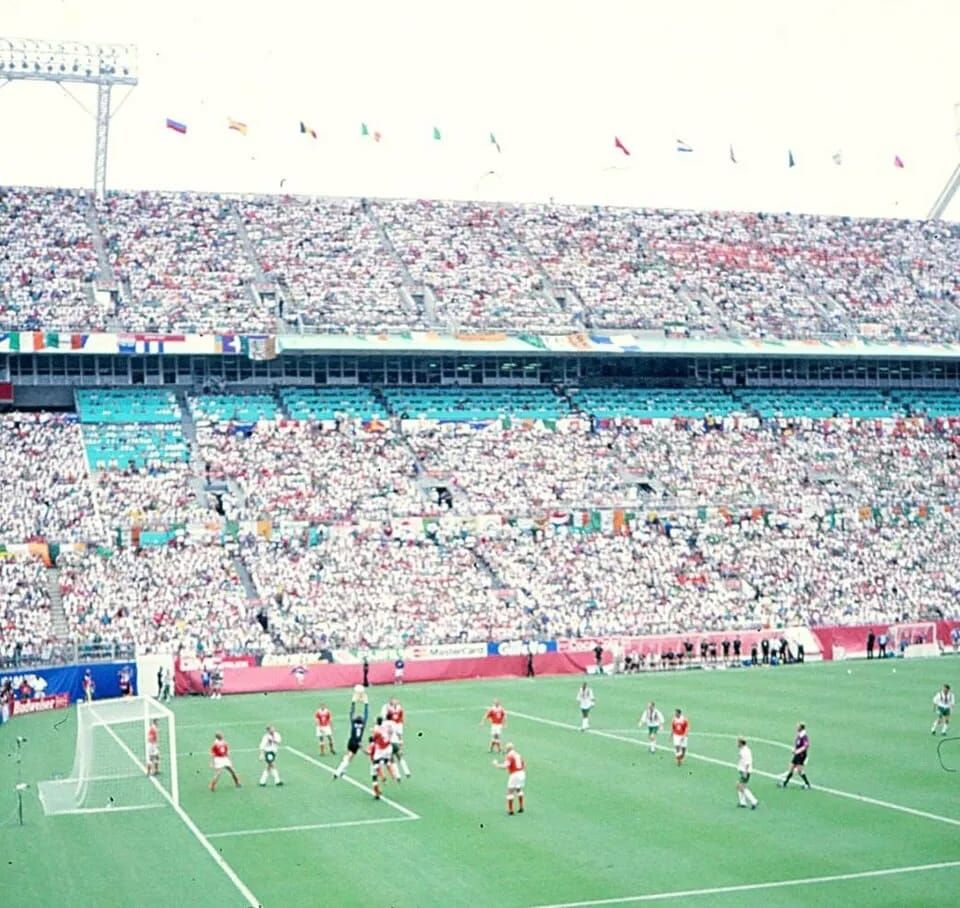
The United States hosted the FIFA Men’s World Cup for the first time in 1994. It was the most‑attended World Cup in history, a record that stood until this year, 2026, when it was broken. I heard Donald Trump taking credit for the current attendance records and, secondarily, America. The 1994 matches still hold the average attendance records with 68,991 per match. Early matches were played in cities including Los Angeles, Chicago, Dallas, Orlando, Detroit, Boston, New York/New Jersey, and Washington, D.C.
The 2026 average (so far) is 64,720 per match. The main reason attendance records are being broken is that the number of teams has expanded from 24 in 1994 to 32 in 1998, and now to 48 for the first time in 2026. We should note that matches are also being played in Canada and Mexico.
The 1994 FIFA Men’s World Cup is widely credited with launching Major League Soccer (MLS), dramatically expanding U.S. interest in global football, and establishing the U.S. as a viable host for future tournaments. Soccer fields sprang up in suburbs across America. We also hosted the FIFA Women’s World Cup in 1999 and 2003 on short notice, substituting for China after a SARS outbreak.
I had the opportunity to be deeply immersed in the 1994 Men’s World Cup. I wasn’t a spectator but was working inside and on the grounds at two sites. I was at five early-round matches in Orlando and the final match between Brazil and Italy at the Rose Bowl in Pasadena, California. A company I worked with in various capacities- as a joint venture partner, subcontractor, and employee had the merchandising rights for the entire World Cup. I had worked with them at several Super Bowls, the U.S. Open (tennis), and several World Series games at stadiums where they held the rights. We had experience at major events, including stadium concerts for the biggest musical artists, such as the Rolling Stones, U2, and Michael Jackson. The World Cup was unique unto itself because of the number of teams and foreign visitors.
In 1994, the United States had no domestic tradition of soccer hooliganism, but Europe, especially England, Germany, and the Netherlands, had spent the 1980s and early 1990s dealing with violent supporter groups. U.S. officials feared that these groups might travel to America and recreate the same chaos.
The main fears were that groups like England’s Inter City Firm (ICF), Germany’s hooligan ultras, and Dutch hooligan groups were considered high‑risk. U.S. stadiums were not accustomed to soccer-style supporter culture, chanting, drinking, and confrontational behavior. America feared clashes between rival national fanbases, especially England–Germany, Netherlands–Germany, Argentina–Brazil, and other historically tense matchups.
Cities like Orlando, Dallas, and Detroit had never hosted large international soccer crowds. Some European hooligan groups had ties to far‑right or racist organizations, raising concerns about violence toward locals. The World Cup was seen as a test of whether America could host future global sporting events.
The U.S. government, FIFA, and local police forces implemented one of the most extensive security operations in American sports history. The U.S. worked with Scotland Yard, Interpol, and European football associations. Lists of known hooligans were shared with U.S. immigration authorities. Hundreds of individuals with convictions for hooliganism were flagged. Some were denied visas or turned away at airports.
Local police departments trained specifically for soccer crowd control. Officers were placed inside stadiums, outside gates, and along fan routes. Many stadiums limited alcohol sales or cut off sales early. Some venues banned alcohol entirely for certain matches.
European-style fan segregation was implemented for high‑risk matches. Buffer zones were created between rival supporters. Special units were stationed near stadiums in case of crowd surges. These units were trained using European riot‑control models. Fans were monitored at airports, hotels, and public transit hubs. Police tracked known supporter groups moving between cities.
For all America’s concerns, the anticipated hooliganism never happened. The 1994 World Cup is remembered as one of the safest and most peaceful tournaments ever held. The combination of strict entry controls, heavy policing, and the American cultural environment prevented the kind of violence seen in Europe. In my opinion, there was no trouble in Orlando because it was so hot. There were misting stations throughout the stadium and grounds. All the games were played midday with average temperatures in the 90s. FIFA later shifted match times in future tournaments because of 1994’s heat issues. Several fans were taken to medical tents, not as a result of hooligans but from heat exhaustion.
The early matches I worked in Orlando involved five matches over two weeks. On June 19, Belgium beat Morocco 1–0, On June 24, Mexico beat Ireland 2–1. On June 25, Belgium beat the Netherlands 1–0. On June 29, the Netherlands defeated Morocco, and on July 4, the Netherlands beat Ireland 2–0. While Orlando hosted only five individual teams, we carried merchandise for all 24 teams. Brazil merchandise was popular, though they weren’t present. Our vendors had to learn the flags of all the nations involved as we sold flag lapel pins. As I recall, we operated 27 stands at what was then The Citrus Bowl, including a 100-ft tent on the grounds outside the stadium. When the Orlando games were over, we sent our remaining merchandise to Detroit for later matches. I got a few days' rest and flew to Los Angeles for the final match among teams yet to be determined.
I arrived in LA about a week before the July 17th final match. We now knew it would feature Brazil and Italy at the Rose Bowl. I’d worked Super Bowls at the stadium twice before and thought I knew the layout. The stadium itself seated around 100,000 people, but there would be at least that many on the grounds outside the building. Adidas had set up a large multi-sided tent with televisions facing outward so fans could watch the game. Inside the stadium, many corporate tickets were sold (like at Super Bowls), but outside were fans of the sport from both countries. Brazil’s fans seemed to outnumber Italy’s about three to one. I saw almost none of the match as we were moving merchandise around, but I was aware the game ended in a tie and would go to a shootout to determine the winner. The outside fans had been drinking and singing all afternoon, some blowing those damned vuvuzelas, 2-foot-long plastic horns that produced a loud buzzing sound. Vuvuzelas have been banned since the 2010 South Africa World Cup.
As the teams readied for the shootout, I was suddenly concerned about what would happen after the match. Would there be an altercation between the fan bases? I’d learned in my month of World Cup that fans were pretty intense about their teams. I hadn’t cared to that point who would win, but found myself rooting for Brazil because they had so many more fans present. I had been moving in and out of the stadium throughout the day and decided to go inside where security was tighter. I watched on a screen as Brazil won the shootout, 3–2.
There wasn’t the pandemonium I anticipated. I headed back outside to find Brazilians hugging Italians and vice versa. None of the fans seemed to want to go home, though the corporados in suits quickly exited, some in limos. One of the core goals of the FIFA World Cup is to promote global unity and cultural exchange. FIFA frames the tournament as a celebration of nations, cultures, and shared identity through sport.
I think some of that has been lost in the pursuit of money and the injection of politics. When the American President intervened to overturn a red card against an American player, it wasn’t a good look. America was eliminated 4–1 by Belgium the following day, which might be karma. Unlike the Knicks, the USMWT won’t have additional games to recover from the Trump jinx. World Cup soccer teams in general have become melting pots, with 47 of the 48 teams having players of African heritage. Argentina seems to have a different agenda.
The U.S. player Folarin Balogun was a beneficiary of birthright citizenship. Donald Trump is actively trying to end birthright citizenship, demanding Congress do it, having failed to convince the Supreme Court. In December 2025, FIFA President Gianni Infantino awarded Donald Trump a made-up peace prize without consulting FIFA council members in a blatant attempt to suck up to Trump. Infantino bent over when Trump asked that he overturn the red card against Balogun.
As I watch the 2026 matches, culminating with the final game. I’ll be looking for what I saw on the Rose Bowl grounds. Citizens of different nations finding common identity through sport. We will see.