
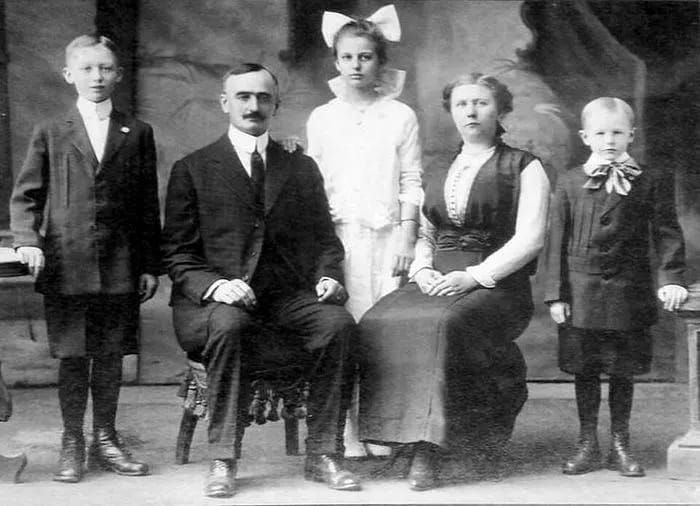
Donald Trump did not invent Donald Trump. He was assembled, piece by piece, by a family whose history reads like a manual for manufacturing a man who would treat life as a demolition derby. The Trumps were not a Norman Rockwell clan with a white picket fence and a golden retriever. They were a dynasty built on opportunism, reinvention, racial exclusion, and the unspoken rule that feelings were for other people. If you want to understand the man who would one day insist he alone could fix America, you have to understand the family that taught him that losing was a moral failure and winning was the only proof of worth.
This is the story of growing up Trump, a childhood shaped by a grandfather who ran frontier hotels and brothels, a father who built an empire on federal subsidies and segregation, a mother who vanished into illness, and a brother who drank himself into an early grave. It is not a story of wealth. It is a story of training.
I. The Grandfather: Friedrich Trump and the Original Hustle
Donald Trump never met his grandfather, Friedrich Trump, but he inherited the man’s worldview as if it were a genetic mutation. Friedrich was a draft‑dodging immigrant from Bavaria who reinvented himself in America with the moral flexibility of a man who understood that rules were for the rule‑followers. He made his first real money in the Klondike Gold Rush, running hotels and restaurants that offered miners everything they needed: food, liquor, and sex. The polite term was “sporting house.” The accurate term was brothel.
This was the first Trump business model: Find a boomtown. Build something fast. Extract as much money as possible. Don’t ask questions. Leave before the sheriff shows up.
When Friedrich returned to New York, he invested his profits in Queens real estate — the seed that would grow into the Trump empire. Then he died in 1918, leaving behind a widow, three children, and a blueprint for how Trumps would operate for the next century:
The family would later claim Swedish ancestry to hide their German roots during WWII. Donald would repeat the lie for decades. Reinvention wasn’t a strategy; it was a family tradition. In his 1987 book The Art of the Deal, Donald Trump explicitly wrote that his grandfather “came here from Sweden.”
II. Fred Trump Sr.: The Enforcer
If Friedrich built the template, Fred Trump Sr. turned it into a doctrine. Fred was thirteen when his father died, and he responded by becoming the kind of man who never again wanted to feel powerless. By fifteen, he was building houses. By twenty‑two, he had a company. By middle age, he was one of the most powerful real‑estate developers in New York — and one of the most feared.
Fred Trump was not subtle. He built his empire on federal housing subsidies while loudly insisting he was self‑made. He kept his buildings white by design, not accident. When folk singer Woody Guthrie moved into Fred’s Beach Haven apartments in 1950, he was so disgusted by the racial exclusion that he wrote a song about it: “Old Man Trump.” Guthrie accused Fred of stirring up “racial hate” and drawing a “color line” through the complex. The Department of Justice later agreed, suing Fred and Donald in 1973 for systematic discrimination.
This was the household Donald grew up in: A father who believed racism was a business model, tenants were adversaries, and compassion was a defect. Several years after Guthrie’s song, Fred Trump Sr. was arrested at a Klan protest of a Memorial Day parade in Queens. Donald later claimed his father wasn’t there.
This is nonsense, and it never happened. This never happened. Never took place. He was never arrested, never convicted, never even charged. It’s a completely false, ridiculous story. He was never there! It never happened. Never took place.”
The same attorney who represented Fred also represented six Klan members arrested at the same time. Fred was released without charges.
Fred Trump taught his children that the world was a battlefield and the only safe place was on top. He favored Donald because Donald mirrored his aggression. He dismissed Donald’s older brother, Fred Jr., as weak. He rewarded dominance and punished vulnerability. He was the sun around which the Trump household orbited — and he cast a long, cold shadow.
III. The Mother Who Disappeared
Donald’s mother, Mary Anne MacLeod Trump, was the opposite of Fred: soft‑spoken, devout, and elegant. She immigrated from the Outer Hebrides at eighteen, worked as a domestic servant, and married into a world she could never have imagined as a child in a Gaelic‑speaking fishing village.
But when Donald was young, Mary Anne suffered a traumatic medical emergency after childbirth. She was hospitalized for months and never fully recovered. For long stretches of Donald’s childhood, she was physically present but emotionally absent — a ghost in the house.
This left Donald with a father who barked orders and a mother who could not buffer the impact. The emotional center of the home collapsed, and Fred Trump filled the vacuum with his own values: toughness, dominance, and the belief that love was conditional.
Growing up Trump meant learning early that affection was earned, not given — and that the safest way to earn it was to imitate the man who controlled the room.
IV. The Brother Who Became a Warning Label
If Fred Trump Sr. was the enforcer, Fred Trump Jr. was the family’s cautionary tale. He was charming, kind, and uninterested in real estate. He wanted to fly airplanes, not collect rent. He joined TWA and built a life outside the family business. His father hated it.
Fred Sr. mocked his son’s career, belittled his choices, and treated him as a disappointment. Under the weight of that contempt, Fred Jr. began drinking. His alcoholism worsened. He died at 42.
Donald watched all of it. He saw what happened to the son who didn’t fight hard enough. He saw what happened to the child who didn’t mirror his father’s aggression. He saw that gentleness was punished and vulnerability was fatal.
Fred Jr.’s death didn’t just teach Donald to avoid alcohol. It taught him to avoid weakness in himself and in others. It taught him that the only safe identity was the one his father approved of: the fighter, the winner, the killer.
V. The Schools That Tried to Contain Him
Donald Trump was not an easy child. Teachers at the Kew‑Forest School described him as disruptive, aggressive, and impossible to discipline. By thirteen, he was getting into fights and pushing boundaries in ways that alarmed his parents. Fred Trump’s solution was not therapy. It was militarization.
He sent Donald to the New York Military Academy, a boarding school where discipline was enforced with boots and shouting. Donald thrived in the hierarchy. He learned to command attention, to dominate peers, and to treat rules as negotiable if you had enough swagger. He learned that leadership was performance and performance was power.
After NYMA, he drifted through Fordham and then Wharton, where he was not a standout student but an absolute standout self‑promoter. He told classmates he would be famous. He told friends he would be rich. He told the world he was destined for greatness long before he had done anything to justify the claim.
VI. The Family Mythology That Became His Operating System
Growing up Trump meant growing up inside a mythology — a story Fred Trump told so often that it hardened into family scripture:
- We are winners.
- We are self‑made, even when we aren’t.
- We are strong, even when we’re terrified.
- We never apologize.
- We never lose.
- If we lose, we say we won.
This mythology required constant performance. It demanded that Donald present himself as the embodiment of Trump success, even when the facts contradicted the narrative. It taught him that truth was flexible, that shame was optional, and that the past could be rewritten if it became inconvenient.
It also taught him that the world was divided into two categories: killers and losers. His father was a killer. His brother was a loser. Donald knew which one he had to be.
VII. The Man the Family Built
By the time Donald Trump entered adulthood, the influences that shaped him were fused into his personality:
From Friedrich, he inherited opportunism and the belief that rules were obstacles, women were objects to be possessed and used.
From Fred, he inherited aggression, racial hierarchy, and the obsession with dominance.
From Mary Anne, he inherited a void — the absence of maternal warmth that left him hungry for attention.
From Fred Jr., he inherited a warning: never be vulnerable.
From military school, he inherited the idea that leadership was performance and performance was war.
Donald Trump did not become who he is by accident. He became who he is because the family that raised him rewarded aggression, punished empathy, and treated winning as the only moral value.
VIII. The Family as Destiny
Growing up Trump meant growing up in a house where love was conditional, success was mandatory, and the family name was both a shield and a weapon. It meant learning that the truth was negotiable, that losing was unacceptable, and that the only safe position in life was on top.
Donald Trump is not an anomaly. He is the logical outcome of the Trump family system — a man engineered by a lineage that believed in dominance above all else. To understand the adult, you have to understand the child. And to understand the child, you have to understand the family that built him: a grandfather who hustled, a father who enforced, a mother who vanished, and a brother who broke. Growing up Trump was not a childhood. It was an apprenticeship.
If only the pattern ended with Donald. It seems three of his children have inherited the same traits from Donald. I don’t have to document it, you already know. Don Jr. attempted escape and didn’t speak to his father for years before crawling back. Ivanka tried to separate herself, but is on call when needed. She and her husband, Jared, are attempting to create a luxury private island rivaling anything Epstein owned.
 William Spivey
There are generations of Trumps who have been exposed to the Trump traditions. All haven’t succumbed, time will tell about the rest.