
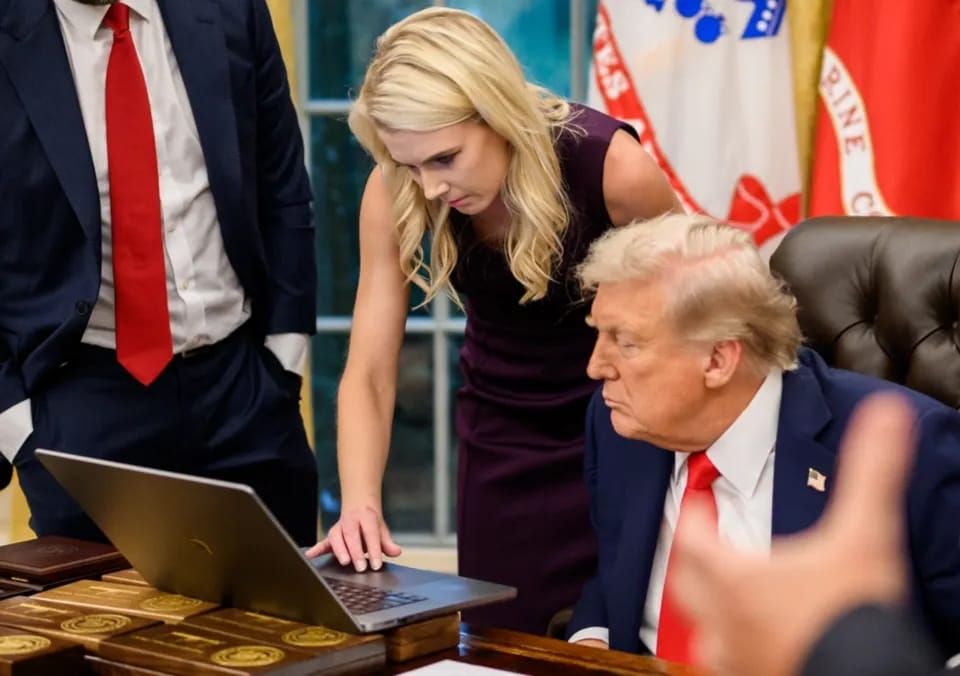
It’s been 112 years since an American president had someone acting as the First Lady other than their spouse. You can be forgiven if such a thing doesn’t exist in your memory. Here is a summary of the first nine situations, leading up to our current situation, where Melania Trump is mostly gone, and Natalie Harp has stepped in.
Thomas Jefferson (1801–1809)
Thomas Jefferson arrived at the presidency as a widower — his wife Martha had died in 1782, nearly two decades before he took office, and he had promised her on her deathbed that he would never remarry. That promise left the White House without a formal hostess for the full span of his two terms. Jefferson filled the gap pragmatically, enlisting two women who between them represented very different models of the role. His daughter Martha Jefferson Randolph visited Washington during the 1802–03 and 1805–06 social seasons, lending her father’s table a familial warmth. However, Jefferson’s own philosophy held that women should not participate in politics, which limited her to what was essentially a decorative function. The more consequential surrogate was Dolley Madison, wife of Secretary of State James Madison, who became the operational center of Jefferson’s social world, seating herself at the head of the table with an ease and authority that Jefferson himself encouraged. Dolley’s time as Jefferson’s de facto hostess was a kind of apprenticeship; she brought to the role a genius for putting people at ease across factional lines that would define her own tenure as First Lady when her husband reached the presidency in 1809. It should be noted that Sally Hemings, Jefferson’s enslaved servant whom he was raping throughout his two terms, never visited what was then the President’s House.
Andrew Jackson (1829–1837)
Andrew Jackson entered the White House in March 1829 in the shadow of personal grief. His beloved wife Rachel had died of a heart attack just weeks after his election, and Jackson — who blamed the vicious campaign slanders against her character for breaking her health — wore his mourning like armor for the rest of his presidency. The role of White House hostess fell to Emily Donelson, the niece of Rachel Jackson and wife of Jackson’s presidential secretary and foster son, Andrew Jackson Donelson. Emily was only twenty-one when she arrived in Washington, but she possessed a striking combination of beauty, poise, and education that made her a natural social presence. She managed the White House entertainments with grace and ran what an otherwise stormy administration’s social calendar with considerable skill — though she was no pushover. When Jackson insisted on socially rehabilitating Peggy Eaton, the controversial wife of his Secretary of War, Emily flatly refused to receive her, a quiet act of defiance that caused a genuine political crisis. After a period of estrangement and exile from Washington, Emily eventually returned and resumed her duties. She died in 1836 near the end of Jackson’s second term, and the hostess role then passed to Sarah Yorke Jackson, the wife of Jackson’s adopted son, who carried the duties through the final months of the administration.
Martin Van Buren (1837–1841)
Martin Van Buren became president in 1837, a widower of eighteen years — his wife Hannah had died of tuberculosis in 1819, and Van Buren never remarried. He had four adult sons, but no daughter, and the White House hostess gap was filled, with considerable elegance, by his daughter-in-law Angelica Singleton Van Buren, who had married his son Abraham in 1838. The match itself was a piece of Washington social history: Angelica had been introduced to Abraham Van Buren by none other than Dolley Madison, by then an elder stateswoman of capital society who still understood the architecture of these arrangements perfectly. Angelica was well prepared for the role, having been educated at a female academy in South Carolina and a French finishing school in Philadelphia. She quickly adapted to White House life and became a popular, accomplished hostess, though she attracted criticism for reportedly receiving guests in regal fashion—seated on a raised platform, in a manner her detractors found more monarchical than republican. She nonetheless gave Van Buren’s White House a social luster it might otherwise have lacked, and served through the entirety of his single term.
John Tyler (1841–1845)
John Tyler’s White House required not one but a succession of women to fill the First Lady role — a circumstance that made his administration uniquely complicated on that front. When Tyler unexpectedly assumed the presidency after William Henry Harrison died in 1841, his wife Letitia Christian Tyler was already gravely ill, having suffered a severe stroke in 1839 from which she had never recovered. She made only one public appearance as First Lady — at her daughter’s wedding — and the duties of White House hostess were immediately delegated to her daughter-in-law Priscilla Cooper Tyler, the wife of the president’s son Robert. Priscilla was a former stage actress — a background that, in the Victorian social order, was considered slightly scandalous but that also gave her an innate theatricality and composure that served her enormously. She was charming, witty, and energetic, managing multiple receptions and dinners each week, sometimes to the point of exhaustion, and she became the first woman in the role to travel with the president as part of his official entourage. Letitia Tyler died in September 1842, and Priscilla continued as hostess until 1844, when Tyler began preparing to remarry. He wed the much younger Julia Gardiner in June 1844, ending what had been one of the more complex multi-chapter First Lady arrangements in presidential history.
James Buchanan (1857–1861)
James Buchanan holds the distinction of being the only man ever to reach the American presidency without having been married at all. His niece Harriet Lane—for whom he served as legal guardian after her parents' deaths —stepped into the First Lady role with an assurance and capability that made her one of the most admired White House hostesses of the nineteenth century. Harriet was raised in part by Buchanan himself. She accompanied him on his diplomatic posting to London, where she was presented at the Court of Queen Victoria and gained a polish and international social fluency that proved invaluable in Washington. She was poised, diplomatically astute, and genuinely interested in using her platform for substantive purposes — she advocated for the arts, championed the welfare of Native Americans, and helped establish a precedent for First Ladies engaging with reform causes that would carry forward into the twentieth century. Her popularity was enormous, and in a presidency that is otherwise remembered primarily as a prelude to catastrophe — Buchanan’s failure to act as the Southern states moved toward secession is one of the most damning executive records in American history — Harriet Lane stands out as one of its few unambiguous successes. She was so beloved that Congress later named a children’s hospital in her honor, the Harriet Lane Home, associated with Johns Hopkins.
Chester A. Arthur (1881–1885)
Chester A. Arthur came to the presidency under circumstances as melancholy as any in the office’s history. His wife Ellen had died of pneumonia in January 1881 — just months before James Garfield’s assassination elevated Arthur to the presidency — and her death so struck Arthur that he reportedly wept openly and kept a portrait of her near him throughout his time in office. The role of White House hostess fell to his sister, Mary Arthur McElroy, a middle-aged mother of four from Albany who confessed with remarkable candor that she was “absolutely unfamiliar with the customs and formalities” of the White House when she arrived. She found her footing, however, and became known particularly for her New Year’s galas and weekly open-house dinner receptions, which Washington society received warmly. To manage some of her larger events, she enlisted former First Ladies Julia Tyler and Harriet Lane as co-hostesses — a remarkable tableau of women who had all, in their own ways, held the role outside the expected parameters. McElroy divided her time between Washington and Albany throughout Arthur’s term, spending roughly six months in each city, a compromise that allowed her to maintain her own family life while fulfilling the social obligations her brother’s presidency required.
Grover Cleveland (1885–1886)
Grover Cleveland entered the White House in March 1885 as a bachelor, and his sister Rose Elizabeth Cleveland — scholar, lecturer, professor, and published literary critic — stepped into the hostess role with a combination of social grace and barely concealed intellectual impatience that made her one of the more memorable figures in the history of the position. Rose was thirty-eight, formidably educated, and had penned a volume of literary criticism, George Eliot’s Poetry and Other Studies, which she published in 1885 while simultaneously serving as the nation’s de facto First Lady. She was charming and witty in company, and Washington received her well — but she was candid about finding the social demands of the role tedious. She once admitted that she fought off boredom during presidential receptions by conjugating Greek verbs in her head, a detail that has endured as one of the more delightful footnotes of White House history. When her brother married the twenty-one-year-old Frances Folsom in the White House in June 1886 — one of only two presidents to marry while in office — Rose reportedly stepped aside with undisguised relief and returned to her career as a scholar. She later lived openly with a female companion in Italy, where she died in 1918.
Benjamin Harrison (1889–1893)
Benjamin Harrison’s wife Caroline was an accomplished and active First Lady — she helped found the National Society of the Daughters of the American Revolution, served as its first President General, and took a deep interest in the history and renovation of the White House. But in 1891 she was diagnosed with tuberculosis. As her health declined through 1892, she increasingly delegated her social duties to her daughter Mary Harrison McKee, who had lived in the White House throughout her father’s presidency. Caroline Harrison died in the White House on October 25, 1892 — just two weeks before her husband lost his reelection bid to Grover Cleveland — and Mary assumed formal hostess duties for the final four months of the Harrison administration. The circumstances made her tenure almost entirely one of mourning rather than entertaining: the White House New Year’s reception was canceled, events were repeatedly delayed, and by the time Washington social life was scheduled to resume, Harrison had lost the election and only weeks remained in his presidency. Mary McKee hosted a final event for the Daughters of the American Revolution on February 23, 1893, and a farewell reception for the incoming Clevelands the day before the inauguration—a graceful note at the end of a difficult chapter.
Woodrow Wilson (1913–1915)
Woodrow Wilson’s first wife, Ellen Axson Wilson — a painter of genuine talent and a woman of quiet but effective social conscience, most notably in her advocacy for improved housing for Washington’s Black residents — died in the White House on August 6, 1914, the same week that Europe collapsed into the First World War. The intersection of personal grief and global catastrophe made for one of the most somber seasons in White House history, and the burden of maintaining the presidency's social functions fell to Wilson’s eldest daughter, Margaret Woodrow Wilson. Margaret was a trained soprano — she had studied voice at the Peabody Institute and had already begun a modest concert career — and an outspoken advocate for women’s suffrage at a time when her father was still resistant to a federal constitutional Amendment. She served as White House hostess from August 1914 until December 1915, when Wilson remarried, taking Edith Bolling Galt as his second wife. The sixteen months of her tenure were constrained by the wartime atmosphere and her father’s grief, but Margaret used her position to advance the suffrage cause publicly, becoming only the second president’s daughter in the First Lady role to do so. After leaving Washington, she pursued her singing career, moved to Greenwich Village, embraced a bohemian lifestyle, and eventually, in 1938, relocated to the ashram of Sri Aurobindo in Pondicherry, India — where she spent the last years of her life, took the spiritual name Nistha, and co-edited an English translation of the Gospel of Sri Ramakrishna with the scholar Joseph Campbell. She died there in 1944.
Donald Trump’s Second Term (2021-Present)
In the long, unexplained quiet surrounding Melania Trump’s public absence, a different figure has stepped into the soft‑focus space traditionally occupied by a First Lady. Natalie Harp, once a loyal media surrogate, now Donald Trump’s executive assistant, has become a constant presence at his side, performing duties that look less like staff work and more like the ceremonial, emotional, and symbolic labor historically associated with the role of First Lady. It is not a formal title, but in the choreography of Trump’s second administration, Harp has become the woman closest to the president, filling a void the public cannot help but notice.
“Thank you for being my Guardian and Protector in this life.” — Natalie Harp
Harp’s proximity is the first and most visible shift. In settings where a First Lady might traditionally appear — exiting motorcades, greeting supporters, hovering just behind the president during informal interactions — Harp is there instead. She moves with the practiced ease of someone who has learned the rhythms of Trump’s public life: when to step forward, when to fade back, when to offer a document, a phone, or a reassuring presence. Her role as the keeper of Trump’s portable printer, once a quirky anecdote, has become more symbolic: she materializes whatever Trump needs in the moment, ensuring his world runs smoothly.
“I had no idea how rapidly I was approaching burnout… starting to envy those whose only ‘job’ seems to be to talk with you and look pretty. I want that job!!” — Natalie Harp
But the more striking shift is Harp’s involvement in Trump’s communications. Historically, First Ladies have shaped the tone of a presidency by softening edges, amplifying themes, signaling priorities through speeches, initiatives, or even silence. Harp’s influence differs in form but is similar in effect. Her access to Trump’s Truth Social account puts her at the center of his messaging, helping set the administration's emotional temperature. When posts appear that blend grievance, triumph, and personal narrative, observers increasingly note Harp’s hand in the mix. She is not speaking as a First Lady would, but she is shaping the president’s voice in ways that echo the influence previous First Ladies have held.
“You are all that matters to me… I don’t want to ever let you down.” — Natalie Harp
Her presence at events reinforces the impression. Harp stands where a spouse might stand, listens where a spouse might listen, and reacts with the kind of attuned attention that suggests deep trust. In photo after photo, she occupies the visual space traditionally reserved for a presidential partner — close enough to signal intimacy, visible enough to signal importance. Without explanation from the administration, the public is left to interpret the tableau on its own.
“I’ve been distracted all week… forgetting to eat throughout the days, and even forgetting to sleep.” — Natalie Harp
None of this is framed officially. There was no announcement, no acknowledgment, no narrative offered to the public about Melania Trump’s absence or Harp’s expanding role. But politics is often communicated through staging rather than statements. And in the staging of Trump’s second term, Natalie Harp has become the woman beside the president: his aide, his messenger, his constant presence. In the absence of a First Lady, she has stepped into the symbolic vacuum, performing the soft power duties that define the role, even if no one has said the words aloud.
I suppose if Melania truly cared, she could demand that Donald get rid of Natalie and insist on taking her role back. I don’t believe she will, however. Being Donald Trump’s First Lady means spending far too much time near Donald. A price she’s unwilling to pay.