
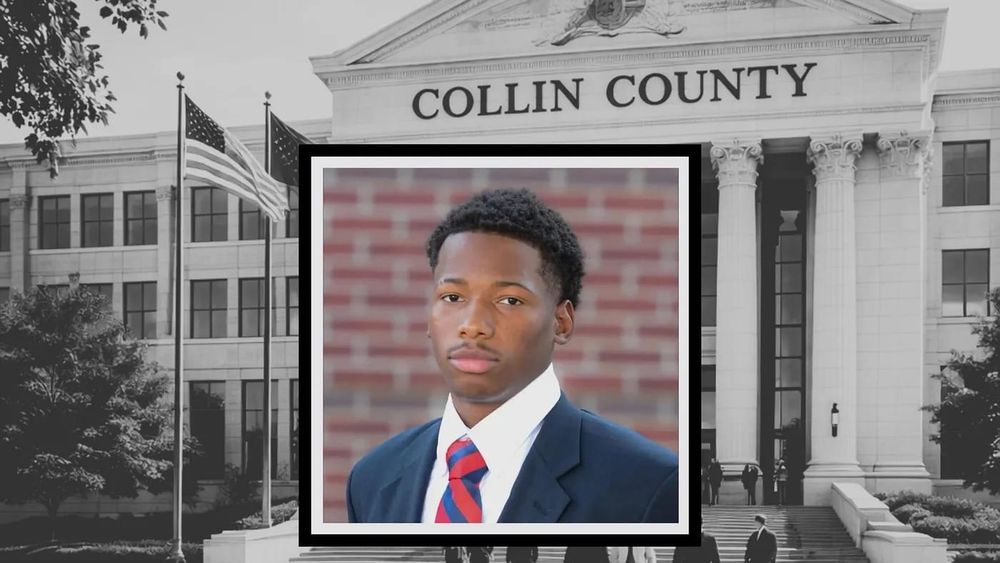
There’s widespread backlash to the guilty verdict and sentencing in the case of Karmelo Anthony, the Black teenager who claimed to have acted in self-defense when he fatally stabbed Austin Metcalf, a white teenager, during a Texas track meet. Without context regarding the nation’s history of racial prejudice, some may wrongly assume that those calling the outcome of the case an injustice support acts of violence, but this couldn’t be further from the truth. For instance, in an online statement, Bernice King, the daughter of Dr. Martin Luther King Jr., suggested “a Black teenager has been sentenced to 35 years in prison after being convicted by a jury with no Black jurors,” adding that “whatever one believes about the verdict itself, we cannot ignore the larger truth that many Americans are still wrestling with: justice is still being administered through a system with a long history of racial disparity in sentencing and punishment.” What may seem like a colorblind process often falls short of that standard.
While self-defense laws appear race-neutral, research suggests otherwise. For instance, one report found that “white-on-black homicides have justifiable findings 33 percentage points more often than black-on-white homicides,” in states with Stand-Your-Ground laws. According to a Texas Defender Service (2024) report, from 1992 to 1999, Harris County prosecutors sought the death penalty for Black defendants at a rate “more than three times higher than when a similarly situated defendant was white.” These findings point to a criminal justice system in which Black people are more likely to be found guilty and face stiffer punishment. Law professor Addie C. Rolnick explained in the Cardozo Law Review that “while the laws governing stranger self-defense are facially race-neutral, self-defense is assessed only according to whether the defendant’s fear is reasonable to the reviewing prosecutor, judge, or jury. Research on unconscious bias and cultural myths about criminality demonstrates that fear is racially contingent.”
Who gets to be seen as reasonably afraid often reflects prejudicial assumptions within a given society.
The Collin County jury, one comprised mostly of white jurors and none who were Black, found Karmelo Anthony guilty, relative to the standard of self-defense in Texas. Section 9.32 of the penal code states that deadly force is only legal when the person poses an immediate danger of deadly force or to stop someone from committing an imminent violent felony. Since Texas state law describes shoving as non-deadly force, the jury didn’t consider the stabbing as a reasonable response. They didn’t believe Anthony was afraid enough to use deadly force and saw his warning not to touch him as provocation. The analysis of this law as it pertains to the case is subjective. While the prosecutor argued that Anthony responded with deadly force when he shouldn’t have, the defense claimed he only acted to stop Austin Metcalf from inflicting further violence against him. Despite Austin Metcalf initiating the physical altercation, the jury found Anthony guilty of murder, and he was sentenced to 35 years.
After hearing the verdict, Anthony’s grandmother shouted, “Racist! Bias,” while sitting in the passenger side of an Acura sedan, near a crowd waiting outside the courthouse. Her sentiment echoed throughout the black community, sparking conversations about the lasting impact of racism in the criminal justice system and how stereotypes that frame Black people as inherently violent impact public perception and even jury deliberations. Brittany Coakley, an activist who spoke outside the Texas courthouse, told reporters, “So many of us Black Americans have similar stories of us being bullied or harassed by these people, and when we try to defend ourselves, it’s an issue.” Like some others who voiced disapproval, she saw the trial of Karmelo Anthony as evidence of a racial double standard, that Black people are being deprived of equal protection under the law. Who gets to be seen as reasonably afraid often reflects prejudicial assumptions within a given society. According to an Urban Institute report, “white-on-black homicides were most likely to be ruled justified, and black-on-white homicides were least likely to be ruled justified (Roman, 2013). While it’s difficult to prove how much impact racial bias played on this jury process, research indicates that it has generally tipped the scales against Black defendants.
The alternative to shining a light on racial injustice is to allow prejudice to persist under the cover of darkness.
In America, Black people are overrepresented in the criminal justice system, not because they are more likely to engage in criminal behavior, as racists often claim. According to a Stanford Law School report, “Empirical analyses do not support the notion that people of color are disproportionately represented in the criminal justice system solely as a result of committing more crimes. Rather, individual and systemic racial biases drive disparities.” Those who adopt a colorblind worldview often ignore evidence of systemic racism in the criminal justice system, and in doing so, fail to consider how the race of a defendant impacts how they’re seen. Researchers at St. Mary’s University explained that “The permanence of racism is evident in unrepresentative juries and the quality of deliberations, as Black defendants are more likely to be convicted and sentenced to longer and harsher sentences when Black jurors are not present during jury deliberations (Conyers et al., 2025).” Within this context, it’s clear that many Black people commenting on the case of Karmelo Anthony are expressing reasonable frustration with a system that often produces racially disparate outcomes.
When Black people cry foul play, they’re often accused of playing the race card. But the alternative to shining a light on racial injustice is to allow prejudice to persist under the cover of darkness. And that is something we shouldn’t do. A Marshall Project report found homicides of Black men by White people were considered justifiable at eight times that of any other combination, a phenomenon that’s persisted for decades (Lathrop & Flagg, 2017). Consistent with other studies, the findings suggest that although self-defense laws appear fair and impartial, our system produces disparate outcomes. Perception of reasonable force used in self-defense cases is tainted by racial bias. Consider, for instance, that Duke University study found that in two Florida counties from 2000–2010, “all-white jury pools convict Black defendants 16 percent more often than whites,” a disparity eliminated entirely once a single Black juror was included.
“Why do you have to make everything about race?” Black people are often asked this when they raise awareness about racial disparities. And yet, as Rolnick (2013) argued, self-defense cases involving strangers are essentially “always ‘about race’ in the sense that they are about individual and shared fear and are therefore uniformly vulnerable to widely shared biases.” In this case, while Anthony knew someone under the team tent and planned to stand there until the rain stopped, the assumption that a Black teenager didn’t belong there and should be promptly removed by force started a chain of events that ended in tragedy, with the death of a white teenager and the long-term incarceration of a Black teenager. Conversations surrounding the trial, while difficult, have exposed the myth of race-neutrality in self-defense cases, and more broadly, in the disparate treatment that Black people endure within the criminal justice system.