
We all know over the last several years there’s been a coordinated effort to pretend race doesn’t exist. To, in the words of some, “stop dividing us” by talking about race.
Translation:
Anything that highlights Black history and achievement suddenly becomes controversial.
In 2025, as part of a Pentagon-wide purge of “DEI-related” content, pages about Colin Powell were removed from U.S. Department of Defense websites. The same sweep removed or altered content about the Tuskegee Airmen, Jackie Robinson’s military service and the first Black Medal of Honor recipient.
Arlington National Cemetery likewise removed web content highlighting Black, Hispanic, and women veterans.
All designed to lower your grocery bills. I digress.
These are just a snapshot of a broader effort to make “adjustments” under the banner of “unity” and remove Black achievement from history.
Nothing says confidence in your history like deleting parts.
But the refusal to discuss race is more than just removing some books, web pages and plaques.
It’s happening across the board. Such as in health care. Robert F. Kennedy Jr. himself refused to answer questions at a recent hearing about disparate health impacts on Black communities, essentially saying that it’s divisive to talk about it:
This same pattern is now happening in classrooms, in corporate boardrooms, and in state legislatures, where even mentioning race can get you labeled “divisive” or “political.”
The message is clear. Stop talking about Black.
Got it.
White history it is.
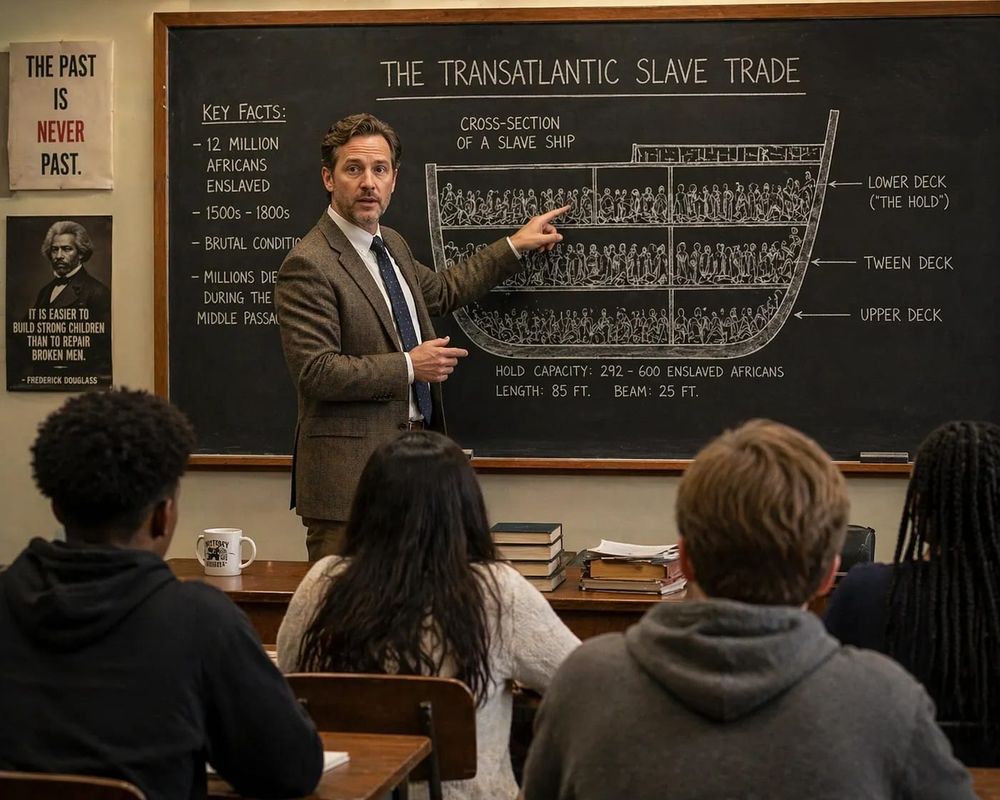
We’ll start with the transatlantic slave trade, the largest forced migration in human history, built, financed, insured, regulated and carried out by European and American institutions.
Millions of people kidnapped across the African continent, dragged in chains, washed in rivers, rubbed in shea butter for sale, sold, stored in dungeons, and then loaded onto ships. And inbetween, a fare share of rape and beatings.
European ships were literally designed and constructed for human cargo. European and American insurance policies were then written on Black bodies. Property insurance by their very terms. People were transported like livestock. Mortality rates were then calculated into profit margins. If people died en route, it was an accounting line item.
Millions of people chained to the ships, forcing people to defecate, bleed and oftentimes die on each other.
Those who survived the journey were then bought, sold, leased, mortgaged, inherited, and used as collateral. Entire families were separated as a matter of routine business. American laws protected the practice, while our Courts enforced it. Then pastors in churches rationalized it. Generational wealth was created from it.
The entire American economy, the economic foundation of America, was built on slavery.
It wasn’t enough to brutalize enslaved Africans and their descendants. America restricted literacy. Punished resistance. And stole inventions of the enslaved.
When slavery ended, white America still couldn’t help itself.
It embedded into the Constitution an amendment that allowed slave labor to continue if it was for punishment of crimes. And who wrote the criminal laws that could result in more slavery? Which is why even today incarcerated Black men and women are forced into free labor.
That still wasn’t enough. Jim Crow laws followed slavery and replicated its outcomes.
After so-called formal emancipation, the system underwent a rebrand. New logo. New tagline. Similar shit.
Segregation laws dictated where people could live, work, learn, travel, and exist. Voting rights were technically granted and practically denied through literacy tests, poll taxes, intimidation, and violence that was often public and rarely punished.
Schools weren’t equal. Infrastructure wasn’t equal. Legal protections weren’t equal. All to keep one group systematically beneath another while maintaining the appearance of order.
Those laws persisted into the 1960s and even 70s after finally deemed illegal. A hundred years after the end of slavery.
Sadly, America kept going.
The modern criminal legal system and mass incarceration was the next rebrand.
Policies like “tough on crime” sentencing, disparities in drug enforcement, and structural inequities in policing and prosecution developed as the new way of assigning suspicion, surveillance, and punishment along racial lines.
The numbers tell the story without needing much commentary. Disproportionate stops, sentencing outcomes, and incarceration rates all align in ways that would be shocking if they weren’t so consistent. The language and brand changed. The outcomes? Not so much.
Entire famililes destroyed. Even today, numerous Black men and women remain incarcerated for selling marijuana for recreational purposes while the practice is now legal in 25 states. Nearly 40 if you count medical marijuana.
But don’t worry, folks, that’s not teaching Black history.
That’s white history. So yes, let’s teach it. All of it.
Black history, by contrast, is survival in the face of all of this. It’s resilience even when rules were designed for their failure. It’s the building of culture and community when systems insisted none of it should exist.
Black history is orbiting the moon.