
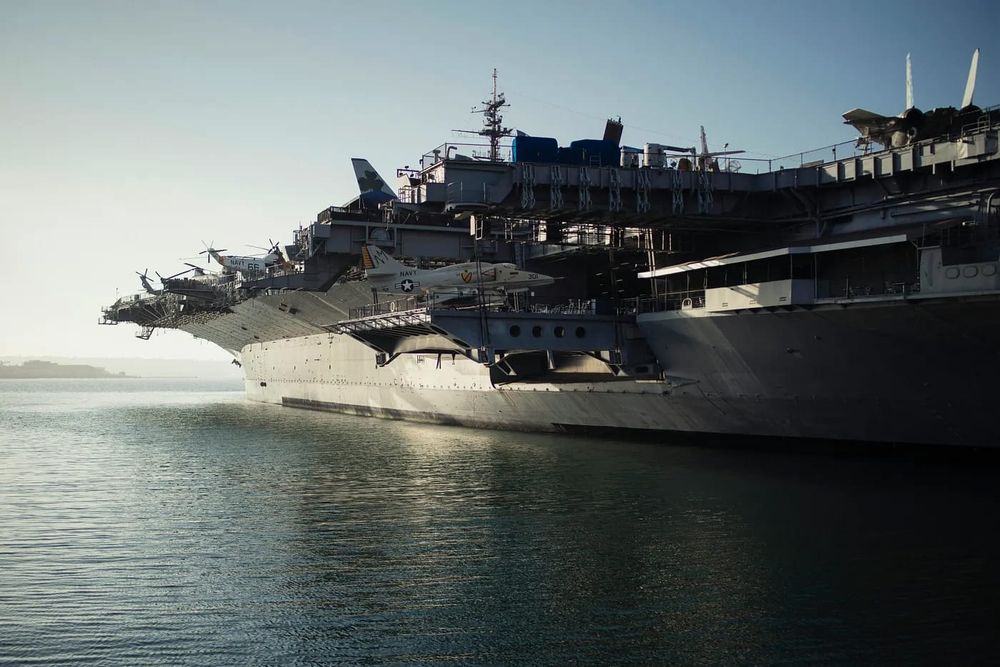
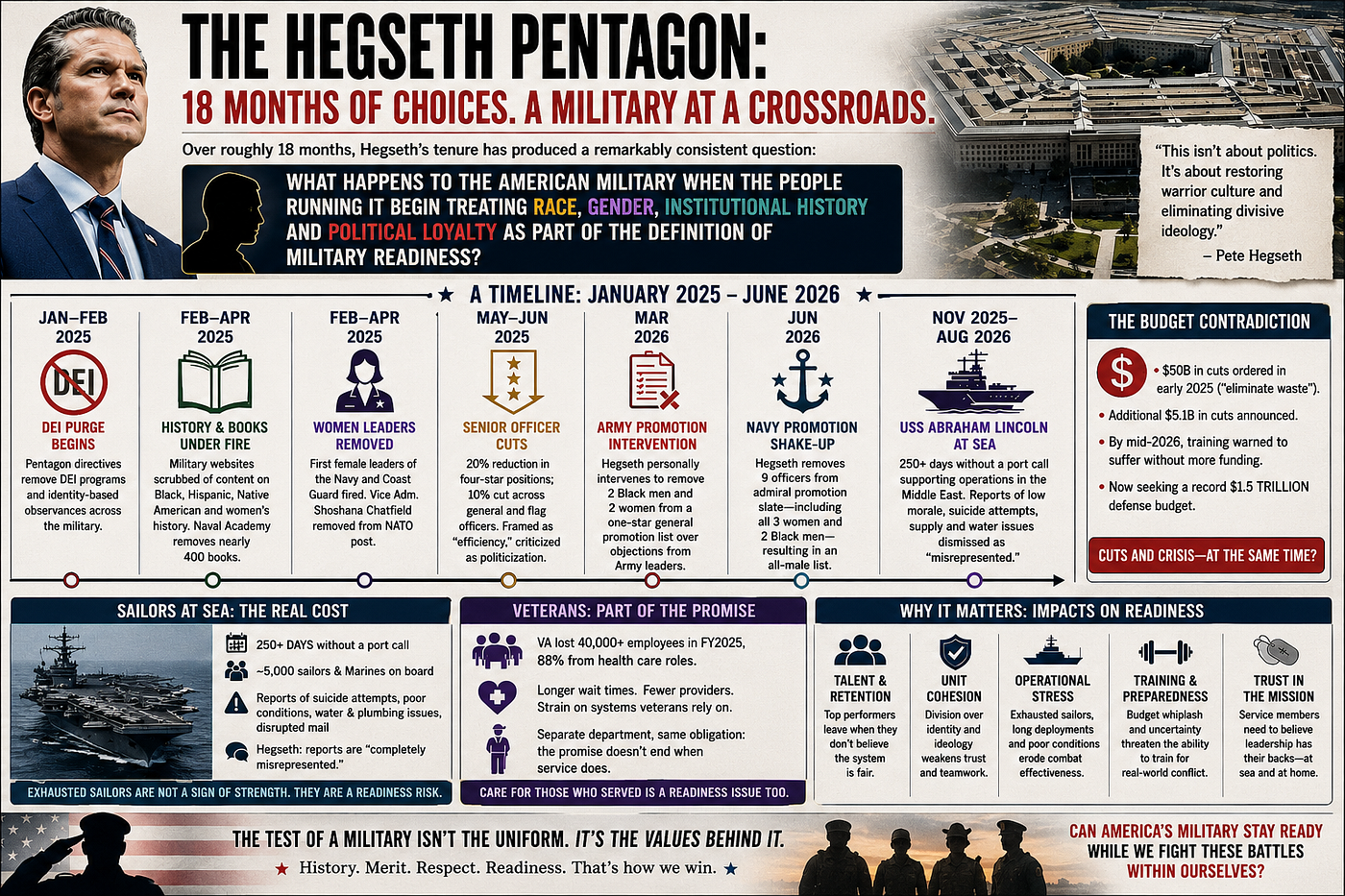
Two hundred and fifty days into the USS Abraham Lincoln’s deployment, a sailor still hasn’t stood on land. The carrier left port in November 2025. By August, it had gone longer without a port call than some enlistments run between reenlistments. Navy Times and Stars and Stripes have reported sailors attempting suicide aboard the ship, and morale bad enough that officers have flagged it up the chain. Pete Hegseth called those reports “completely misrepresented.” (Reuters)
That’s one data point. It isn’t the story by itself. But it’s where the story starts, because eighteen months into Hegseth’s Pentagon, the same question keeps surfacing: what happens to a military when the people running it treat race, gender, institutional history, and political loyalty as part of the definition of readiness?
Look at any single decision, and there’s an explanation. Look at the pattern, and the explanations stop being enough.
The Pattern Starts With Erasure
A viral claim said Hegseth personally scrubbed Colin Powell, the first Black chairman of the Joint Chiefs, from Arlington National Cemetery’s list of notable Americans. That specific claim is false. Powell’s profile stayed up. What actually happened was broader and, in its way, worse: about 40 profiles were pulled down and later restored, part of a sweep that stripped Arlington’s website of its African American history, Hispanic American history and women’s history categories.
That’s not a story about one webpage. It’s a story about which parts of military history the Pentagon decided were worth keeping visible.
The sweep started with language and expanded fast. By February 2025, identity-based observances and DEI programs were being cut across the department. In April, the Naval Academy pulled nearly 400 books tied to a directive reviewing material on race and gender. In May, the Pentagon ordered every military school to search its libraries for “divisive concepts and gender ideology.” (Reuters)
Then it reached people.
Adm. Lisa Franchetti, the first woman to serve as chief of naval operations, was fired in February 2025. Coast Guard Commandant Adm. Linda Fagan, the first woman in that job, had already been removed on the administration’s first day. In April, Vice Adm. Shoshana Chatfield, the only woman on NATO’s Military Committee, was pulled as well; officials told reporters the move traced back to her past support for diversity initiatives.
These weren’t mid-level personnel lost in a reorg. They were among the most senior women the American military had.
Then the Purge Widened
Hegseth ordered a 20% cut to four-star positions and a 10% cut across general and flag officer ranks, framed as trimming bureaucracy. Maybe it was. But the framing doesn’t answer the harder question: who got removed, how, and whether professional judgment was giving way to political judgment.
Two moments in 2026 make that question impossible to wave off.
In March, Hegseth removed two Black male officers and two women from an Army promotion list for one-star general, overriding a secretary who had resisted the change on the strength of their records.
In June, the Navy sent up 31 names for a one-star admiral. Hegseth cut nine, including all three women on the list and two Black men. What went to confirmation was an all-male slate, in a service where women make up roughly a quarter of officers and nearly a third of the midgrade ranks.
Hegseth’s office says none of it involved race or gender. Take that seriously. Then look at the same list twice, once before he touched it and once after, and decide for yourself what changed.
The Ship Tells the Same Story from a Different Angle
The Lincoln isn’t an isolated bad deployment. Sailors aboard have gone months on disrupted mail, plumbing that hasn’t worked right since spring, and water that runs the wrong color out of the tap. That’s what “more than 250 days without a port call” looks like from inside the ship instead of on a briefing slide.
A long wartime deployment isn’t proof of mismanagement on its own. But a ship that hasn’t touched port in the better part of a year is a readiness problem, whether or not anyone wants to call it one. Weapons and fuel are half of readiness. The people running the ship are the other half, and exhaustion doesn’t stop counting just because leadership calls it resilience.
The Same Administration, the Same Pattern
The Lincoln isn’t sitting off the Middle East by accident. It’s supporting a war with Iran that opened in February 2026 and is still running, and that war is the clearest place to see how this leadership crisis and the country’s economic crisis are the same, wearing two uniforms.
The war was sold as decisive. General Dan Caine told reporters US forces had struck more than 11,000 targets and were “focused on interdicting and destroying” Iran’s missile and drone programs. Eighteen months later, the Pentagon’s own casualty count has climbed past 600, munitions stockpiles have run low enough that the department is leaning on defense contractors to speed up production, and the president says the US is “low-keying” negotiations rather than closing them out. Gas prices are still running more than a third higher than before the war began.
The same pattern shows up in the deportations and the tariffs.
Deportation was sold as a jobs program for American-born workers. A May 2026 study tracked what actually happened: a 5% employment drop among undocumented workers, and a 1.3% drop for American-born men without a college degree working the same industries, because employers didn’t raise wages to pull native workers into the jobs left open. Texas, one of the states leaning hardest into enforcement, saw its job growth fall from roughly 2% a year to near zero. Tariffs were sold as protection for American consumers. Wholesale vegetable prices jumped nearly 39% in a single month, with food-industry officials pointing to the same labor shortages the deportations created.
Sailors without a port call. Officers removed from promotion lists. Workers who lost jobs were supposed to be saved by the deportations. Families are paying more at the register for the tariffs that were supposed to protect them. Different departments, different press releases, the same administration asking people to accept the cost up front on a promise that the payoff is coming.
Eighteen months in, that promise is still a promise.
The Obligation Doesn’t End at the Gangway
The Pentagon and the VA are separate departments, and it would be wrong to lay every VA failure at Hegseth’s feet. But the two are connected by the same promise: the country asks for real sacrifice, then owes the people who gave it. A Senate Veterans’ Affairs report from January 2026, produced by Sen. Richard Blumenthal’s office and worth reading with that in mind, found the VA lost more than 40,000 employees in fiscal 2025, 88% of them health care staff. That’s not Hegseth’s decision. It’s the same question asked from the other end of a career.
What the Pattern Adds Up To
None of these facts alone proves intent. Cutting DEI programs can be called eliminating bureaucracy. Changing a promotion list can be called enforcing merit. A long deployment can be called a wartime necessity. A stalled economy can be called short-term pain before long-term gain. Each explanation is plausible in isolation.
Stacked together, the record is short. The Pentagon erased the history. It removed the senior women. It stripped officers from two promotion lists in three months. It produced an all-male slate. It kept a carrier at sea without a port call and called the complaints misrepresented. It asked for a bigger budget the year after it promised to cut waste. And it did all of it while the war ran past its promised decisive window and the bill for tariffs and deportations landed on the people who were promised the opposite.
That’s not a coincidence. So who’s answering for it?
Colin Powell, Lisa Franchetti, Linda Fagan, Shoshana Chatfield, the four officers dropped from the Army’s list, the nine cut from the Navy’s, the sailors on the Lincoln, the workers priced out of jobs the deportations were supposed to save for them, the 40,000 employees who left the VA. None of them are the story by themselves. Together, they’re the evidence.
The Test of a Military Isn’t the Uniform
The United States doesn’t have the world’s most capable military because its leaders are good at slogans. It has one because millions of people have trusted the institution with their lives, and that trust runs on specifics: a Black general believing his record outweighs his race, a female admiral believing her judgment gets weighed on its own, a sailor nine months from home believing someone in Washington understands what that costs, a veteran believing the country hasn’t forgotten what he gave it, a worker believing the sacrifice asked of him is actually buying something.
The real story behind Colin Powell was never that Hegseth deleted him. It’s that his Pentagon has spent eighteen months redefining who counts as ready, who counts as deserving, and who counts as remembered, inside an administration asking the whole country to carry more than it’s been carrying, on a promise that keeps getting pushed back.
Can a military, or a country, stay ready while its leadership is fighting over who gets remembered, who gets promoted and who gets believed?
That answer won’t come from a press release. It’ll come from the retention numbers, the promotion records, the price of groceries, and from whether the sailor on the Lincoln finally sees land and finds anything waiting for him worth the wait.
That’s the real Hegseth test.