
Americans have told themselves a story for generations about how this country grew: A man with a little courage, a strong back, and a willingness to work could head west, claim a piece of land, build a home, and make something of himself. His family could farm the land, raise children, start a business, and pass it down to the next generation. That opportunity, multiplied across millions of acres, helped transform the United States from a collection of eastern settlements into a continental power. It is a compelling story. It is also an incomplete one.
Free and inexpensive land was among the most important tools the federal government used to encourage American expansion. But the opportunity to acquire that land was never equally distributed. Native Americans were dispossessed as the country expanded westward. Women faced legal and practical obstacles to property ownership. And Black Americans, particularly those emerging from slavery, were denied the economic foundation that land ownership could have provided. Even after emancipation, the promise of land and independence remained elusive for millions of formerly enslaved people.
The story of the Exodusters, especially the founding of Nicodemus, Kansas, shows what happened when Black Americans tried to claim a share of the opportunity that had helped build the country.
Land: One of America’s Greatest Engines of Growth
From the beginning of the republic, land was more than a place to live. It was a source of wealth, political power, economic independence, and opportunity. The federal government used the sale and distribution of public lands to encourage settlement, finance government operations, and populate territories that eventually became states.
The Homestead Act of 1862 was one of the most consequential examples. Signed by President Abraham Lincoln on May 20, 1862, the law let eligible applicants claim up to 160 acres of federal land. To obtain ownership, a settler generally had to live on the property, improve it, cultivate it, and meet a five-year residency requirement. After fulfilling those obligations, the homesteader could receive a title to the land for a modest filing fee.
The program's scale was extraordinary. More than 270 million acres of public land eventually passed into private hands under the Homestead Act. Settlers established farms, built communities, opened businesses, and helped create the agricultural economy of the American West. Railroads, local governments, schools, and commercial centers followed. The land was not always fertile, and the work was often punishing, but for millions of Americans, homesteading offered a chance to acquire something that might otherwise have been financially impossible.
Much of the land made available to settlers had been taken from Native American nations through treaties, forced removal, warfare, and federal land policies. The Homestead Act was part of a larger expansion that transferred Indigenous territory into the hands of non-Native settlers. The American opportunity story was, for Native Americans, frequently a story of dispossession.
For Black Americans, the problem was different but equally fundamental: emancipation did not come with the land necessary to make freedom economically meaningful.
Freedom Without Land
At the end of the Civil War, approximately four million formerly enslaved people were attempting to build lives in a country that had spent generations treating them as property. They had been denied wages, property rights, education, and the ability to accumulate wealth. Many had spent their entire lives working land owned by someone else.
Land ownership offered a possible way out of that dependence. A family with its own farm could grow food, sell crops, educate children, and build assets to pass on. Without land, many freedpeople faced the prospect of returning to work for the very plantation owners who had enslaved them. Briefly, there was reason to believe the federal government might help.
In January 1865, Union General William Tecumseh Sherman issued Special Field Orders №15, setting aside approximately 400,000 acres of abandoned or confiscated coastal land in South Carolina, Georgia, and northern Florida for settlement by formerly enslaved families. The land was to be divided into plots of up to 40 acres. Sherman also authorized the loan of army mules to help the settlers work their new farms. This became the origin of the famous phrase “40 acres and a mule.”
For a moment, the federal government appeared prepared to connect emancipation with economic independence. Thousands of Black families settled on the designated land, believing they had finally acquired something of their own. But the promise did not last.
After Lincoln’s assassination, President Andrew Johnson pursued a policy of restoring property to former Confederates who sought presidential pardons. Much of the land distributed under Sherman’s order was returned to its previous owners. Freedpeople who had already begun farming were evicted, often with little recourse. Black farmers made improvements to the land, but the new white owners received them without compensation. The government that had offered them land ultimately restored much of it to the men who had once owned them.
The Freedmen’s Bureau was authorized to help freedpeople acquire land, including through provisions allowing some to rent and eventually purchase abandoned or confiscated property. Johnson’s restoration policy undermined those efforts.
The significance of this reversal cannot be overstated. The federal government had a chance to give enslaved families a foundation for economic independence formerly. Instead, most were left with freedom but little property, little capital, and few protections against the people who had controlled their lives for generations.
The Homestead Opportunity — and its Limitations
The Homestead Act of 1862 was another potential route to land ownership. Its original eligibility language referred to citizens and those who intended to become citizens, and the question of Black citizenship remained deeply contested. The Civil Rights Act of 1866 and the Fourteenth Amendment established the legal foundation for recognizing African Americans as citizens and protecting their rights. Black Americans subsequently used federal homestead laws to acquire land. But legal eligibility did not mean equal access.
A person could not simply walk onto 160 acres and expect a farm to appear. Homesteading required transportation, tools, livestock, seeds, construction materials, and enough money to survive until the first successful harvest. Settlers needed to build a house, dig or secure a water supply, break the prairie, and endure years of uncertainty. Even white settlers with resources frequently failed.
For formerly enslaved people, those expenses were particularly difficult to meet. Generations of unpaid labor had left most without savings or inherited property. In the South, white landowners frequently resisted selling productive land to Black families. Sharecropping and tenant farming offered a way to survive, but they also kept many freedpeople economically dependent on landowners. Crop liens and high-interest debts could leave families owing more at the end of a growing season than at the beginning.
Violence made matters worse. The Ku Klux Klan and other white supremacist organizations used intimidation and murder to suppress Black political participation and discourage economic independence. A Black family attempting to purchase land, leave a plantation, or challenge a white landowner could face threats that had little to do with the law and everything to do with maintaining white control. The result was an enormous gap between the promise of American land policy and the ability of Black Americans to benefit from it. Still, some refused to accept that the plantation system had to determine their future.
Pap Singleton and the Road to Kansas
One of the most important figures in the movement toward Black western settlement was Benjamin “Pap” Singleton, a formerly enslaved man from Nashville, Tennessee. Singleton understood that freedom without economic independence left Black families vulnerable to the same people who had once enslaved them.
In the late 1860s, he encouraged Black families to acquire farmland in Tennessee. But white landowners were often unwilling to sell them productive property. Singleton began looking west, where public land and the chance to establish independent Black communities offered a different future.
Kansas was an especially attractive destination. It had become nationally identified with the struggle against slavery during the violent years of Bleeding Kansas in the 1850s. Its reputation as a free state, combined with the availability of homestead land, made it a symbol of possibility.
Singleton organized migration through land and settlement associations, including the Edgefield Real Estate and Homestead Association. His promotional materials described Kansas as a place where poor people could find land, build peaceful homes, and escape the South's racial restrictions.
His efforts helped direct thousands of Black migrants toward Kansas. The movement eventually became known as the Exoduster migration, a reference to the biblical Exodus of the Israelites from slavery in Egypt.
The name was appropriate. These migrants were not simply looking for a better job or a more comfortable neighborhood. They were attempting to escape a system that had denied them control over their labor, their property, and frequently their personal safety. They wanted land of their own.
Singleton was not the only organizer. Black ministers, community leaders, land companies, and local associations helped encourage migration. Some settlers traveled in organized groups, while others made the journey independently. The movement included families with some money and resources, as well as desperately poor people who arrived with almost nothing.
The largest wave came around 1879 and 1880. The National Archives estimates that approximately 40,000 to 60,000 African Americans left the South for western destinations during the 1870s, with more than 6,000 arriving in Kansas in the spring of 1879 alone.
But Kansas was not a promised land waiting to receive them with open arms. It was a place where they would have to build their future largely with their own hands.
Nicodemus: A Town Built from Hope
Before the largest wave of Exodusters arrived, another group of Black settlers had already begun establishing a community that would become one of the most enduring symbols of African American western migration.
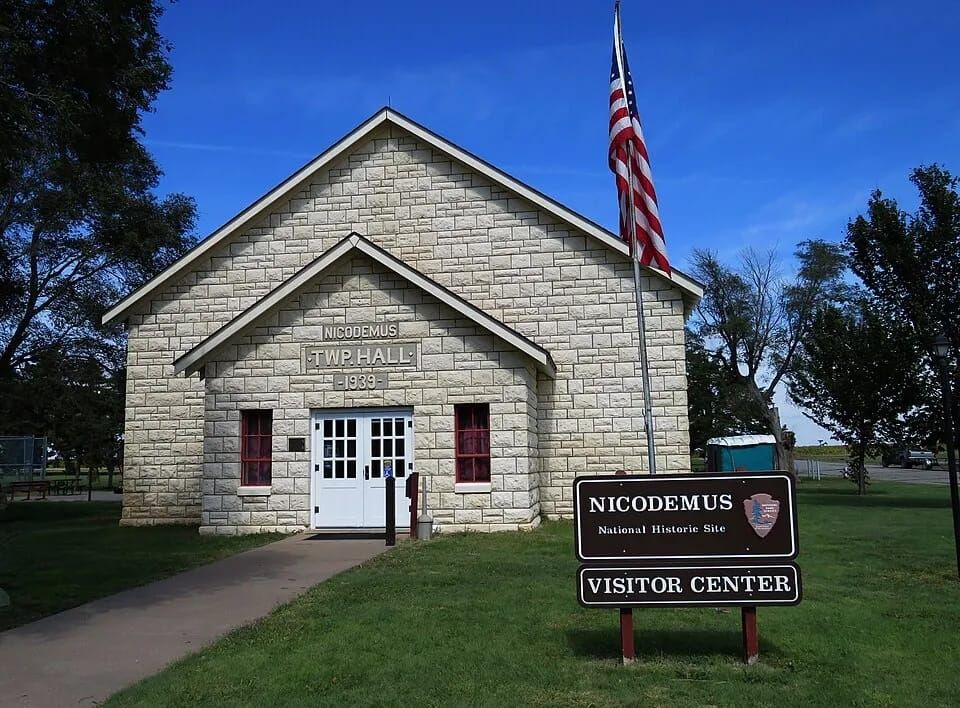
In 1877, six Black entrepreneurs in Topeka joined with a white developer, W. R. Hill, to establish the Nicodemus Town Company. They planned to create an independent Black settlement in Graham County, in north-central Kansas, using federal land policies and the opportunity to acquire town lots and homesteads.
The first major group of settlers was recruited from the Lexington, Kentucky, area. Promoters described the Solomon River valley as an attractive place to build a new life. They spoke of available land, water, building materials, and the opportunity to establish a community free from the racial oppression of the South. The reality was considerably less inviting.
Approximately 350 to 380 people signed up for the journey, paying a small fee to participate in the migration. They traveled by train, wagon, and on foot, arriving on September 17, 1877. They found a remote stretch of prairie, far from established rail lines and stagecoach routes. The landscape was largely treeless, transportation was difficult, and the nearest established towns were a considerable distance away.
Some settlers were stunned by the difference between the advertised destination and the land before them. The promises of plentiful timber and easy farming had been exaggerated. The area received relatively little rainfall, and the absence of transportation made obtaining supplies difficult. Roughly 50 of the most disappointed settlers reportedly returned east almost immediately.
Those who remained faced a decision that would define the community: abandon the dream or begin building. They began building.
With little timber available, the settlers dug out shelters in the earth and built houses from sod. These were not romantic pioneer cabins. They were practical shelters made from the materials at hand. Families had to prepare for winter while simultaneously clearing land, planting crops, and creating the basic infrastructure of a town.
The first crops failed. Breaking the prairie was exhausting work, and families had little financial cushion to absorb a bad harvest. Men, women, and children did the labor needed to establish farms. Additional migrants arrived from Kentucky and Mississippi, and by the end of the decade the community had begun to take shape.
Within two years, hundreds of people had migrated to Nicodemus. Settlers established farms across the surrounding countryside, while the town developed the institutions that make a community more than a collection of houses.
The town had churches, a general store, a hotel, a post office, livery stables, and a real estate office. The residents established Graham County’s first public school. Education was especially important to people whose ancestors had been prohibited from learning to read and write under slavery. A school represented not only an investment in children but a declaration that the community intended to have a future.
Churches became centers of religious and civic life. Businesses provided services and employment. Community leaders participated in local politics, and Nicodemus residents used their votes to help elect candidates to county offices. The settlement demonstrated that Black Americans could establish and govern a community, manage businesses, acquire land, and participate in political life. The community was not simply surviving. It was building.
The Exodusters Arrive — and Kansas Struggles to Respond
Nicodemus was one part of a much larger movement. By 1879, Black migrants were arriving in Kansas by the hundreds, many of them traveling by steamboat to river cities such as Atchison, Wyandotte, and Kansas City.
The scale of the migration overwhelmed some receiving communities. Many migrants arrived sick, exhausted, and without enough money to begin farming. Yellow fever outbreaks had complicated travel, and families sometimes reached Kansas in desperate need of food and shelter.
Not all settlers could immediately take advantage of a homestead claim. Some had little more than the clothes on their backs. Others were too poor to purchase equipment, livestock, or supplies. They needed assistance before they could become self-sufficient.
Kansas Governor John P. St. John responded by helping establish the Freedmen’s Relief Association in May 1879. The organization collected and distributed aid to migrants, providing food, temporary shelter, and settlement support. It also helped establish colonies and communities where Black newcomers could begin rebuilding their lives.
The response was significant, but the influx of people created tensions. Local communities were already struggling economically, and some white residents resented the migrants. Black newcomers were sometimes given derogatory names for the neighborhoods in which they settled. The experience revealed that even in a state with a reputation for opposing slavery, racial prejudice had not disappeared.
The Exodusters also faced a difficult economic reality. Free land did not mean free farming: a homestead required money, labor, and years of patience. Many families could not afford the supplies necessary to make their claims successful. Others found that the land was less productive than expected.
Nevertheless, thousands stayed. They built homes, established churches, opened businesses, and created communities throughout Kansas. Their migration was not a failure simply because not every family became prosperous. For many, the opportunity to live beyond the direct control of former slaveholders was itself a profound change.
The Railroad that Never Came
Nicodemus experienced growth and relative prosperity in the early 1880s. Farmers were becoming established, businesses were opening, and the town’s population and political influence were increasing. One development was expected to secure the community’s future: a railroad.
Railroad connections were essential to the economic survival of many western towns. They provided market access, transported crops, brought in supplies, and encouraged merchants and new residents to settle nearby. A town bypassed by the railroad could lose business and population to a neighboring settlement. Nicodemus residents believed a rail line would serve their community. The expectation encouraged investment and growth. But in 1887, the railroad bypassed Nicodemus in favor of another town several miles away.
The consequences were serious. Businesses lost opportunities, farmers faced higher transportation costs, and commercial activity shifted elsewhere. The community was further battered by droughts that struck the region from the late 1880s into the 1890s.
Farmers who had struggled for years to establish themselves found it increasingly difficult to remain on their land. Some sold their property; others lost it. According to National Park Service research, landownership in Nicodemus Township fell from approximately 96 percent in 1885 to 54 percent by 1900. The number of farms declined from about 70 to 48 during the same period.
Nicodemus did not disappear. Its population continued to grow into the early twentieth century, reaching approximately 400 residents around 1910. But the community never regained the economic momentum its founders had hoped the railroad would bring.
What Nicodemus Tells us about the American Promise
The story of Nicodemus is not simply a tale of hardship. It is a remarkable example of what Black Americans accomplished when they had the opportunity to pursue land ownership and community independence.
The settlers did not wait for someone to build a town for them. They constructed homes from sod, established churches and schools, opened businesses, organized local government, and created a community where their children could imagine a future beyond the restrictions of the South. Their achievement deserves to be remembered alongside the stories of the millions of other settlers who helped build the American West.
But it also raises an uncomfortable question: What might have happened if formerly enslaved people had received the land that briefly appeared within their reach after the Civil War? What if the promise of 40 acres had been honored? What if Black families had entered freedom with the same opportunity to accumulate property and pass wealth to their children as so many other Americans?
There is no way to calculate the economic consequences of the opportunity that was denied. But it is impossible to discuss the history of American land ownership honestly without acknowledging the difference between the opportunities extended to white settlers and the barriers confronting Black Americans.
The Homestead Act helped transfer hundreds of millions of acres into private ownership. It helped create farms, businesses, towns, and generations of inherited wealth. Black Americans eventually participated in that process, but they did so after slavery had denied them the ability to accumulate property, after the federal government reversed an early land redistribution effort, and amid discrimination, violence, and economic disadvantages that white settlers did not face in the same way.
Nicodemus stands as a reminder that Black Americans were not absent from the great American westward migration. They participated in it, built it, and believed in its promise. They wanted what other Americans wanted: a piece of land, a home, a measure of independence, and something to leave their children.
They found a place on the Kansas prairie and built a town where almost nothing existed before they arrived. The railroad bypassed them, drought threatened them, and economic hardship drove many away. Yet Nicodemus survived, and its founders' descendants continue to preserve its history.
America’s growth was built largely on the promise that land could turn labor into independence and opportunity into wealth. The Exodusters believed that promise applied to them, too. Their story reminds us that the question was never whether Black Americans were willing to work the land. They had already spent generations doing that. The question was whether a country that had grown rich through land and labor was prepared to let them own a share of the opportunity. For too many, the answer was no.
The federal government’s use of land to encourage westward expansion began long before the Homestead Act of 1862. In fact, it was built into the country’s expansion from its earliest years. The Land Ordinance of 1785 established a system for surveying and selling territory west of the Appalachian Mountains, dividing it into townships and sections that settlers, speculators, and land companies could purchase. The Northwest Ordinance of 1787 established a process for organizing these western territories and admitting new states. Later, the federal government used land grants to encourage settlement, reward military service, support canals and railroads, and promote agricultural development. The Preemption Act of 1841 gave certain squatters who had already settled and improved federal land the right to purchase it before the government offered it to the general public. By the time Congress passed the Homestead Act, the government had spent nearly a century using public land as an instrument of national growth. The Homestead Act did not invent the opportunity; it expanded and formalized a system that had already helped populate and develop the country.
The system benefited successive waves of European immigrants, including Germans, Irish, Scandinavians, Italians, and other ethnic communities who came to America seeking land and economic opportunity. Many could purchase inexpensive federal land, receive military bounty lands, or eventually claim homesteads. The Homestead Act also allowed immigrants who declared their intention to become U.S. citizens to apply, opening the door to millions of newcomers. In that sense, land policy helped turn America into a nation of immigrant farmers and property owners. But the opportunity was never universal.
Native Americans were the greatest victims of this expansion, as their ancestral lands were taken and opened to settlers. Mexican landowners in territories acquired by the United States often faced costly legal battles and lost property. Chinese and other Asian immigrants faced racial restrictions on naturalization that generally prevented them from qualifying for federal homesteads, while Black Americans, although legally eligible for land ownership, confronted poverty, discrimination, violence, and the legacy of slavery. So while European ethnic groups from many different backgrounds benefited from America’s land policies, the benefits were distributed along racial and legal lines. The country welcomed immigrants willing to help settle the West, but it did not offer everyone the same chance to own a piece of it.