
Before I spent my life reading and writing about serious topics like history, race, and education, I was an avid comic book reader. I was well-versed in Superman, Batman, and Wonder Woman, but my heart was with the Marvel characters. I longed for the day when my favorite heroes and villains could be accurately portrayed on the big screen. There have been some big misses, but generally speaking, the Marvel Cinematic Universe (MCU) has come a long way towards making my dream come true.
From 7th-12th grade, I took a city bus to school, transferring once downtown, right in front of Shinders Bookstore, far better known for its comics, trading cards, newspapers, and collectibles than books. There were several racks of comics, bins containing older issues, and a display case with everything. You could buy a replica of Thor’s hammer, Mjolner, or a model of Iron Man or Doctor Doom. I only had comic book money, but a kid can dream.
From 1961 through the late 1960s, the Fantastic Four (FF) were unquestionably Marvel’s flagship title. They were Stan Lee & Jack Kirby’s most ambitious book. The FF introduced Marvel’s biggest concepts: Galactus, Silver Surfer, Black Panther, Inhumans, the Watcher, and the Negative Zone. They outsold the Avengers consistently and were marketed as “The World’s Greatest Comic Magazine,: which was demonstrably true. The Avengers were a second‑tier team at this time, with a rotating cast and less cohesive storytelling.
Due to legal issues, including marketing rights, the MCU spent almost 18 years building towards and focusing on the Avengers, beginning with Iron Man in 2008. The characters outside the control of the MCU were still appearing on film; Spider-Man was owned by Sony, the X-Men were produced by 20th Century Fox, as were the Fantastic Four, with forgettable releases in 2005, 2007, and 2015. A version of Dr. Doom appeared in all three of those films, none of them matching the comic book character who was arguably Marvel’s greatest villain.
Most of the rights issues have been worked out. The MCU still has to borrow Spider-Man from Sony, Universal has solo film distribution rights to the Hulk and Namor. You still have a wait on your hands if you’re looking for Conan the Barbarian or the Micronauts to appear in the MCU. Still, for the most part, Marvel is now able to integrate the Fantastic Four and the X-Men into the MCU, though their existence hasn’t been acknowledged for almost two decades.
That’s all about to change with the release of Avengers: Doomsday on December 18, 2026. Doctor Doom will be the arch-villain in the film, which somehow brings together the Avengers, Fantastic Four, and the X-Men. We know Robert Downey, Jr, best known for playing Iron Man in the MCU until Iron Man died in Avengers: Endgame in 2019, will be the actor portraying Doom. This has created excitement and some concerns (mine especially) whether the Victor Von Doom coming to Avengers: Doomsday will be true to the Doom of the comics, who got his start in 1964.
Robert Downey as Iron Man was a brilliant, wisecracking, deeply wounded, flawed character who does evolve. In a different franchise, Sherlock Holmes, Downey plays Holmes brilliantly. wosecracking, deeply wounded, flawed character, the “jury’s out” regarding his evolution. Downey played essentially the same character as Tony Stark, Sherlock Holmes, and, arguably, Dr. Dolittle. Downey showed great range when playing Lewis Strauss in Oppenheimer, but will he be able to resist joining in on the one-liners when all the heroes around him have theirs? Downey’s performance isn’t my biggest concern; it’s whether the writers understand Victor Von Doom’s character and what made him who he is in the first place. There will be time constraints as to how much time can be spent on Doctor Doom’s origin, while merging at least two universes of characters and the meeting of and inevitable fights between the Avengers, Fantastic Four, and the X-Men. Can Doctor Doom’s back story be truly told in a CliffsNotes version?
Given the first time we saw FF foe Galactus in a movie (admittedly, the Sony version), he was shown as a cloud. I can’t go on blind faith that Marvel won’t take shortcuts. It’s up to me to describe the origins of Doctor Doom and what motivated him to become who he is today.
Victor grew up in a Romani family, an ethnic group with a long history of discrimination against them. They were called gypsies by governments, the police, and the public to criminalize Romani communities, justify forced removals, enforce discriminatory laws, and associate them with theft, fortune‑telling, or vagrancy. The term comes from the mistaken belief that Romani people came from Egypt (“Egyptian” → “gyptian” → “gypsy”). They actually originate from northern India.
Victor’s mother, Cynthia von Doom, is one of Marvel’s most tragic and mythic figures — a woman whose life and death shape every part of Doctor Doom’s destiny. Though she appears rarely, the details we do have paint a vivid picture of a brilliant, fierce, and ultimately doomed Romani sorceress.
Cynthia grew up among a persecuted minority under Latverian nobility. Her people lived in poverty, constantly harassed by soldiers and local authorities. This environment forged her fierce protectiveness and distrust of rulers.
Cynthia showed an early aptitude for mysticism. She had a natural sensitivity to magic, and she learned folk rituals, charms, and protective spells. Cynthia is portrayed as proud, compassionate, and determined to protect her people. She was unwilling to accept oppression as “the way things are. Her sense of justice is what ultimately leads to her downfall.
As an adult, Cynthia marries Werner, a gentle Romani healer. Their marriage is loving but strained by poverty, constant persecution, and the political cruelty of Latveria. Werner is cautious and humble; Cynthia is bold and fiery. Victor inherits both sides — but leans toward hers.
Cynthia gives birth to Victor, and Marvel consistently portrays her as:
- A devoted mother
- Emotionally intense
- Spiritually protective
Victor’s genius and pride are often implied to come from her.
Cynthia was tired of watching her Romani people suffer. Latveria’s Romani population lived under constant harassment, poverty, and violence from the Baron’s soldiers. Cynthia could not accept this. She believed only power could free her people.
Cynthia already had a natural affinity for mysticism. But in her grief and frustration, she began exploring darker, more dangerous rituals. These rituals opened a door, and Mephisto stepped through it.
Mephisto rarely shows his true form at first. To Cynthia, he appeared as a mysterious, seductive, otherworldly figure offering knowledge and power. He promised liberation for her people, telling her exactly what she wanted to hear.
Cynthia made a pact with Mephisto; he would grant her magical power, and she would use it to free her people. The cost would come later. She believed she could outsmart him. She believed she could control the magic. She was wrong.
Cynthia cast a massive spell meant to destroy the Baron’s soldiers. Instead, the magic lashed out uncontrollably. Innocent villagers — not soldiers — died that day. Cynthia realized she had been tricked. Mephisto had given her power, but twisted its purpose.
Horrified by what she had done, Cynthia fled into the forest. She collapsed in the woods, mortally wounded by the magical backlash. Werner von Doom, her husband, found her, but it was too late.
As Cynthia died, Mephisto appeared, her soul was dragged into his realm, and she became trapped in eternal torment. This is the moment that defines Victor von Doom’s entire life.
He grew up believing his mother was taken unjustly. Hell itself wronged his family, and he must master both science and sorcery to one day defeat Mephisto and free her soul. This becomes Doom’s lifelong obsession; it’s why he keeps seeking power, not for riches or because he has control issues. He’s a mother’s boy, seeking to save her soul.
Werner Von Doom, Victor’s father, was a healer, not a fighter. He was humble, self‑sacrificing, and committed to helping others even when it put him at risk.
Young Victor sees this and admires it, but he also sees how it leads to poverty, persecution, and powerlessness. This plants the seed of Victor’s lifelong belief:
“Compassion without power is useless.”
When the Baron’s wife became gravely ill, Werner was summoned to treat her. He realized she was beyond saving and that nothing he could do would prevent her death. When she died, the Baron’s soldiers blamed Werner.
He knew that staying meant imprisonment, torture, or execution, so he grabbed Victor and ran. Trying to escape the Baron’s wrath, Werner carried Victor into the freezing Latverian wilderness.
They had no supplies, no shelter, no warm clothing, no safe place to hide. Werner used his own body to shield Victor from the cold. By morning, Werner had frozen to death. Victor survived only because Werner wrapped him in his cloak. Victor woke up beside his father’s body. When you see Doctor Doom in his cloak, it’s a reminder of his father sacrificing himself trying to save power, not simply a fashion accessory.
Werner’s death teaches Victor several lessons that define Doctor Doom:
“The world punishes the powerless.”
He sees his gentle, compassionate father destroyed by cruelty.
“Only strength can protect the ones you love.”
Werner’s kindness couldn’t save him.
“I will never be weak again.”
This becomes Doom’s lifelong vow.
“I must master every force — science and sorcery.”
Werner couldn’t save Cynthia. Werner couldn’t save himself. Victor decides he will surpass both parents.
After Cynthia von Doom died, Victor discovered her trunks of magical relics, including her grimoires, ritual tools, and fragments of her demonic pact/ As a child, he studied her books in secret, learned basic spells, and experimented with charms and wards. He became obsessed with freeing her soul from Mephisto. This is where his mystic path truly begins.
Victor was self‑taught long before he met any master
By the time he was a teenager, Victor had mastered low‑level sorcery, learned to summon minor spirits, created protective wards, and built magical devices that blended science and mysticism. He was already dangerous before he ever left Latveria. His early magic was raw, powerful, and unstable — which leads directly to the next stage.
His first formal training came at Empire State University (indirectly). At ESU, Victor wasn’t taught magic — but he pushed his mystic studies further. He attempted to build a machine to contact the dead, specifically Cynthia, and pierce the veil between Earth and Hell. This experiment exploded, scarring his face and getting him expelled. The explosion occurred because Victor’s mystical knowledge was powerful yet undisciplined.
This failure sets up the next phase of his training.
After leaving America, Victor wandered the world, sought out occult masters, and followed rumors of ancient orders. He eventually found a hidden monastery in the Himalayas.
There, he trained under Tibetan sorcerers, mystic monks, and practitioners of ancient magical disciplines. They taught him focus, discipline, ritual precision, astral projection, and advanced spellcraft. This is also where he forged his first armor and became Doctor Doom.
20th Century Fox never showed us Doctor Doom with this history and motivation. Then again, they were the ones who gave us Galactus as a cloud. The MCU has the chance to get it right. I hope they do.
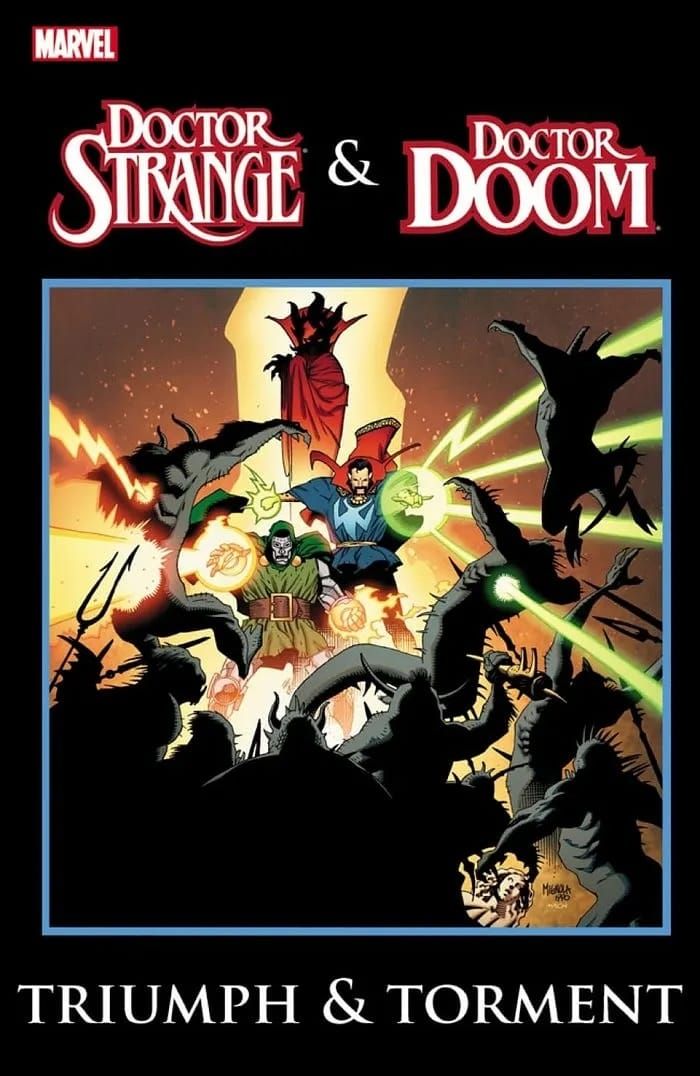
For more of Doom’s origin, and how he recruited Doctor Strange, and how they faced Mehisto in an attempt to recover Doom’s mother. A must-read is Doctor Strange & Doctor Doom: Triumph and Torment (1989). You’ll be glad you did.