
I’m a straight man, but I wasn’t always so sure. This didn’t come down to desire, but how my masculinity presented. To this day, people ask about my sexuality regularly.
Richard Gadd’s work on Baby Reindeer caused a paradigm shift within me. I was forced to reflect on my beliefs about consent, desire, and masculinity. (Read about it here.) Half Man, his newest show, did it again.
The Setup
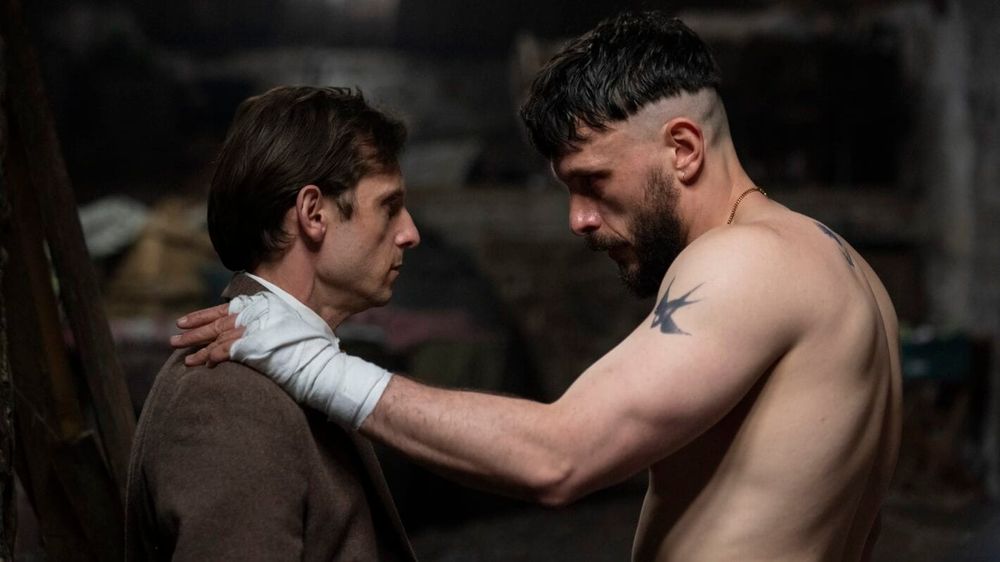
Half Man follows Niall and Ruben, who grew up as brothers despite not being blood-related. On the surface, they seem like opposites. Niall is reserved and closeted. Ruben is charismatic and violent. However, they bond in a way that most would describe as unhealthy and unnatural.
The show jumps through time, showing us that something will happen between the brothers that results in violence and possibly death.
Internalized Hatred
“Why can’t you be happy with that side of yourself? It’s the 21st century. Nobody cares anymore.”
Niall is initially such a relatable character because of his familiar internalized hatred. It is something many people, especially minorities, experience at some point in their lives. As a Black man, it was something I went through at an early age.
Niall’s issues stem from his sexuality. He is surrounded by homophobic slurs and bullying despite his mother being gay. His mother’s presence likely makes his struggle more difficult. He argues it is worse when men are gay. Although this sounds ridiculous, it is a legitimate real-world belief that stems from the patriarchy.
Society views men as superior, so in some twisted logic, it is okay for women to pursue other women because this is a masculine trait. However, for a man to diminish himself by giving up some form of masculinity is unforgivable. This is why some men who desire other men or even act out on their desires will still sometimes claim they aren’t gay. They will find some ineffective way to defend this. Niall is no different.
Niall allows his first lover to take a beating from Ruben to protect his secret. Once he grew up, he claimed not to be gay because he avoided love and relationships. Even though people close to him knew his secrets, he even stole money for conversion therapy.
Just Words
“They are just words. (They only do damage) if you let them…..This is all your shit, son, it has nothing to do with me. Do you want to know who the real homophobe was in your life… You. You were the only one who cared, Niall… You wasted your whole life dancing to other people’s tunes, but you never had the rhythm.
This is Ruben’s response after Niall blames his struggles on Ruben’s use of homophobic slurs when they were children.
I’m not gay. I can never truly relate to that struggle, but I’ve had so many people assume I was gay my entire life that I at least understand the surface-level obstacles. As a kid, it bothered me. I ate the slurs regularly, but they were just a common part of the language at the time. Still, I remember taking some of them personally, even when I was hurling them meaninglessly at my friends.
I once had a relative say I walked like I was gay. I’m still sometimes conscious of how I walk. I remember catching myself standing with the “limp wrist” in elementary school. It genuinely frightened me. I wasn’t attracted to boys, but I was sure this was a secret sign that I must be gay. I made sure it never happened again. Like Niall, society taught me to keep it a secret.
Niall eventually tells most of the people in his life, but he never truly tells himself. I’ve grown a lot since my childhood. I no longer use slurs, and when my students ask if I’m gay, I take it as a compliment. So many of them have opened up to me because of this assumption.
One student once told me it was because of how much I cared, the patience, the softness. Of course, if we look at the big social picture, these are not considered traditionally masculine traits.
What are masculine traits? All we need to do is take a look at Ruben.
Masculine Competition
“I’m your fucking muse.”
Ruben is tall and muscular. Girls love him. He responds with violence. Sometimes this violence is almost heroic, like when he protects Niall from bullies. Sometimes it is horrifying, like when he responds to jealousy.
Ruben seems completely cool and content when compared to Niall’s more fragile character; however, there are moments of weakness in his childhood, especially when his father is mentioned. Once the boys grow up, Ruben’s traditional masculinity has only doubled down after spending time in prison. He moves with confidence and has become the breadwinner.
Niall can’t stand seeing Ruben so successful, and most of the later conflict comes from the delicate balance in their relationship. However, it is revealed that Ruben’s masculinity is just as fragile as Niall’s. He hides his financial failures because he wants people to see him as a provider, as a man. He is extremely jealous when it comes to his girlfriend, and extremely insecure because he can’t have children.
When Niall mentions the infertility, Ruben partially attacks him and partially sexually assaults him. This confusing reaction is something we see a few times between Ruben and Niall.
Each man has a desire to dominate the other, mentally, emotionally, and physically. In most cases, Niall is the dominant force, and when he loses that position, he immediately reacts with violence to reestablish himself. Niall’s dominance is sneakier. He brags about having a child. When the opportunity presents itself, he has unprotected sex with Ruben’s girlfriend. When Niall realizes that he isn’t the only man she has cheated with, he grows upset because he thought he was special. In other words, he thought his masculinity was finally dominating Ruben’s.
Ruben and Niall’s relationship is extreme, but it does remind me of my relationship with my brother. He is the Ruben to my Niall. He is taller, stronger, more athletic, and more financially successful. He has a wife and kids, and he does a great job fulfilling those masculine roles.
I’m proud of him, but there are moments when I feel like Danny DeVito to his Arnold Schwarzenegger. Ironically, most of his motivation came from competing with me. He needed to show his dominance over me. There is no violence or envy there, at least as adults. However, I was struck by how much our masculinity and dynamic mirrored Niall and Ruben.
I was his muse, and he was mine.
To Be a Man
“Fucks you up, man. Makes you a fucking half man…..I spent my life proving it. Filling myself back up to the top.”
Ruben reveals that his father sexually assaulted him when he was a child. He struggles with how his body reacted, even admitting that in a lot of ways, it was the closest he’d ever been to someone.
This complex relationship between assault and sexuality is something personal to Gadd. What I want to point out is how traditional masculine roles are used to almost cleanse Ruben. Lean into the extreme violence because that makes you a man.
The show works in extremes, and it wants the audience to find sympathy for two men who are truly horrible people. It asks us to consider where the responsibility lies. Is the weight of masculinity and a homophobic society too much?
In the end, the desire to dominate each other kills them. Ruben smothers Niall, just like he did in life. He always needed to be on top. Niall, on the other hand, backstabbed Ruben in life and while he was dying. The phallic symbol and the sexual nature of their final struggle aren’t lost on me.
In the end, the two men destroyed each other because they couldn’t love themselves.
The Truth About My Masculinity
If asked, I’m quick to say I’m comfortable with my masculinity. I may even say something that implies I’m “not like other men.” I don’t respond with violence. I’m not driven to prove I’m a man by reproducing, but what I considered to be masculine as a child still drives me.
I perform masculinity, and I enjoy it. I open doors for women. I pay for meals. I insist on fixing things or doing the job myself, even when I should accept help. I struggle to accept gifts or affection. (Read more here.) Never cry.
What did I learn from my father? I wanted to be nothing like him, and to me, that was manhood. Still, I’m motivated by the same systems that destroyed Niall and Ruben. Performing masculinity makes me happy, but I also support tearing these systems down. The patriarchy hurts everyone. The truth is clear. We should be free to express ourselves however we want.
Gadd’s work understands progress does not equate to solution. We still have a long way to go, and he is never afraid to have the difficult conversations.