
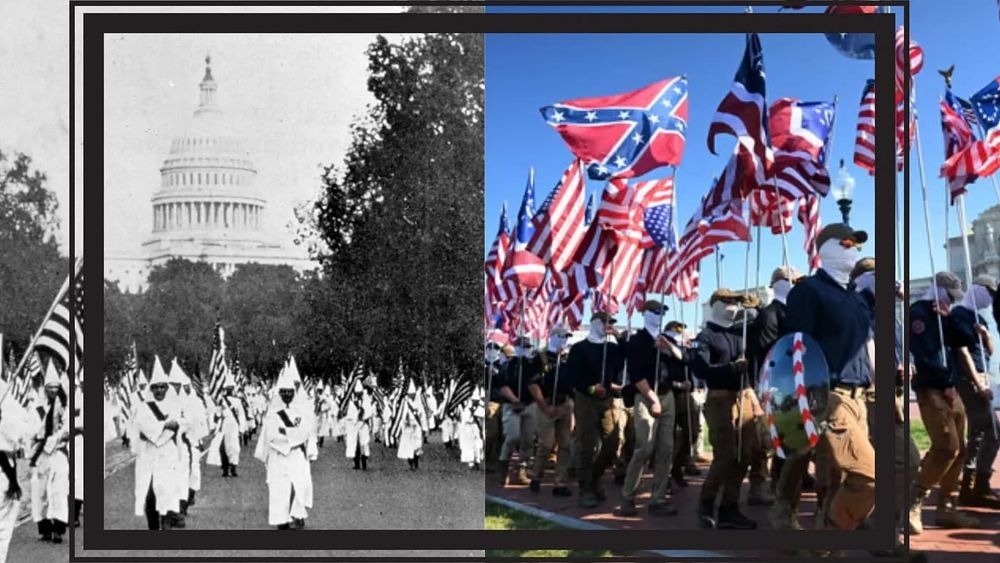
Whoever said "time heals all wounds" couldn't have predicted that some would stubbornly cling to division. Consider that members of the Patriot Front, a white nationalist group, marched through the capital last weekend, just as many gathered to celebrate the country's 250th anniversary. A viral photo of Bernita Bowlding, a Black woman riding a bus, surrounded by the group of masked white men, served as a chilling reminder of the tactics used by some of the country's oldest hate groups. Throughout the Jim Crow era, members of the Ku Klux Klan often wore white pointy sheets over their faces to mask their identity. While each group is distinct, Patriot Front members' emphasis on anonymity and white nationalism mirrors the tone and tenor of Klansmen.
In the Patriot Front's manifesto, leaders claimed that "an African, for example, may have lived, worked, and even been classified as a citizen in America for centuries, yet he is not American." In their view, only White people should be considered full citizens. To those who endorse this worldview, it doesn't matter that many of our enslaved ancestors lived here for longer than those whose descendants are 19th-century immigrants. While racism is seen as extreme by many today, this belief aligns with the Supreme Court decision in Dred Scott v. Sandford (1856). Justices argued that "a free negro of the African race, whose ancestors were brought to this country and sold as slaves, is not a 'citizen' within the meaning of the Constitution of the United States." In this case, racism flowed through mainstream channels.
Confederate veterans founded the Ku Klux Klan in 1866 as a direct response to losing the war and, along with the conflict, their right to enslave Black people. Despite the passage of Reconstruction Era amendments that prohibited slavery, established the concept of birthright citizenship, and guaranteed equal rights regardless of someone's race or previous condition of servitude, these white Southerners continued to resist social progress. They passed laws that racially segregated society and deprived Black people of equal rights. And in addition to these formal actions, their movement had a less public side. Throughout the Jim Crow era, masked White men engaged in racial terror lynchings, massacres, committed arson, and other acts of violence, all under the guise of anonymity.
While many assume that members of the Ku Klux Klan were primarily poor white farmers, this is a common misconception. Many powerful white people joined the Klan, including Theodore G. Bilbo, who served as Mississippi's governor from 1916–1920 and 1928–1932. Robert C. Byrd, a longtime senator representing West Virginia, became a recruiter for the organization in the 1940s, convincing at least 150 White men to join him in establishing a new chapter. David Duke, the former Grand Wizard of the KKK from 1974–1980, served as a Louisiana state representative from 1989–1992 and later ran for president. White men from all walks of life joined the Klan, including leaders who publicly identified with the group; many members wore masks to deny any association, and in doing so, protect their reputation.
David Cunningham, a sociology professor who authored Klansville, U.S.A., suggested members of the Klan would often "pose as ghosts or 'spectral' figures, drawing on then-resonant symbols in folklore." What started as "pranks" quickly evolved into "politically sinister overtones, as sheeted Klansmen would commonly terrorize their targets, using hoods and masks to disguise their identities when carrying out acts of violence under the cover of darkness." Thousands became victims of racial terror lynchings, but officials rarely held these men accountable for their actions. During the Colfax Massacre of 1873, 300 armed white men in Louisiana, including members of the Klan and the White Camelia, attacked the courthouse after Democrats lost an election, killing an estimated 100 to 150 Black people, according to an Equal Justice Initiative report. While federal troops arrested nearly 100 White men in connection with the violence, local officials in Louisiana refused to file charges against them. Despite federal authorities indicting 9 men for violating the Enforcement Acts of 1870, the Supreme Court overturned their convictions.
On February 18, 1915, President Woodrow Wilson watched The Birth of a Nation in the White House along with his cabinet members, close staff, family, and friends. This film, framed by the assassination of Abraham Lincoln and the rise of the Klan, portrayed as righteous men attempting to maintain order, became a popular recruitment tool for white nationalists. But while the imagery of White men chasing Black criminals on horseback appealed to White audiences at the time, for Black people who experienced the terror of their violent campaigns firsthand, Klansmen were racists who used "law and order" rhetoric to justify their plunder. Ten years later, in the fall of 1925, the Ku Klux Klan marched along Pennsylvania Avenue in Washington, D.C.
Historical images of the Klan marching in the nation's capital illustrated the lasting schism. While America began the process of healing during the Reconstruction Era, their efforts were interrupted by the rise of Jim Crow, which limited the rights afforded to Black people. Even after all the smoke cleared from the battlefields and industries began to recover, this conflict didn't fully heal. In the 1860s, the Klan picked up where the Confederacy left off by using positions of power to pass laws and enact policies that sought to uphold the racial hierarchy. They racially segregated communities, including schools, businesses, marketplaces, beaches, public parks, and even hospitals. Modern-day groups such as the Patriot Front show that this ideology of white nationalism persists.
If time heals all wounds, then not enough time has passed. Masked White men recently waved the American and Confederate flags in the nation's capital, which is ironic given that one side fought to preserve the system of slavery. At the same time, the other took a stand against it. Some wanted the internal conflict to stop so the country could unite, regardless of which side won. Black Americans are uniquely positioned to bear witness to the irony of a Trump supporter carrying a Confederate flag into the U.S. Capitol on January 6, 2021, something the secessionists never accomplished during the war. Perhaps it's a sign that we shouldn't take the Union victory for granted, that we have a responsibility to consider threats to racial equality in each generation.
According to a ProPublica article, the "Patriot Front is perhaps the most active white supremacist group in the nation." One of their New York members told reporters that "masking up is their biggest accomplishment" as this strategy distorts their total numbers. When a Black person sees a large group of masked, uniformed men, it's unclear how many of them live in their community, endorse this group's ideology, and what roles they serve in, whether they are policemen, firemen, doctors, lawyers, teachers, industry leaders, or colleagues. In that respect, their anonymity serves as a form of intimidation. While the tactics employed by Patriot Front differ from those of the Klan, their ideologies bear a striking resemblance. Indeed, both groups believe that White people are more deserving of resources and opportunities. White masked men marching in the capital serve as a chilling reminder of the harm caused by old hate groups in this country, and what we stand to lose if we don't learn from our nation's history.