
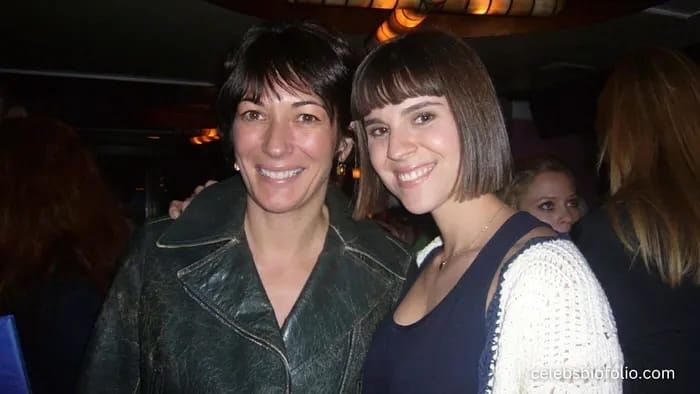
Tell me if you’ve heard this one before? A young woman from a former Soviet satellite state in Europe embarks on a modeling career. She makes her way to New York with the help of a modeling agency that procured a questionable visa for her. Her ability to stay in the country is tied to the agency that controlled her bookings. She stayed in model housing in an apartment complex provided by the agency. Later in life, the woman became involved with a wealthy man and shuttled between mansions in New York and Palm Beach. This is the history of Melania Trump, but equally applies to Adriana Mucinska, who ultimately became one of four schedulers for Jeffrey Epstein and is one of the four people granted immunity from prosecution in Epstein’s 2008 sweetheart deal.
Adriana Ross (also known as Mucinska) was a Polish model and was the most silent among Epstein’s “potential co-conspirators” named in his 2007 non-prosecution agreement. Epstein brought Ross to Florida in 2002, when Ross was 19, to work at his Palm Beach mansion. During civil litigation involving Prince Andrew and Bill Clinton, Ross, now 41, repeatedly invoked the Fifth Amendment to avoid self-incrimination. She currently lives in Miami.
Melania allegedly met her man through modeling agent Paolo Zampolli, who founded ID Models. There have been multiple stories about how Zampolli introduced Trump to Melania at a New York Fashion Week party. Melania told the story in her book, and the New York Times and the Washington Post have repeated it, along with television outlets such as CNN, the BBC, CBS News, ABC, and NBC. The official version has been reported in fashion magazines such as Elle, Vogue, and Harper’s Bazaar.
When I tell the story of how I met my wife, it varies at least slightly with each telling. I’m not saying Paolo Zampolli didn’t introduce Donald and Zampolli. I’m saying the story is exactly the same no matter who tells it, especially when it’s the principals, Trump, Melania, and Zampolli, doing the telling. It’s like when criminals get together to rehearse their alibi.
Adriana Ross met her man through Elite Models, owned by pedophile John Casablancas. It seems Epstein, who was attempting to buy Elite Models from Casablancas, who was being forced out of the industry for his conduct with young girls, saw Adriana’s picture in Paolo Zampolli’s portfolio while visiting his offices. Zampolli admits that Epstein visited his offices but says he does not remember Adriana.
After arriving in New York in 2002 as an Elite model, Ross soon worked as a scheduler for Epstein in Palm Beach. She was one of four “potential co-conspirators” in the 2008 Non-Prosecution Agreement worked out with Epstein. In depositions, she invoked the Fifth Amendment more than 100 times. Not only was she present in the house while minors were being abused, but she destroyed evidence (computers, hard drives) at Ghislaine Maxwell’s direction, according to sworn testimony.
So how do Adriana Ross and Melania intersect?
Ross’s FBI interview is now public and helps connect a lot of dots. Ross’s FBI interview links her indirectly to Paolo Zampolli’s office. A typed FBI note says that Epstein visited Zampolli’s office, and he saw Ross’s photo in a portfolio there. The Elite ↔ ID Models overlap was real
Melania’s early U.S. life is tied to the same office, the same visa pipeline, and the same era. Ross could clarify how Elite and ID Models actually shared talent
Melania’s public narrative depends on a clean, linear story: Zampolli discovered her, ID Models sponsored her, she lived in the ID apartment and then met Trump
But the real modeling ecosystem was messy: Elite and ID shared scouts, portfolios moved between offices, Epstein tried to buy Elite.
If Ross ever described that ecosystem in detail, it could complicate the tidy version of Melania’s origin story, even without implicating her in anything improper.
Ross is one of the few people who could speak to Epstein’s interest in model‑visa pipelines; his attempted purchase of Elite; his presence in Zampolli’s office; and his use of modeling agencies as recruitment vectors. All are documented. Ross is uniquely positioned to explain how Epstein viewed modeling agencies, how he accessed portfolios, how he interacted with scouts and bookers, and how he evaluated new arrivals. If she ever spoke openly, she could illuminate the system, not necessarily Melania.
But Melania’s early life is part of that system’s history. Ross can tie Epstein, Elite, and Zampolli together.
Adriana Ross has not been publicly seen or heard from since 2010, and her current location is unknown. Despite extensive investigative efforts, no journalist or law enforcement document has identified her whereabouts today. But has Kash Patel’s FBI really been looking?
The walls are closing in on Donald and Melania. It isn’t because of a single witness or a single document, it’s the architecture of the past itself. The modeling‑visa ecosystem they once moved through with ease is being excavated in real time, its forgotten names and buried paperwork resurfacing in ways no one predicted. Adriana Ross hasn’t spoken in more than a decade, yet the documents tied to her, the FBI interview notes, the deposition transcripts, the fragments of a life lived inside Epstein’s operation, are speaking loudly enough on their own. And each newly unearthed detail pulls another thread from the carefully curated mythology surrounding Melania’s early years in New York.
None of this proves wrongdoing by the Trumps. But it does show how fragile their preferred narrative has become. The more the public learns about the overlap between Elite, ID Models, Epstein’s attempted acquisition, and the shared scouting networks that fed all three, the harder it becomes to maintain the illusion that these worlds existed in neat, separate compartments. They didn’t. They were porous, overlapping, and shaped by the same men who believed they would never be held accountable.
That’s the real pressure point now. Not a single revelation, but the cumulative weight of a system finally being mapped with clarity. A system that once relied on silence, Ross’s silence, the industry’s silence, the public’s disinterest, now finds itself illuminated by archives, lawsuits, and the stubborn persistence of the historical record.
If the walls are closing in, it’s because the story is no longer theirs to control. It belongs to the documents, the timelines, and the people who refuse to let the past stay buried. And those walls don’t close quickly. They close slowly, methodically, one rediscovered fact at a time.