
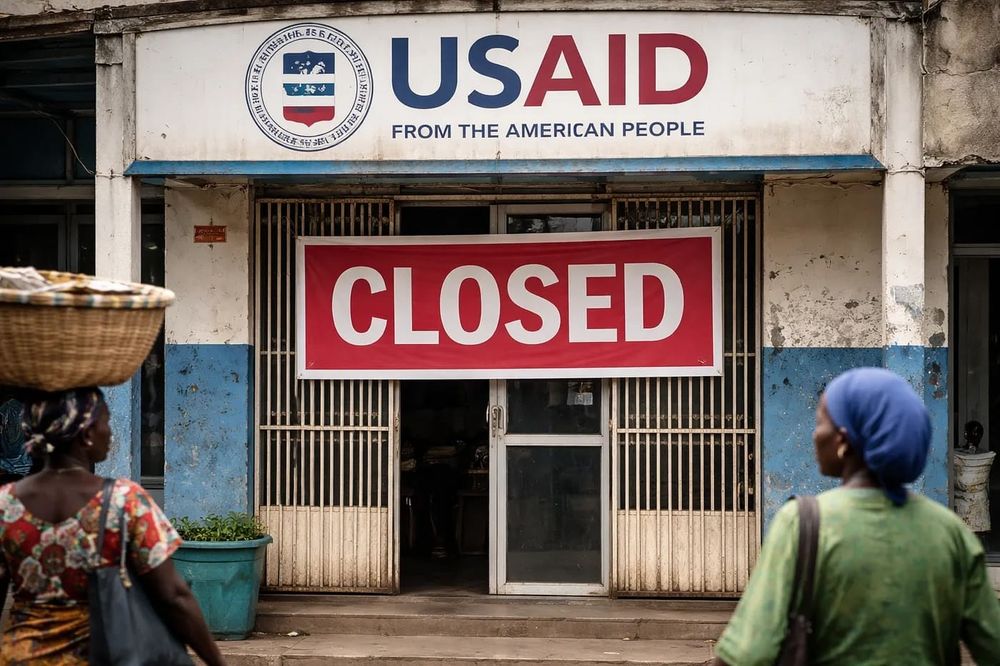
It was recently discovered that cuts to USAID resulted in terrorists in Yemen getting a hold of significant American equipment.
But the aid cuts tells a much worse story than just loss of equipment that has directly harmed Black people.
We all know the administration’s attacks on diversity and harsh impact on Black Americans.
It eliminated all federal programs promoting diversity, inclusion, and fairness. And threatened to sue companies and universities that continued such programs. The fallout has been substantial, with Black unemployment rates rising sharply in 2025. That impact deserves its own article and discussion.
But there’s a lesser discussed action that has also disproportionately harmed Black people.
Within a mere hours of the inauguration, an executive order “paused” all U.S. foreign aid for 90 days pending a review under his “America First” strategy. Shortly after that review, the administration permanently canceled more than 80 percent of USAID programs.
On July 1, 2025, the U.S. government officially announced the closure of USAID as an independent agency. A limited number of emergency programs were folded into the State Department under the administration’s restructuring plan. The rest gone forever.
USAID, for those unfamiliar with it, stands for the United States Agency for International Development. It was created in 1961 by President John F. Kennedy as a civilian agency to administer U.S. humanitarian and development assistance. It was continued by every president since. Republican and Democrat.
Its mission was never simple charity. It was designed to promote global stability, which in turn benefits the United States economically, strategically, and morally.
USAID funded programs that prevented famine and mass disease, stabilized fragile states, supported global health systems, reduced conflict driven by extreme poverty, strengthened democratic institutions, and responded to natural disasters and humanitarian crises. It operated in more than 100 countries, with a major concentration in Africa.
Its work included HIV and AIDS treatment and prevention, malaria and tuberculosis control, maternal and child health services, food security and famine prevention, education and literacy initiatives, water and sanitation projects, emergency disaster relief, and governance and anti-corruption efforts.
Even from a purely self-interested perspective, President Kennedy understood that a more stable, healthier world benefits the world and the United States. Global instability raises food prices, disrupts supply chains, fuels conflict, causes more spreadable diseases and increases forced migration.
Americans saw this firsthand when wheat prices spiked after Russia invaded Ukraine. We’re far more interconnected than political slogans suggest.
The elimination of USAID has already caused instability that may take generations to reverse. The short-term damage is already visible, and it’s overwhelmingly harming Black people across the African continent.
In Nigeria, individuals who relied on U.S.-funded HIV prevention and treatment programs lost access to medication that reduces infection risk by approximately 99 percent. Some have already tested HIV positive after supplies stopped.
Health programs supported by USAID in South Africa, Malawi, Zambia, Tanzania, Zimbabwe, Lesotho, and Eswatini were terminated, including services for pregnant women, children, and other marginalized communities.
The end of this funding has already led to more than 8,000 health workers losing their jobs, the closure of specialized clinics, and sharp declines in viral load testing, threatening decades of progress against the HIV epidemic.
Significant cuts to malaria programs have weakened prevention, treatment, and disease surveillance across Africa. Millions of people at risk of malaria are affected because reductions undermine bed net distribution, early diagnosis, and national malaria control programs in endemic countries.
In Mali, which is already suffering instability from terrorists, the USAID-funded literacy and livelihoods program are being forced to shut down, affecting roughly 20,000 young people receiving basic education and vocational training such as welding, hairdressing, and pastry-making. In a country where approximately 70 percent of the population is illiterate, the loss of this program eliminated a critical pathway out of poverty overnight.
Cuts to nutrition and food security programs in Kenya have disrupted supplies of therapeutic food and malnutrition screening. Reuters reported critical shortfalls in treatment for severely malnourished children. In some Kenyan counties, mass screening coverage dropped from about 75 percent of hotspots to less than 15 percent, leaving many children undiagnosed and untreated.
Physicians for Human Rights reported that the January 2025 aid pause and stop-work orders immediately and significantly reduced U.S. global health support in Kenya. Clinics lost staff, services were curtailed, and continuity of care for patients relying on routine and lifesaving treatment was disrupted.
USAID’s Prosper Africa initiative, a roughly $520 million program designed to promote U.S.–Africa trade, economic growth, and private-sector development, was canceled as part of the sweeping cuts. Projects in countries such as Zambia that supported agriculture, small manufacturers, and economic resilience were abruptly halted, leaving farmers and entrepreneurs without crucial support.
U.S. funding cuts also eliminated dozens of maternal health and gender-based violence programs. Forty-eight grants worth approximately $377 million for maternal care, rape treatment, and lifesaving services in more than 25 countries were removed. The result has been fewer safe childbirth options and reduced support for survivors of sexual violence, disproportionately affecting young women and girls.
AP reported that the World Food Programme closed its southern Africa office in Johannesburg amid major U.S. aid cuts, even as the region faced its worst drought in decades with 27 million people at risk of hunger. Cutting regional capacity during a drought increases the risk of delayed responses, weaker coordination, and gaps in food distribution.
Physicians for Human Rights also documented disruptions to HIV services in Tanzania and Uganda. Waivers were limited, many programs received termination notices, clinics reduced hours or closed, staff left, and patients lost consistent access to testing, prevention, and treatment.
A 2025 peer-reviewed modeling study hosted by the NIH estimated that the funding freeze will significantly increase HIV incidence and mortality across seven sub-Saharan countries including Ethiopia, Kenya, Malawi, South Africa, Tanzania, Zambia, and Zimbabwe.
UNAIDS has reported direct disruptions in Zambia, long considered a success story in HIV treatment. Clinics have been affected, patients have missed refills, viral loads have rebounded, and health officials fear a return to the “dark days” of the epidemic, with preventable illness and death already occurring.
America is far from perfect and still struggles to confront its own systemic racial inequities. But one of the things that once made me proud to be American was the belief that we sometimes could reduce suffering beyond our borders.
We were supposed to be different from Russia. We were supposed to lead, not retreat.
Ending USAID isn’t just a policy change. It’s a change to America’s soul.