
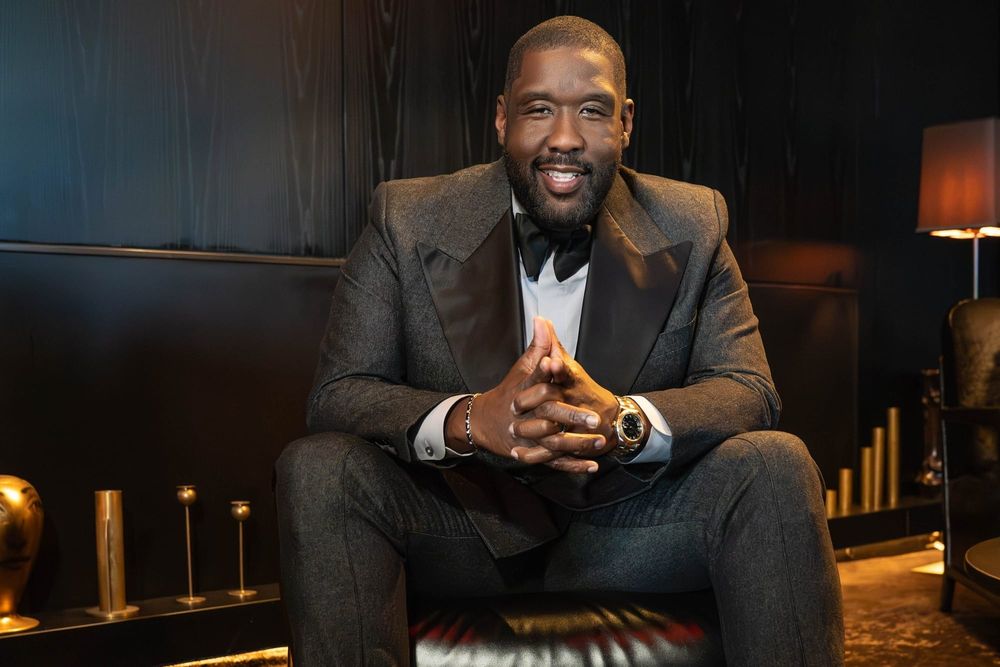
Adam Blackstone can feel the energy pulsating throughout New York City—coursing through the streets, subways, social media, and local radio airwaves. It’s a Thursday morning in July, and Jay-Z’s longtime musical director is en route to the vortex of all the vibes, Yankee Stadium, for a second consecutive day of rehearsals ahead of a trio of must-see homecoming concerts kicking off in just 57 hours.
Outside of the iconic Bronx ballpark, DJs spin Jay-Z-themed playlists, pop-up shops sling Roc-a-Fella merch, bartenders pour D'USSÉ, and fans speculate about what surprises the rap legend has planned as he celebrates milestone anniversaries of Reasonable Doubt and The Blueprint, which turn 30 and 25 years old this year, respectively. It’s only the rap legend’s second headlining show in seven years. His most recent was in Philadelphia at The Roots Picnic in May.
“The buzz here is heavy,” says the 44-year-old musical mastermind. “It shows the level of greatness and excellence that our boss, Mr. Carter, is trying to display by the amount of rehearsal he's doing, the amount of reps that he's getting in… and the importance of what it means culturally and locationally.”
Blackstone has become a cultural force in his own right. The New Jersey native has also served as musical director for icons like Rihanna, Jill Scott, Justin Bieber, Justin Timberlake, Queen Latifah, and Maroon 5. After orchestrating halftime performances at the Super Bowl and helming music for Broadway (Alicia Keys’ Hell’s Kitchen) and TV (The Masked Singer), Blackstone is just one Oscar away from EGOT status. In 2022, he released his debut album, Legacy, which featured the Grammy-nominated “’Round Midnight” with Jazmine Sullivan, a song President Barack Obama named one of his favorites of the year.
All of that musical experience is helping shape Jay-Z’s ’96 & Forever career retrospective, which will continue with spot dates in Los Angeles, London, and Paris. Ahead of Jigga’s highly anticipated shows at Yankee Stadium, Blackstone hopped on the phone with LEVEL to chat about the DNA of his shows, giving Ms. Lauryn Hill her flowers at the 2026 BET Awards, and why some believe he is his generation’s Quincy Jones.
LEVEL: What is your identity as a musical director? What is it that makes Adam Blackstone shows hit the way they do?
Adam Blackstone: I'm always about musical excellence. The through line for me is emotional connectivity with the music, and playing some of your favorite records. The nostalgia and legacy of it all. Remember where you were when you heard “Izzo” for the first time. I remember being in my dorm room when I watched the “Give It 2 Me” and “Big Pimpin’” videos. I always want to bring that same feeling to the stage because I'm a fan and I care about these artists—not just Jay, but every artist that I work with, from the smallest to the biggest, whatever race, culture, or gender. I really care about their music, so I take the approach as a fan. What would I want to hear? What wouldn't I want to hear?
My role as a musical director for all the artists I work with is talking about everything live music-oriented, from screen content to—if I'm doing pop music—the dancers, the hits, and the wardrobe changes.
Is there anything that makes your process different when directing a show for Jay-Z?
When I do Queen Latifah or Justin Timberlake or Alicia Keys, and it’s solely on me, the pressure’s there. When you come into an artist of the iconic stature as Jay, there's a team of people, which alleviates some pressure. Jay has an incredible team of musicians and musical directors and producers, from Young Guru to Omar Edwards to Just Blaze. I have nothing but love and respect and admiration for those guys, because we make each other's jobs easier. And it just goes to show the level of trust Jay has for his team. Each person is a link.
The process is very intense. A bunch of ideas are always floating around. Ultimately, my job is to execute the artist’s vision. So [Jay-Z] says, “We're going to concentrate on Reasonable Doubt, maybe sprinkle something else in there. How can we execute that?” And then I get to cooking. That's how we're operating this weekend. I'm excited, man.
Once you assemble the set list, how do you find moments in the show to enhance or tweak it for the stage?
This is where my hip-hop and Broadway background come in. Jay is so lyrical. Things with him are never a figure of speech. It’s really his experience. So when he says, “And I wish I never met her at all!” [from “I Just Wanna Love U (Give It 2 Me)”] at the Roots Picnic, I’m like, “Let's go into this Carl Thomas break,” because that's where we know that line from. So then he raps over “I Wish.” With an incredible rapper like Mr. Carter, let me take what he's saying as literally as he's saying it, and then make it a literal music reference. I do a lot of those kinds of flips.
Also, with the genius of Questlove, he knows where these original samples come from. So as a radio listener for “Song Cry” or “Never Change” or “What We Do,” Ahmir has taught me to start with the original sample. It automatically has a built-in crescendo, because we're getting to the part of the song that we know and that loops. So those are two references I try to live by when it comes to making a dope Jay show or break. Let me listen to what he’s saying and see if it relates to something that's going on musically, or let’s take the original sample and do this built-in climax.
You mentioned your Broadway background—you worked on Hell's Kitchen with Alicia Keys...
Yeah. Great successful run. Thirteen Tony nominations, two wins. I think that's a success.
Talk that talk, king! Has working on Broadway influenced your approach to musical direction?
Yeah. When I moved to Philadelphia in 2000 to go to University of the Arts, I was doing every gig just to pay the bills. $50 jazz gig, open mics for free, all of the things. Those are things you invest in yourself back in the day, especially as a college student. I needed to show up and be places. I wanted to be known as the hardest worker in the room. That mentality landed me a gig working at the Prince Theater. I was a session musician for a bunch of the local Philadelphia Off-Broadway shows. That allowed me to see how important a lyric was in telling a story. Sometimes, especially growing up in church or R&B or hip-hop, we’re listening to the beat. But when I started doing these plays and musical theater shows, it allowed me to see how incredible lyrics and dialog can help tell a story.
I took that approach when I started MDing and doing concerts. One of the first moments I got to use that was with my sister Jill Scott, who was a poet as well. I really valued how her poetry—which we would deem lyrics—told her story. The music was a compliment. I got to listen to each pause, each breath, each color in the tone, each word, and see where I could enhance to drive home the point she's making. I do that same thing, just like we talked about with Jay, getting those elements from Broadway to accent the lyric and make it a moment.
Also, in reverse, I brought hip-hop to Broadway. I was able to have a successful '90s-themed play. I had to bring the 808s. We brought some Wu-Tang and A Tribe Called Quest vibes. And, of course, we told it all through Alicia's song catalog, arguably some of the greatest pop songs of the decade that have a gutter R&B, New York swag. I was thankful that theater has influenced me, but I was glad to impact theater with our culture, and my music expertise.
Jill Scott has called you this generation’s Quincy Jones, saying there is no other musical director or composer alive with your range and genius. How do you feel about that comparison?
Jill's quote really took me aback and made me look at my life—not in comparison to Quincy, but just in admiration. To see people give me that same trajectory is a blessing. I was able to do a Quincy tribute with HarbourView at my venue, Sun Rose Hotel, in L.A. I got to see his expansiveness. It really, really does mirror—I should say I mirror his start and everything, from jazz beginnings to going to theater with The Wiz, gospel stuff with Aretha Franklin and Ray Charles, and then into pop stuff with Michael Jackson. I'm super thankful for that quote to have been said about me. If I can do one-fourth of what Quincy has done to impact music, I'll be straight.
Another inspiring caveat is that Thriller came later in [Quincy’s] life. So me being 44, that tells me this is just the beginning of what God has in store for me. I truly feel I haven't seen the pinnacle yet.
Your first show with Jay was Fade to Black at Madison Square Garden, way back in 2003. You were playing bass on that show, but what do you remember observing about Jay back then as an artist and performer, and how has he since evolved?
That's a great question, man. I don't think I've been asked that. One of the things that I observed then was the value of teamwork. I wasn't the musical director, but he always invited us to give the best suggestion possible musically. Of course, he is the end-all, be-all. He makes the decisions, but he's open to ideas. I thought about that early as an MD, artist, and leader in general. You're only as strong as your team is. He instilled that in me early.
Since Fade to Black, you've worked with Jay on so many different shows over the years. Are there any that stand out as the most iconic, musically impressive, or memorable?
I'm going to say my top three in no particular order. Definitely Fade to Black, because that's what put me in his space. I cultivated so many relationships from there. Met a kid from Chicago with a pink polo on (Kanye West). I met this Barbadian girl named Rihanna. A young Beyoncé, Mary [J. Blige]. Those relationships I forged are still going strong to this day. Fade to Black means so much to me.
The next one is the 10-year anniversary of Reasonable Doubt at Radio City Music Hall with an orchestra. We see a lot of orchestra shows now, but that had really never been done with hip-hop. My brother drove a bubble Lex on the stage, bro. I was like, “Oh, he different.”
And then I gotta jump to 2026. The Roots Picnic was so nostalgic for me to come home, to be with my brothers, The Roots, to play a classic set of Jay, to see State Property get back together. To see Meek Mill and my sister Jazmine Sullivan—it was like a huge family reunion to the umpteenth power musically. It felt good to be a part of that history, to be part of Philadelphia history.
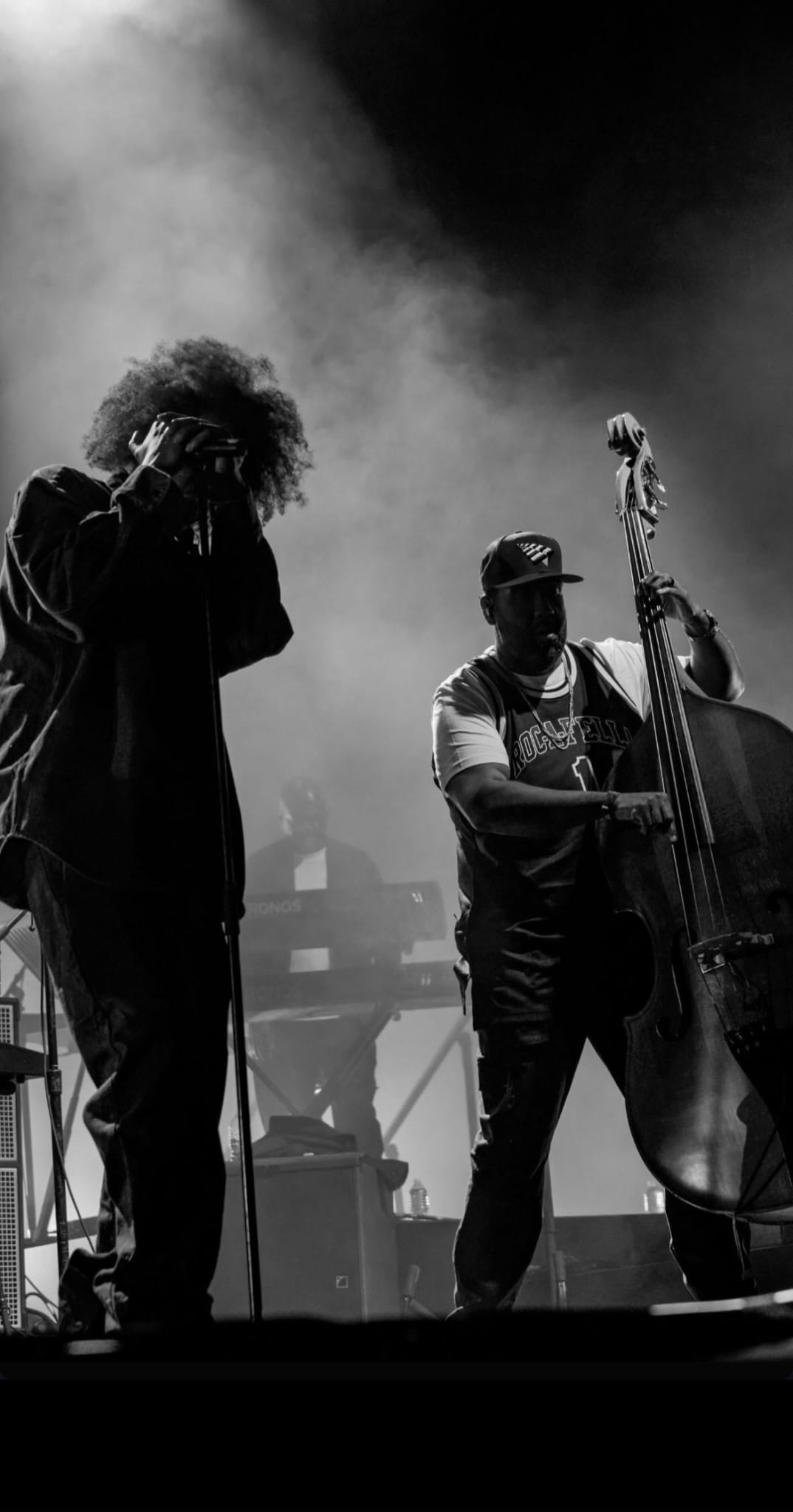
Was there anything from Jay’s The Roots Picnic performance that you were like, we definitely gotta keep that, or let’s tweak it for the New York shows?
I got to be honest, man. Philly was one-of-one; people will see that after this weekend. If anything, I was just explaining to him, like, let's keep the energy. Him loving to rap and us loving to play the songs. And we're about to do that, man… With these announcements we made for the London, Paris, and L.A. shows, and Yankee Stadium this weekend, maybe we'll create some new memories.
You produced the BET Awards last month, which was a beautiful celebration of culture and icons like Ms. Lauryn Hill. Congrats on that. How did that all come together, and what aspects of her artistry did you want to highlight?
Thank you for the congratulations. That BET Awards was very meaningful to me. It broke records since 2018 or something like that, so that was really cool to see. Before I get to Lauryn, I gotta give a huge shout-out to Tems, who had a moment. Raye definitely had a moment. My girls Erica Campbell and Leandra Johnson playing gospel music on national TV is always a plus. Those three stood out. Cardi B as well. And my new favorite jam is French Montana’s [“Ever Since U Left Me (I Went Deaf)”]. I don't know if it's the sample or what, but that thing makes me dance, man.
As we found out that Ms. Hill was getting the lifetime achievement award—it's so interesting. I did the Usher [tribute] a couple years ago. Anita Baker some years ago. Jamie Foxx. New Edition. These people have like nine, 10, 11 albums. Lauryn Hill has one. Of course, The Fugees and the Unplugged joint, which created waves in our culture. But I don't think that's ever happened before where we're giving a lifetime achievement award to somebody with one solo studio album. Just think about how impactful that had to have been to still resonate.
I had to put the set list together first, then we started to insert people. I knew I wanted to do a throwback to where we saw her as a solo artist in Sister Act 2. I have a great relationship with The War and Treaty, and Tanya Blount (one-half of the duo) was Lauryn’s Sister Act 2 co-star. When I started putting these pieces together and getting it approved by Jesse Collins at BET, I started to see her evolution on paper.
It was inspiring to me to hear people like SZA and Lizzo and Doja Cat talk about her influence in their music today. And Rapsody and Tierra Whack. Then you have Common and Queen Latifah talking about how they stopped what they were doing in [1998] to listen to her record over and over and over. These are super-duper stars. And then Ms. Lauryn Hill’s children wanted to be a part of it. So it all came together, man. I was super thankful. She gave me a shoutout and thanked me. She ain't have to do that. She's a Jersey girl; I was born in Jersey as well. I got nothing but love and respect for Ms. Hill. It just feels exciting to have her legacy live on forever through that tribute.
To close on Jay-Z, there are fan theories that he’s positioning himself to perform at the Super Bowl next year. Hypothetically speaking, if you were musically directing a Jay-Z Super Bowl show, how would you approach it?
A hypothetical Super Bowl? What I will say is this: I've been blessed to do Justin Timberlake Super Bowl in 2018, Shakira and J. Lo in 2020, Dr. Dre and Snoop in 2022, Rihanna right after that. Jay-Z would be the pinnacle of those for many, many reasons. Just from his global success and the reach he has had through his music and culture. So, hypothetically, it would be great.