
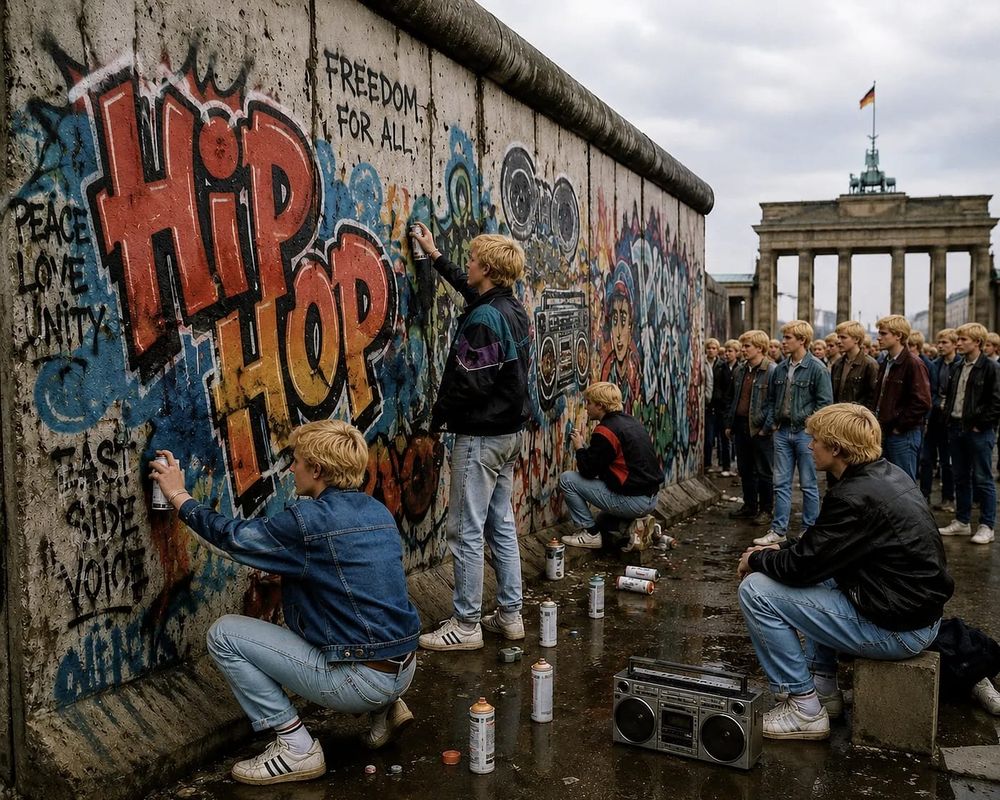
East and West Germany, for you younger folks, used to be separated into two countries. West Germany was a western style democracy with typical baked-in freedoms and East Germany was a communist-socialist country with vast restrictions.
The two countries were divided by a 96 mile fortified wall, built by East Germany to prevent citizens from fleeing to the free West Germany.
It finally came down in 1989, after which East and West Germany reunited into what today is just Germany.
Five years prior, though, the leaders of East Germany, which had prevented most western influence, decided to let its citizens watch one Hollywood film: Breakin’.
Breakin’ was a hip-hop break-dancing movie released in 1984. I was 15 at the time and rememeber it well.
Here was the East German communist-socialist thinking. Let their youth see how America has vast inequalities, as depicted in the movie. How Black neighborhoods suffer in America. And how socialism, by deduction, had to be way better.
Under socialist East Germany, there was no free speech, intense surveillance and censorship of its citizens, and imprisonment for dissenters or anyone trying to leave the country. Eight years in jail if you tried leaving without permission.
Political parties were banned. No freedom of press. And educational and career opportunities were strictly conditioned on loyalty to the totalitarian Socialist Unity Party.
As with nearly every other socialist country in history, the lack of freedoms in East Germany made America and its massive race issues look like child’s play. (side note, it could be that with the collapse of and less focus on communism, some Americans were finally able to see their problems were serious, too).
But what better way to distract East Germans from their painful reality than to show the worst of America. Its mistreatment and abuse of Black people and their daily life in America. All on background display in the movie.
The movie began showing in 1985 in multiple East German theaters.
But something unexpected happened.
The music. The rap lyrics. The break-dancing. The art. The camaraderie. The laughter. It seeped into the souls of East German teens and young adults.
And thus, a new unofficial movement was launched.
Kids painting graffiti. Break-dancing in the streets. Recording German rap songs. DJs scratching records. Gatherings of friends to talk culture.
Hip Hop created a new energy in East Germany.
Even without overt politics, hip-hop culture carried the implicit message of a freedom East Germans weren’t aware of. It signaled individuality, self-expression and a connection to the world outside of the wall.
Hip-hop made East Germans aware of a broader global culture and challenged the socialist regime’s narrative that the outside world was inferior or irrelevant.
Political scientists don’t give hip hop any credit for the reunification of Germany. But if you study what happened after Breakin’ hit the screens in East Germany, you’ll see that it for sure played a major part in the dismantling of a brutal regime and helped free nearly 17 million people living there.
While East Germans were waking up to something new, though, here in America we were still avoiding something old. Racism.
Today, America still shamefully refuses to confront its past and present when it comes to race.
Thankfully Hip Hop remains a brief detour and respite from that racism and provides a micro-world where freedom, expression, culture and individuality get to flourish despite America’s ongoing sins.