
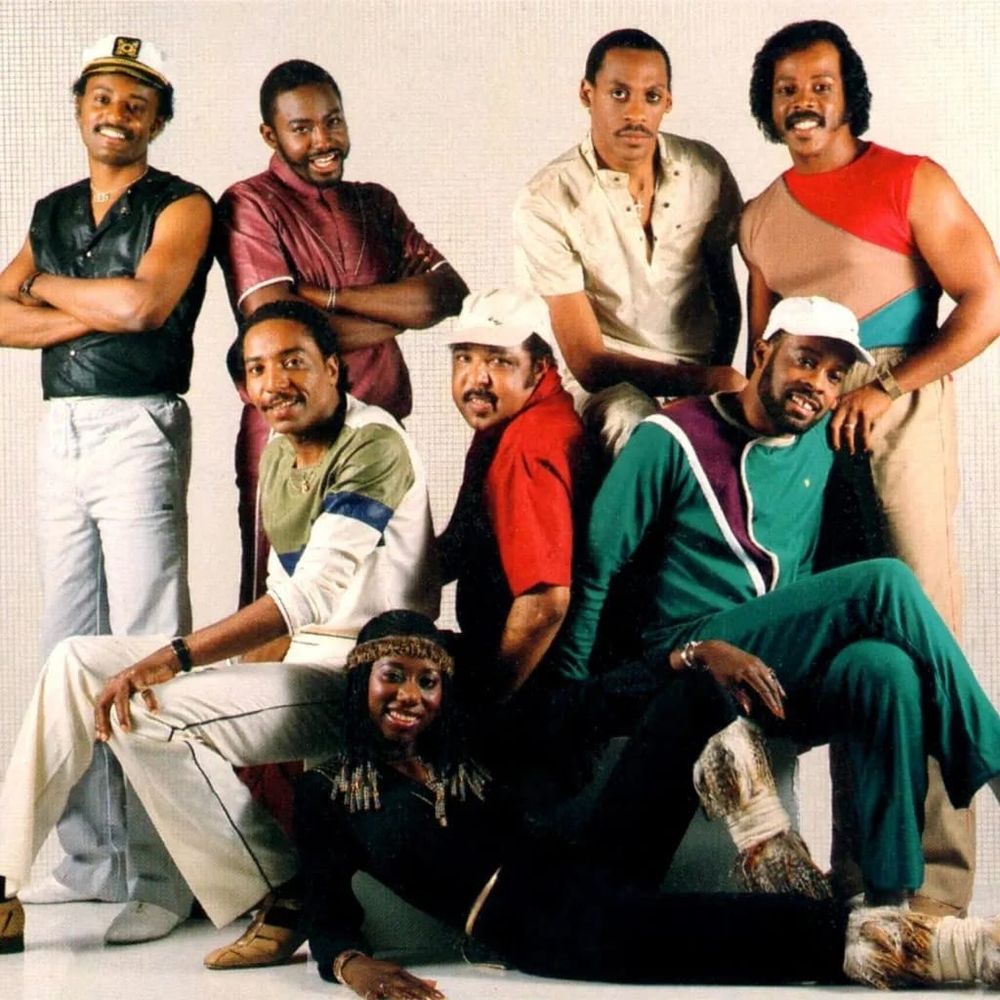
“When I think about you, my feelings can’t explain, why after all this time…” and it’s like it just happened last night; Alexander O’Neal and Cherrelle’s “Saturday Love” is on the turntables, and amidst another dark, musky mid-1980s Black college house party, a generation of overachievers took turns singing the parts of the two singers: “Sunday, Monday, Tuesday, Wednesday, Thursday, Friday, Saturday love…” And if it was indeed a Saturday night, and you were dancing with the one you came with — or were leaving with — you held on just a little tighter when that two-step gave way to Midnight Starr’s “Slow Jam.” For this generation of future Black “mover and shakers”, Black music had never been so Black.
As a practice, R&B music — the more formal corporate product of the post-1970s era — has been given short shrift by the critical intelligentsia. The volume of writing on Soul, Jazz, Hip-Hop and the more traditional Rhythm & Blues has easily dwarfed any significant critical forays into contemporary R&B music. Aside from the important work of Daphne Brooks, Jason King, Danyel Smith, Alexander Weheliye and Robert J. Patterson, traditional R&B is seemingly an afterthought to the hybrid musical landscape that its furtive relationship with Hip-hop production has wrought.
And if such a gap in critical assessment of R&B exist, nowhere is it more pronounced than in the music produced in the early to mid 1980s — a time when mainstream pop-top-40 radio (after its homophobic and racist retreat from Disco), in concert with MTV’s then musical apartheid approach to pop music programming, effectively undermined the social experiment that was pop radio in 1970s.
Ironically this market segmentation was only a few years after many of the major labels had invested heavily in Black acts with the hope of crossing those artists over to White mainstream audiences. Enter the recession of the late 1970s and early 1980s and what was left was a musical environment that was as segregated as it was when the “Hot Soul Singles” charts — soon called “Black Singles” and later “Urban singles” charts — were still referred to as the “Race Music” charts.
In this context a generation of artists and producers emerged, with new technologies at their disposal, like the first generation of Roland TR-808 and Linn LM-1 programmable drum machines — and little pressure to make music for the mainstream (read: White folk). For producers like James Mtume, Reggie Lucas, The Calloway Brothers (Reggie and Vincent), and Jimmy Jam and Terry Lewis the period represented a chance to innovate, while reinvigorating the music’s relationship with the Black masses. It was George Clinton who famously described the music as “rhythm and bullshit” in the late 1970s, as he called for “One Nation Under a Groove.” As many of these young producers cut their first rugs to Parliament Funkadelic they took heed: “Here’s our chance to dance our way, out of our constrictions.”
While mixed company in post-Civil Rights, multicultural America can all hum Motown, Atlantic-era Stax, Al Green, Aretha Franklin, and The Stylistics, check their silence when names like Midnight Starr (“Curious”; “Slow Jam”) Patrice Rushen (“Forget Me Nots”), The SOS Band (“Weekend Girl”), Frankie Beverly and Maze (“We Are One”), Stephanie Mills (“What Cha Gonna do with My Lovin’” ) Atlantic Starr (with Sharon Bryant on lead: “Send for Me”), The Deele (“Sweet November”), Cheryl Lynn (“Encore”;), Kashif (“Stone Love”), Alexander O’Neal (“Criticize”), DeBarge (“I Like It”) and Loose Ends (“Slow Down” ) hit the playlist.
There are of course exceptions; cross-over figure like Chaka Khan managed to straddle the Funk world via her work with Rufus, while her solo career — “I’m Every Women” era Chaka — pivots with the emergence of contemporary R&B. The same can be said for George Benson, who transitioned from elite Jazz guitarist to a major purveyor of pop radio-friendly R&B, on the strength of his chart-topping ballad “This Masquerade” (1976) and his foot-tapping live remake of The Drifters’ “On Broadway” (1977).
As with so much so-called Black music from the late 1970s and early 1980s, George Benson’s success on both the Pop and R&B charts is often forgotten. Musically, Benson’s sound was enhanced by his work with bandleader and producer Quincy Jones, who began the 1970s with a string of funk-heavy jazz releases (of which Body Heat is most typical) and began to push for a more pop-ish sound (with a nod to Gamble and Huff, I’d say) with the release of Sounds…And Stuff Like That in 1978. Sounds… featured the vocals of goddaughter Patti Austin, Ashford and Simpson, Chaka Khan, Gwen Guthrie and a then unknown Luther Vandross.
For Jones, 1978 marked his first collaboration with Michael Jackson (on the soundtrack for The Wiz), which of course led to their future accomplishments with Off the Wall (1979), Thriller (1982) and Bad (1987). Of the three albums Jones produced with Jackson, Off the Wall was likely the most influential in the R&B world (see Rod Temperton’s songwriting for the connection), as young producers drew from the examples of Jones, Gamble and Huff, the aforementioned Clinton, Bernard Edwards and Nile Rodgers (Chic) and the adult Stevie Wonder to create sounds pitched for the post-Bakke, B-Movie era (with a nod to Gil Scott-Heron).
The real visionaries of R&B in the late 1970s were two recording industry veterans, who created recording labels out of the ashes of failed projects. Dick Griffey’s SOLAR label was born after Griffey parted ways with Soul Train’s Don Cornelius ending their joint venture Soul Train Records. Clarence Avant, “The Black Godfather”, founded Sussex records in the early 1970s, with Bill Withers as his most prominent artists. After Sussex folded for financial reasons in 1976 (Withers ended up at CBS), Avant returned in 1977 with Tabu Records. What Griffey and Avant shared was an innate ability to discover and develop new talent.
Among the groups eventually signed to SOLAR were Midnight Starr (and their producing members, the Calloway Brothers), Lakeside (“Fantastic Voyage”), The Whispers (“And the Beat Goes On”), Shalamar (“This is For the Lover in You”) and The Deele. Within The Deele, Griffey identified the producing potential of Kenny Edmonds and Antonio Reid. One of Edmonds’s early songwriting efforts was with label-mate Midnight Starr’s classic “Slow Jam”. By the end of the 1980s Edmonds and Reid were popularly known as LaFace, one of the dominant R&B production houses in the period.
At their peak in the late 1980s and early 1990s, LaFace shared a friendly competition with producers Jimmy Jam and Terry Lewis, who founded a group in Minneapolis in the late 1970s called Flyte Time. When Morris Day and others joined the group shortly thereafter, they became simply known as The Time, and became a part of the musical camp Prince was developing in the Minneapolis area. The Time’s 1982 debut What Time is It? contains R&B radio classics like “Gigolos Get Lonely Too” and “777–9311.
Jam and Lewis caught the attention of Clarence Avant, who signed the duo to produce the third album of Tabu’s best known artists, The S.O.S. Band with Mary Davis on lead vocals. The immediate product of that collaboration was “Just Be Good to Me”, which began a string of hits for the S.O.S. Band until Davis departed the group in 1987. When their production responsibilities began to conflict with their work with The Time, Jam and Lewis were famously fired by their management (Prince). Out on their own, they produced Tabu artists like Alexander O’Neal and Cherrelle, and others such as Cheryl Lynn, eventually leading to their groundbreaking work with Janet Jackson with Control (1986).
The seeds to Jam and Lewis’s vision can be heard in that initial hit they had with the S.O.S. Band. In “Just Be Good to Me”, the audacity and brashness of this generation of R&B producers and performers can be easily discerned. The song begins with simple drum programming (and that familiar cowbell), followed by a cacophony of synthesized noise that suggest the coming of something grandiose (you can almost hear God coming over the horizon) before the song settles into a rapid staccato dance rhythm neatly packaged inside a rolling baseline. It was a sound, like the post-human noise the Calloway Brothers crafted for Midnight Starr on tracks like “Freak-A-Zoid” and “Wet My Whistle”, that simply redefined the sound of R&B with traces of that moment still heard in the early 21st century rhythms of the Dirty South.
In retrospect, there was no reason for these young producers to think so boldly of themselves, except for the fact that they could — and because R&B mattered so little to the bottom line of the music industry, than no one was gonna check these folk on their brash designs.
There no small irony that the major Black crossover Pop music stars of the era — all unprecedented in many regards — like Prince, Rick James, Whitney Houston, Lionel Richie (whose self-titled solo debut in 1982 was primed to be the Thriller, well before Thriller), Luther Vandross (though it took him longer than the others) and of course Michael Jackson, were all products of the very R&B world that their success helped to obscure. Yet this was also R&B World that kept Black radio afloat, with Hip-Hop on the commercial horizon, and primed the success, two decades later, for Mary J. Blige, Usher Raymond, and Beyoncé, among many others.