
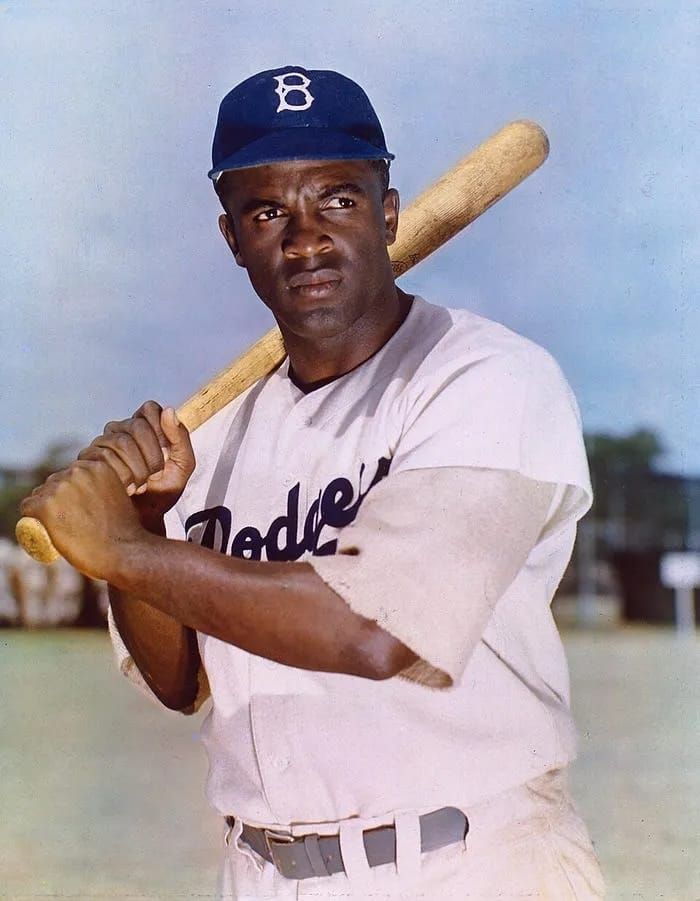
When Hakeem Jeffries was asked if he supported the NAACP’s call for Black athletes to boycott 8 SEC schools in response to their states’ mid-cycle redistricting and targeting Black Districts, Jeffries said the athletes should abandon those schools. He said: “This is a Muhammad Ali moment. This is a Bill Russell moment. It’s a Jackie Robinson moment.”
Constitutional lawyer and Trump-apologist Jonathan Turley wrote a column, “This is a ‘Jackie Robinson moment,’ but not the one Hakeem Jeffries thinks it is.” Turley went on to frame Robinson’s attitudes and politics to reject Jeffries statement.
“To invoke Jackie Robinson to support racial discrimination in politics is to denigrate his legacy. Ironically, Robinson was a Republican who spoke out against what he saw as the rise in racial politics in the 1960s in the Republican Party. He warned that there is “a new breed which is seeking to sell to Americans a doctrine which is as old as mankind — the doctrine of racial division. It would make everything I worked for meaningless if baseball is integrated but political parties were segregated.”
Turley mentioned Robinson speaking out against racism in the Republican Party, but he wholly misrepresented the extent and ignored Robinson’s experience when attending the 1964 Republican National Convention.
Before Black voters got criticized for being on the “Democratic Plantation, they used to vote almost exclusively for the Republican Party. Republicans were the Party of Lincoln; they were responsible for abolishing enslavement (though they varied about what to do with the freedmen). Republicans pushed through the 13th, 14th, and 15th Amendments, which abolished enslavement, made Black people citizens, and gave Black men the right to vote (most women got the right to vote in 1920). The Democratic Party was home to the KKK; Democrats, especially in the South, promoted voter suppression (including lynchings), segregation, and all forms of discrimination. It seemed like Black voters would always vote Republican until they didn’t.
It started with the “New Deal,” when Black people actually received the same benefits as the rest of the public. Black people couldn’t get FHA loans or VA loans, and Jim Crow was the law of the land. Democrat Franklin D. Roosevelt did something for Black people; Eleanor Roosevelt stood up for Marian Anderson when the Daughters of the American Revolution prevented her from performing at Carnegie Hall, and Black voters began to notice.
When Democratic President Harry Truman integrated the armed forces in 1948, Black voters noticed, and so did segregationist white Democrats who began what was initially a slow shift to the Republican Party that picked up speed during the Civil Rights Movement. By the time of the Republican National Convention of 1964, race was truly on the ballot after the Civil Rights Act of 1964 had passed less than two weeks earlier. The whitelash was strong, and the Republican Party was flush with recent converts who found the Democratic Party was not sufficiently racist, with hopes of shaping the Republican Party into their own image.
The top Republican candidates for the nomination were New York Governor Nelson Rockefeller and Arizona Senator Barry Goldwater. Rockefeller was a more traditional, liberal Republican. Goldwater openly appealed to the racist wing of the Party. He voted against the Civil Rights Act of 1964, making him a hero of the new Republicans.
Jackie Robinson was a special delegate on behalf of Nelson Rockefeller at the 1964 convention. It was a time when Black people were highly visible among Republicans, though having power would be a stretch. When delegates arrived at the convention hall in San Francisco, they were met by protesters from the Congress of Racial Equality (C.O.R.E.) wearing funeral attire and holding a sign, “Republican Party — Born 1860, Died 1964.” All but one of the Black delegates, including Robinson, were among those protesters against Goldwater.
This was the scene when Jackie Robinson attended the 1964 Republican National Convention. He described his experiences in his autobiography, “I Never Had It Made.”
“I wasn’t altogether caught off guard by the victory of the reactionary forces in the Republican party, but I was appalled by the tactics they used to stifle their liberal opposition. I was a special delegate to the convention through an arrangement made by the Rockefeller office. That convention was one of the most unforgettable and frightening experiences of my life. The hatred I saw was unique to me because it was hatred directed against a white man. It embodied a revulsion for all he stood for, including his enlightened attitude toward black people.
A new breed of Republicans had taken over the GOP. As I watched this steamroller operation in San Francisco, I had a better understanding of how it must have felt to be a Jew in Hitler’s Germany.
Rockefeller himself added some words in a convention speech about inserting words in favor of inserting pro-civil rights wording into the Party platform. Goldwater delegates booed throughout.
In 1964, the Democratic presidential candidate won the election after receiving 94% of the Black vote. Republicans got 6% after receiving 32% of the vote in 1960 and 40% in 1956. Read Nelson Rockefeller’s words about the danger facing the Republican Party and decide for yourself whether the current Party heeded his words or embraced what he called “wholly alien to honest conservatism?”
Turley didn’t mention Robinson and all but one of the Black delegates at the 1964 RNC protesting Goldwater. It isn’t unimaginable that Robinson would support the NAACP Boycott of 8 SEC schools in the same way he protested segregation in the U.S. Army.
On July 6, 1944, Robinson was a young lieutenant in the U.S. Army at Camp Hood, Texas. He boarded a military bus with a light‑skinned Black woman he was dating. The driver ordered him to move to the back — even though Army buses had been officially desegregated since 1940. Robinson refused. This was nine years before Rosa Parks, and he took the same stand.
The driver called the military police. Robinson was detained, interrogated, threatened, and ultimately charged with multiple offenses, including insubordination, disturbing the peace, refusing a lawful order, and conduct unbecoming of an officer. The charges were a transparent attempt to punish him for challenging Jim Crow.
Robinson was court‑martialed in August 1944. At trial, the prosecution’s case fell apart. Witnesses contradicted each other. The bus driver admitted Robinson had not been violent. The “lawful order” was unlawful because Army policy prohibited segregated seating. Robinson was acquitted on all charges.
But the Army still made sure he paid a price, even though he won the case. He was transferred out of his combat unit (the 761st Tank Battalion), barred from deployment, and effectively pushed out of the Army.
The 761st went on to become one of the most decorated Black units of WWII. Robinson never got to serve with them. His military career ended not because of misconduct, but because he refused to accept segregation.
Robinson’s stand in 1944 foreshadowed the courage he would need in 1947 when he integrated Major League Baseball. It also shows that the military claimed to be desegregated but still enforced Jim Crow in practice. Robinson was already a civil rights figure long before baseball.
Turley argues that Jefies misuses Robinson’s legacy by urging young athletes to sacrifice their careers to protest the Supreme Court’s recent decision ending racial gerrymandering. The athletes wouldn’t be sacrificing their careers; they could go anywhere else, as they were highly recruited. Turley contends that Robinson stood for eliminating race‑based barriers, not preserving them, and that invoking him to defend political racial sorting distorts both constitutional principles and Robinson’s own stated opposition to racial division in politics. He positions Jeffries’ appeal as a self‑serving political gesture that would harm the very athletes he claims to champion. At the same time, the Court’s ruling, in Turley’s view, restores consistency by prohibiting all forms of racial discrimination in district design.
Turley is ignoring that Republicans are using racial targeting to create new districts. Until he has a better understanding of who Jackie Robinson was and what he’d been through, perhaps Jonathan Turley should leave Jackie Robinson’s name out of his writings.